
IELTS Reading
- Introduction
- Matching Headings
- Locating Information
- True_False_Not Given / Yes_No_Not Given
- Multiple Choice Question
- Summary Completion
- Notes / Table / Flow Chart Completion
- Diagram Labelling
- Matching Sentence Endings
- Matching Features
- Sentence Completions
- Short Answer Questions
- Introduction to academic reading beginners lesson
- IELTS Reading Introduction
- Question Types IELTS Academic Reading
- Common Reading Tips
- Tips for transferring answers to the answer sheet
Welcome to IELTS Academic Reading Beginner's Lessons!
The purpose of these lessons is to acquaint you with all the features of IELTS Academic Reading and develop your reading skills to achieve a good score.
The comprehensive lessons include various components.
The components are:
1) Introduction to question types
2) Common strategies for solving IELTS Reading
3) Important tips for transferring answers on the answer sheet
4) Approach to individual question types
For each question type, there is a separate folder in which you will find strategies to solve that particular question along with a short skill-building exercise.
This is followed by some exercises for practice. In some exercises, the texts are shorter than in the actual IELTS test to focus on the required strategies. whereas some texts are similar in length to the actual IELTS Reading passages to put the real challenge. Most questions follow the actual IELTS pattern.
Each Skill-building exercise and Practice exercise has a detailed answer key.
So, BEST WISHES for your IELTS practice with Beginner’s Lessons !!!
A candidate attempts for either IELTS Academic or General depending on the status of their application. Students aspiring for higher studies have to appear for IELTS Academic whereas professionals opting for Permanent Residence or employment have to undertake IELTS General.
IELTS Reading is a one hour test. A total of 40 questions is divided into three reading comprehensions.
IELTS Academic has questions based on extracts from academic journals, textbooks etc.
Whereas in IELTS General the questions are related to advertisements, notices, employment contracts, i.e. extraction from newspapers, magazines, travel brochures etc.
In IELTS reading, there are different types of questions.
The question patterns are as below:
- Matching headings
- Locating information
- True/false/Not given or Yes/No/Not given
- Multiple choice questions
- Summary completion
- Notes/ Table/ Flow Chart completion
- Diagram completion
- Matching sentence endings
- Matching Features / Categorisation
- Sentence Completion
- Short-Answer questions
The Exercise will be based on the above-mentioned question types.
Question Types in IELTS Academic Reading
(Note: The questions on this page are given as examples. You cannot attempt them here as the reading passages are not provided.)
1) Matching Headings
In this task, a list of headings is provided numbered as i, i, ii, iv. etc. The candidates must match each or some paragraphs of the reading passage with the suitable headings from the list. There will be more headings than the paragraphs so some headings will not be used.
Skills tested: identifying the main idea in the paragraph
Example:
Questions 1-5
Reading Passage 1 has six paragraphs, A-F.
Choose the correct heading for paragraphs B-F from the list of headings below.
Write the correct number, i- ix, in boxes 1-5 on your answer sheet.
Example | Answer |
Paragraph A | iv |
- Paragraph B
- Paragraph C
- Paragraph D
- Paragraph E
- Paragraph F
List of Headings i A bigger war was foreseen ii Other nations joined in ili A late realization iv Recent developments remind of a past nightmare v Stopping the spread of communism at any cost vi A war between the East and the West vii An extremely serious matter handled casually vili A civil war involved outsiders ix A forgotten lesson in spite of heavy casualties? |
2) Locating Information
In this task, the candidates are required to find out which paragraphs/sections of the reading passage contains the given pieces of information.
Skills tested: looking for and identifying specific information
Example:
Reading Passage 1 has six paragraphs, A-F.
Which paragraph contains the following information?
Write the correct letter, A-F, in boxes 1-5 on your answer sheet.
You may use any letter more than once.
- mention of a characteristic related to brain providing humans unparalleled mental skills
- future benefits of research on brain
- reference of a convention proved wrong
- details of brain anatomy
- mention of the purpose of an involuntary action
3) True/ False/ Not Given OR Yes/ No/ Not Given
In this task, some statements based on the reading passage are given. The candidates are required to decide whether each statement is correct or wrong according to the passage. If there is not enough information in the passage to decide, the answer is Not Given
The statements are in the order of the information in the passage. This means that answer to the second question of the set will come after the answer to the first question and so.
Skills tested:
True/ False/ Not Given tests the ability to understand specific information especially within factual texts.
Yes/No/ Not Given tests the ability to understand the writer’s opinion especially within argumentative texts.
Example:
Do the following statements agree with the information given in the passage?
In boxes 1-5 on your answer sheet, write
TRUE if the statement agrees with the information
FALSE if the statement contradicts the information
NOT GIVEN if there is no information on this
- Less moisture in soil has an adverse effect on vegetables and crops.
- It is predicted that altered winter duration will impact vegetation.
- Low-lying islands will not be affected because of the increase in sea levels.
- Developed countries have stopped using fossil fuels.
- Emission of harmful gases can be controlled only by using public transportation.
Do the statements agree with the claims of the writer in Reading passage 1?
In boxes 1-5 on you answer sheet, write
Yes if the statement agrees with the claims of the writer
No if the statement contradicts the claims of the writer
Not given if it is impossible to say what the writer thinks about this
- The desire to possess unachievable body size gives rise to a variety of mental disorders.
- All models who walk the ramp suffer from Anorexia Nervosa.
- The extremely lean models certainly drive other women towards eating disorders.
- According to Becker’s study in Fiji, a bond is found between the inception of TV. and disturbed food intake.
- A change in mind-set can help to set a benchmark of appropriate weight.
4) Multiple Choice Questions
In this task, candidates are required to select one or multiple correct answers (according to the instructions) from a given list of options.
The questions are in the order of the information in the passage, but options are not necessarily in order.
Skills tested: understanding specific points or an overall understanding of the main points of the passage
Example:
Choose the correct letter A, B, C or D.
Write the correct letter in boxes 1 and 2 on you answer sheet.
- Lee Marcel’s Ravensong mentions that
- Native Canadians were aware of the uses of herbs.
- African natives unaware that IV drips exist.
- Native Australians live close to each other.
- Natives were treated as an exotic race.
- When Achebe talks about things falling apart in Africa he means
- The African people want to imitate the culture of the whites.
- The people want a democratic government.
- How the invasion of the whites has caused old ways of life to become destroyed..
- Native Africans are interested in conversions.
OR
Choose four letters, A-H.
Write the correct letters in boxes 1-4 on vour answer sheet.
The list below contains some reasons as to why aboriginals prefer to be left alone.
Which FOUR of these are mentioned by the writer in this passage?
- They were labelled as ‘drunken.
- They were forced to work as slaves.
- They fear wrong representation to the press.
- They were forced to convert.
- They were considered inferior.
- Their culture and traditions are not respected
- They think their elders will not be respected.
5) Summary completion
In this task, the candidates are required to complete a summary by filling in the blanks with words from the passage or a box. The summary is usually from a part of the passage, but sometimes from the whole text. The answers are not necessarily in order.
Skills tested: understanding details and/or main ideas, identifying appropriate words in respect of meaning as well as grammar.
Example:
Complete the summary using the list of words below.
Write the correct word in boxes 1-5 on your answer sheet.
*Note- The words in the list may also be numbered, for example
An excess B dense, and so on |
Follow instructions while writing the answers on the answer sheet.
Water scarcity is increasing day by day. By 2025, almost 2 billion people will face 1____of it. Ocean water, which constitutes majority of the proportion of water on the earth. 2____whereas 30% of water stored deep underground in 3._______ is fresh water. Climate change will also affect water quality not only due to indiscriminate industrial growth but also due to 4____ use of fossil fuel. As the population in big cities gets 5.____, the demand of water also rises, which the supplying geographic area cannot sustain
Excess | Dense | Utmost |
Contains salt | Crowded | Saline solution |
Core | Random | Heedless |
Aquifers | Shortage |
6) Notes/ Table/ Flow-Chart Completion
In this task, the candidates are required to complete notes or a table or a flowchart with words from the passage
Skills tested: understanding details and/or main ideas, identifying appropriate words in respect of meaning as well as grammar. Understanding order of information(in case of the flowchart).
Example:
Notes Completion
Complete the notes below.
Choose ONE WORD ONLY from the passage for each answer.
Write vour answers in boxes 1-6 on vour answer sheet.
Domestic Robot Tasks
Entertainment: No particular 1____but conduct conversations interest of the
2____must be captured.
Everyday tasks: 3_____actions
Domestic chores that involve cleaning or rearranging 4____
Assistance for elderly or disabled: utility and operation are 5_____
A gamut of tasks require 6_____
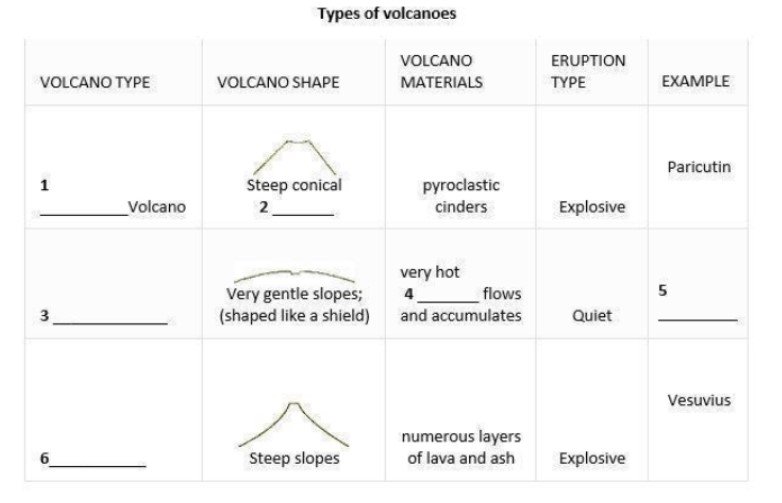
Table Completion
Complete the table below.
Choose ONE WORD ONLY from the passage for each answer.
Write your answer in boxes 1-6 on your answer sheet.
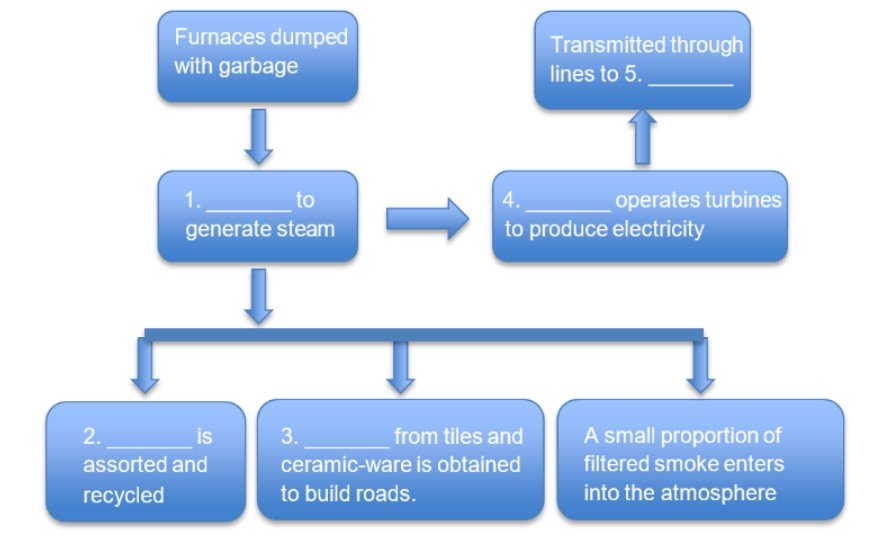
Flowchart Completion
Complete the flowchart below.
Choose NO MORE THAN THREE WORDS from the passage for each answer.
Write your answers in boxes 1-5 on your answer sheet.
7) Diagram Completion
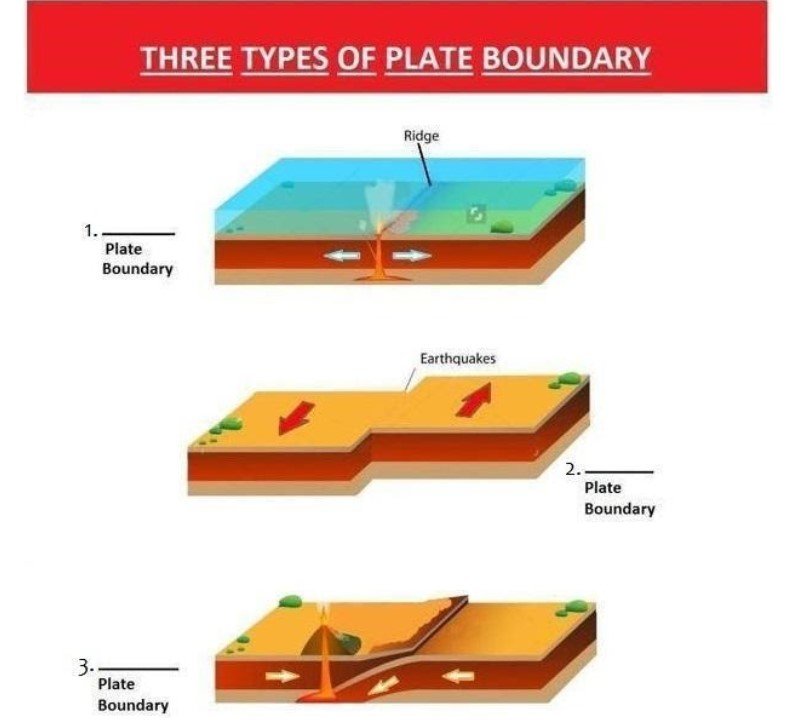
The candidates are required to complete the labels of a diagram which is described in the reading passage. The words are to be chosen from the passage.
The answers are not necessarily in the order of the information in the passage.
Skills tested: relating a diagram with its description, understanding it and identifying appropriate words
Example:
Label the diagram.
Choose ONE WORD ONLY from the passage for each answer.
Write your answer in boxes 1-3 on your answer sheet.
8) Matching sentence endings
In this task, the candidates are required to complete the sentences by matching the first half of the sentence with the correct ending from a given list.
The questions are in the order of the information in the passage, but the options are not in order.
Skills tested: locating information and understanding the main ideas within a sentence
Example:
Questions 1-6
Complete each sentence with the correct ending, A- H. below.
Write the correct letter, A-H, in boxes 1-6 on your answer sheet.
- Mere registration of physical abuse online leads
- Perpetrators of cyber-crimes visit sites as they plan
- The internet space is comparable
- More than half of the teenagers in the study opted
- All virtual accounts may not be easy
- Members of dark chat rooms are likely
A. to reach on networking sites. B. to eliminate the instance. C. to identify the vulnerable. D. to refrain from communicating with strangers. E. to approach friends. F. to be disillusioned about the real world. G. to safety zones within large cities. H. to be silent about their virtual interaction with strangers. |
9) Matching Features/ Categorisation
The candidates are required to match statements or facts with options from a list or classify several pieces of information into three or four categories. For example, to match opinions with persons, events with years, causes with consequences etc. Sometimes options are more than the questions, and sometimes, options can be used more than once.
Skills tested: locating and categorising information, identifying connections between facts and details, understanding views and paraphrased statements
Example:
Matching Features
Look at the following statements (Questions 1-5) and the list of researchers below.
Match the statement with the correct researcher, AC.
Write the correct letter, A-C in boxes 1-5 on your answer sheet.
A J B Rhine
B Uri Geller
C Matthew Manning
- Made huge money by fixing timepieces, using the mystical inner strength.
- Failed to repeat results of the dice experiment.
- Was sure that there was more to understand than what is apparent.
- Was a psychic who could control machines functioning with his mind power.
- Exposed a number of fabricated mediums.
Categorisation
Questions 1-4
Match each description (Questions 1-4) with the type of diabetes listed in the box.
Write the correct letter A, B, or C in boxes 1-4 on your answer sheet.
A. Type 1 B. Type 2 C. Both (type 1 and type 2) |
- Patients need to know their medical condition well.
- Weakened eyesight is one of the effects.
- Cuts on the body take time to heal.
- This condition can neither be prevented nor cured.
10) Sentence Completion:
In this task, sentences are to be completed by filling in the blanks when words and/or a number from the reading passage. The instructions specify the
a maximum number of words to be used.
The sentences are in the order of the information in the passage. This means that answer to the second question of the set will come after the answer to the first question and so.
Skills tested: locating detail or specific information
Example:
Complete the sentences below.
Choose NO MORE THAN TWO WORDS from the passage for each answer.
Write your answer in boxes 1-5 on your answer sheet.
- Virtual accounts contain_____such as images and preferred free time activities
- The people approached are acquainted with in order to____and develop friendly relations.
- Unlike big urban areas, there is no regulatory authority_____social networking sites or the internet.
- A lot of online content is aggressive, and on some adult sites, the display is____
- Unmonitored use of the internet by teenagers is crucial as it culminates into untoward incidents of molestation, kidnapping or even_______
11) Short-answer Questions
The candidates are required to answer questions which are based on details within the specified word limit. The questions are in the order of information in the passage.
Skills tested: locating and identifying specific information
Example:
Answer the questions below.
Choose NO MORE THAN TWO WORDS for each answer.
Write your answer in boxes 1 and 2 on your answer sheet.
- What term describes the people who suffer from anxiety related to food?
- What is the tendency to injure one’s person called?
Common Tips for IELTS Reading
- In IELTS Academic reading, you are required to answer 40 questions that are based on three long passages. So it is NOT ADVISABLE to read all the passages in depth (reading word to word and then attempting the questions
- The two most basic and important skills needed to get a good score in IELTS Reading are – SKIMMING and SCANNING. Either one of them or both are needed while answering the different question types.
Skimming – This is the ability to get the gist (or general understanding) of the structure of the passage and what information it contains. This skill is useful while solving questions such as Matching Headings, Summary Completion, etc.
There are different ways of skimming:
1). Read the title and subtitle (if any) of the passage.
2). Read the titles of each paragraph ( if provided).
3). Read the first sentence of each paragraph to understand the content better.
However, if you are a slow reader, you may spend too much time… In that case, you need to improve your reading speed.
Scanning – This is the ability to locate individual words or short phrases in the passage and is required in various question types such as Sentence
Completion, true/ false/ not given, and so on.
Through this skill, you would be able to answer certain questions without even going through the whole content or structure of the passage. Therefore, it is a time-saving skill and strategy. For example, it is easier and faster to answer certain questions in IELTS Reading by locating proper nouns or numbers in a passage.
- The other skills tested are reading for detail, recognizing the main idea, recognizing the writer’s opinion, comparing and contrasting facts or ideas from two sentences (a sentence from the passage and a question statement) and so on.
- One essential skill required for IELTS Reading is the ability to correctly interpret PARAPHRASED information.
Paraphrasing is the rewording (using synonyms) or restructuring (breaking a sentence or combining two or more sentences or details into a single sentence) of a sentence but without changing the meaning. In IELTS, almost all question sentences are a paraphrase of the information in the passage.
How can you develop these skills?
- Read and practice skimming and scanning extensively.
- Skimming articles from newspapers, magazines and books will improve your reading speed as well as develop the skill.
- To increase your reading speed, develop the habit of reading through eye movement. Stop reading through lip movement.
Important Tips for Transferring answers to the answer sheet for Paper Based Test (PBT)/ Writing answers for Computer based Test (CBT)
(Some points are applicable for PBT only as marked while the others are common to both.)
1 In IELTS PBT, you will be provided with an answer sheet for the Reading component. It is a must that all answers are written on the answer sheet. The Question paper will not be checked for answers.
In the CBT, instructions are provided for correct format of answering e.g. Writing the answer in a box, Choosing the correct answer from a drop down list or Drag and drop. You can come back to an unanswered question later within the 1 hour of Reading session.
2 (For PBT You can write the answers directly on the answer sheet or write them on the question paper and transfer them together at the end. But, you will not be given any extra time after one hour for transferring answers in the Reading Test.
3 (For PBT You must write the answers in pencil.
4 The answers can be written in upper or lower case (capital or small letters).
(For PBT But, it is advisable to write your answers in capital letters as they are clear and easily readable especially if you have poor handwriting.
5 Read the instructions before each question set carefully and DO AS DIRECTED.
(a) Do NOT exceed the word limit. Your answer will be WRONG if you do so.
(b) If the instruction is to write a letter (A, B, C…) or a Roman numeral (i, ii, iii,…), do NOT write any words or phrases.
(c) Do not write ‘True’ for ‘Yes’ or ‘False’ for ‘No’ and vice-versa.
(d) Select and write one answer only. You cannot give options in brackets. It will be counted as a wrong answer.
6 In questions where the words are taken from the Reading passage or a box such as in Sentence Completion or Summary Tasks, you MUST NOT change the form of the words.
7 In questions where you are required to fill in the blanks, consider the words before and after the blanks. You must not repeat them in your answer. E.g. writing ‘the before your answer on the answer sheet will make the answer wrong if it is already written before the blank in the question sentence.
8 Be careful with singular and plural nouns. Use them correctly.
9 Be careful with spellings. Wrong spelling is a wrong answer.
10 Both the British and the American variants of a spelling are acceptable. However, you should use any one variant within a test. Do NOT use a mix of both in a test.
11 Answer all questions. There is no penalty for a wrong answer.
12 (For PBT) Take care that your answers do not go out of the box on the answer sheet.
- Tips To Solve
- Exercise 1
- Exercise 2
- Exercise 3
- Exercise 4
In this task, the paragraphs/ sections of the reading passage will be labelled with alphabets- A, B, C, and in the question set, there will be a list of headings (marked with Roman numerals – i, if, iii, etc.). You are required to match each or some paragraphs ( according to instructions) to the correct heading.
Be Careful: In the actual IELTS test, whenever this task is present in a passage, it is placed before the passage.
Tips to solve:
- Read the instructions carefully.
- In most cases, there will be one example done in this task. If so, strike out that heading off your list. You are not going to use it for any other paragraph.
- Read the first paragraph quickly (‘This is called skimming!) and try to get the main idea.
- Read all the headings in the list and find out which heading summarises the paragraph best.
- Do not pick up a heading only because it has one or more words from the paragraph. This may lead you to a wrong answer. MATCH THE MAIN IDEA.
- While matching, eliminate the unsuitable options
- vii. If there is no heading in the list matching the main idea of the paragraph, look for detail (mostly the dominating one) in the paragraph. Sometimes, a detail forms the heading (but only in the absence of the main idea).
- If two headings seem to be correct, re-read the paragraph to select the most suitable one. Repeat the process i-vi with other paragraphs
- Generally, the first sentence of the paragraph introduces the main idea, but selecting the heading after reading only the first sentence could be a mistake. Sometimes, the first sentence refers to the previous paragraph.
- Look for signpost words in the paragraph, e.g. However, Nevertheless, Although, Additionally etc. These words tell you about the progress of the paragraph. For example, if you get the word However early in the paragraph, it indicates a shift in the focus of the paragraph towards a contrasting idea than the previous idea.
Now attempt some skill-building exercises given below using the tips.
Choose the most appropriate heading for the following paragraphs from the three options given below each of them.
A. The Northern Lights are actually the result of collisions between gaseous particles in the Earth’s atmosphere with charged particles released from the sun’s atmosphere. Variations in colour are due to the type of gas particles that are colliding. The most common auroral colour, a pale yellowish-green, is produced by oxygen molecules located about 60 miles above the earth. Rare, all-red auroras are produced by high-altitude oxygen, at heights of up to 200 miles. Nitrogen produces blue or purplish-red aurora.
Heading Options:
- i) Colourful Northern Lights
- ¡i) What causes the Northern Lights?
- iii) Changes in colour
B. Whilst an asteroid impact has gained ground over most other theories, there still remain problems with the theory. Palaeontologists have yet to find dinosaur fossils dating to the time of the impact, and some evidence suggests dinosaurs may have already been extinct before this event. In fact, dinosaurs had been steadily declining for tens of thousands of years before the Chiculub asteroid impact.
Heading Options:
- i) The dominating theory
- ii) Dinosaur fossils as evidence
iii) Problems with the Asteroid Theory
C. The exhibition also explores tea’s enormous significance in Japan, where it was first introduced during the early Heian period (794-1185) by monks who travelled to China to study Zen Buddhism. Tea was consumed in monasteries and some aristocratic circles, but it was not until the late 12th century that its role in art and culture became more prominent, after a Buddhist priest brought back to Japan the powdered tea (known as matcha), then popular in China.
Heading Options:
- i) Tea in Japan
- ii) Tea in China
- iii) The Tea Exhibition
For the next three paragraphs (A, B and C) select the best heading from the three possible choices given above each paragraph. Do not focus only on keywords. Keywords will only help if they in some way reflect the main idea of the paragraph.
A Crossing the Channel Tunnel / Pullman Trains / Folkestone Harbour
The Pullman train terminates at Folkestone West (a small station just west of Folkestone Central), where passengers transfer to a waiting fleet of executive road coaches. Until 2007 the Venice Simplon Orient Express went down to Folkestone Harbour to meet the buses, reaching the Harbour station via a slow descent of the steep 1 in 30 gradients on the weed-strewn branch line to the seafront, a historic line once used by regular boat trains. The coaches cross the Channel somewhat unauthentically on board a vehicle-carrying shuttle train throush the Channel Tunnel. At Calais, the coaches drive off the shuttle train at the Eurotunnel terminal and head for Calais Ville station. Calais Maritime station, where the ferries originally arrived to connect with the trains to Paris and beyond, was closed and tarmacked over in 1994 following the start of Eurostar services via the Channel Tunnel.
B Aboard the Titanic / Travelling in Style / Jaded Travellers
For four days the ship’s elite passengers revelled in the brand new amenities of the Titanic, replete with every modern luxury known at the time. During the early part of the 20th century, it was considered quite sophisticated for wealthy families to spend portions of their time in Europe, which necessitated crossing the Atlantic at least once per year. Even to these jaded travellers, however, the Titanic ship was like no other. Nothing had been spared to ensure the comfort of the first class guests. However, the ship was equipped with only 20 lifeboats, so that precious deck space for the first class passengers would not be taken up by bulky lifeboats.
C Beautiful Mansions and Statues / Heaven and Hell / Dharma and Chitragupta
The eastern half of the south gallery, the ceiling of which was restored in the 1930s, depicts the punishments and rewards of the 37 heavens and 32 hells.
On the left, the upper and middle tiers show fine gentlemen and ladies proceeding towards 18-armed Yama (the judge of the dead) seated on a bull: below him are his assistants, Dharma and Chitragupta. On the lower tier is the road to hell, along which the wicked are dragged by devils. To Yama’s right, the tableau is divided into two parts by a horizontal line; above – the elect dwells in beautiful mansions, served by women, children and attendants; below – the condemned suffer horrible tortures
Show Answers
A - Crossing the Channel Tunnel; Paragraph A explains the transportation system for crossing the Channel Tunnel. So it is the main idea of the paragraph.
Pullman trains and Folkestone Harbour are just the names needed to explain this system.
B - Travelling in Style; Paragraph B describes the luxuries provided to the rich passengers on the Titanic. This has been emphasised by the use of various words - elite passengers, brand new amenities, every modern luxury, comfort etc. So the heading is 'Travelling in Style.
Aboard the Titanic' is too general and does not reflect the main idea of the paragraph.
"Jaded Travellers' is just a word from the paragraph. (Refer tip number v)
C - Heaven and Hell; Paragraph C describes a structure with the concept of Heaven and Hell depicted on it. The other two heading options only contain words from the paragraph and do not carry the main idea.
The reading passage has six paragraphs, A-F.
Choose the correct heading for each paragraph, A-F, from the list of headings below.
Write the correct number, i-ix, as your answer for each question.
1 Paragraph A
2 Paragraph B
3 Paragraph C
4 Paragraph D
5 Paragraph E
6 Paragraph F
List of Headings ¡ Arecord number of jailbreaks it The Punishment Camp ili Inmates from different nationalities iv The unsuccessful attempts to escape v Apparently invincible yet challenged vi A shared interest vi Social interaction between prisoners vili Overcoming the security breaches ix An extraordinary plan failed to materialise |
Colditz – The POW Camp of World War lI
A. Colditz achieved fame after World War Two as the prisoner of war camp that no one could escape from. Colditz was an isolated castle built on top of a cliff, overlooking the River Mulde in central Germany. To all intents it was seemingly impossible to escape from – so the Germans believed. However, this did not mean that men did not try to do so and by putting together the best escapees from POW(Prisoner of War) camps, the Germans effectively made a problem for themselves.
B. In the early days and months of the war. Colditz was used as a transit camp for Polish troops after the surrender of Poland. On November 6th, 1940, a handful of British RAF officers arrived, quickly followed by six British Army officers. By the end of the year, the numbers had increased and included French, Dutch and Belgium POWs. Colditz was seen by the Germans as a ‘super-camp’ where men who could not be held by other POW camps were sent.
Officially, Colditz was a Sonderlager (Special Camp), but it was also known as a Straflager (Punishment Camp).
C. Men of all nationalities were brought to Colditz from 1941 onwards. It housed 600 POWs – British, French, Belgium, Dutch and Poles. Each nationality tended to stick to themselves, and there was little national intermingling. The French and British did set up language lessons between themselves, and some sport was played within the confines of the castle. However, the one thing that united all of them was that they were at Colditz for a good reason, and it was this defiance of German authority, despite being prisoners, that did unite all the POWs at the camp. The Germans had put together in one camp many experts in forgery, lock picking, tailoring and so on – all vital for the success of escaping. With such a collection of experts, it was only a matter of time before escape attempts were made.
D. Hermann Goering had visited the castle and declared it to be escape proof. He was proved to be wrong. In the time Colditz was used as a POW camp, there were many escape attempts. One hundred and twenty of these men were recaptured after breaking out, but by the end of the war, 31 POWs had successfully got back home. No other POW camp in World War Two had the same rate of success
E. There was little to do at Colditz and time was spent trying to escape. Probably the most famous attempt at escape was the building of a glider in an attic above the castle chapel. When the glider was built, the idea was that the glider could be catapulted from the roof to the other side of the River Mulde with two men on board. The idea came from Bill Goldfinch and Anthony Rolt. Together with Jack Best and Stooge Wardle, they set about designing and building the glider. Using hundreds of pieces of wood – especially bed slats and floorboards – the men constructed the glider which they hoped would glide the 60 metres required to take two men to the other side of the Mulde. The skin of the glider was made from prison sleeping bags, and the material’s pores were sealed by boiling prison issue millet and smearing it onto the material. However, their daring idea was never put to the test as the war ended before the glider had been completed.
F. Tunnels were also built, but the thickness of the castle walls made digging tunnels very slow work. Also by 1944, the Germans had worked out many of the ways that POWs had been using to escape, and these lapses in security had been plugged. Colditz Castle was liberated on April 16th, 1945.
Show Answers
(Note: The text in italics is from the reading passage and shows the location from where the answer is taken or inferred. The text in regular font explains the answer in detail.)
- V
Explanation: Colditz achieved fame after World War Two as the prisoner of war camp that no one could escape from...To all intents it was seemingly impossible to escape from - so the Germans believed. However, this did not mean that men did not try to do so..
- iii
Explanation: In the early days and months of the war, Colditz was used as a transit camp for Polish troops... a handful of British RAF officers arrived, quickly followed by six British Army officers. By the end of the year, the numbers had increased and included French, Dutch and Belgium POWs.
- vi
Explanation: Each nationality tended to stick to themselves, and there was little national intermingling... However, the one thing that united all of them was that they were at Colditz for a good reason, and it was this defiance of German authority, despite being prisoners, that did unite all the POWs at the camp.
Though the first sentence of the paragraph states that there were prisoners from different nations, (ili) is not the answer because the central idea of the paragraph is that these prisoners did not interact much with each other, but they were all united in their opposition against German authorities and in any possible attempts to escape.
- i
Explanation:...but by the end of the war, 31 POWs had successfully got back home. No other POW camp in World War Two had the same rate of success.
- ix
Explanation: Probably the most famous attempt at escape was the building of a glider in an attic above the castle chapel. However, their daring idea was never put to the test as the war ended before the glider had been completed.
- viii
Explanation: Also by 1944, the Germans had worked out many of the ways that POWs had been using to escape and these lapses in security had been plugged.
Questions 1 - 6
The reading passage has six paragraphs, A-F.
Choose the correct heading for each paragraph from the list of headings below.
Write the correct number, i-ix, as your answer to each question.
List of Headings i Symbolising contrasting traits it Rejected therapies gaining acceptance iii The Middle Ages iv An exclusive colour v The colour of war vi Colours from nature vii Dyeing fabrics viii Using colours to bring positivity ix Discovering the components of sunlight |
1 Paragraph A
2 Paragraph B
3 Paragraph C
4 Paragraph D
5 Paragraph E
6 Paragraph F
Colour Through the Ages
A. The ancient Egyptians have been recorded to have been using colour for cures and ailments. They worshipped the sun, knowing that without light there can be no life. They looked at nature and copied it in many aspects of their lives. The floors of their temples were often green – as the grass which then grew alongside their river, the Nile. Blue was a very important colour for the Egyptians too – the colour of the sky. They built temples for healing and used gems (crystals) through which the sunlight shone. They would have different rooms for different colours. We could perhaps relate our present methods of colour/light therapy to this ancient practice.
B. During the Middle Ages, Paracelsus reintroduced the knowledge and philosophy of colour using the power of the colour rays along with music and herbs for healing. Unfortunately, the poor man was hounded throughout Europe and ridiculed for his work. Most of his manuscripts were burnt; but today he is acknowledged by many as one of the greatest doctors and healers of his time – a man, it would seem, very much ahead of his time. Not only do we now use colour therapy once again, but his other ideas, using herbs and music in healing, are also reflected in many of the complementary therapies which are now used regularly.
C. A pioneer in the field of colour. Isaac Newton. published his first controversial paper on colour in 1672, and his work Optics forty years later. Newton passed a beam of sunlight through a prism. When the light came out of the prism it was not white but was of seven different colours: Red, Orange, Yellow, Green, Blue, Indigo and Violet. He referred to the spreading of light into rays as dispersion and the different coloured rays as the spectrum.
D. Before World War II it was noted that a lot of red was being worn. Red in its most positive is the colour for courage, strength and pioneering spirit, all of which were much needed by the men and women who were fighting that war. However, in the most negative aspect, it is the colour of anger, violence and brutality. As the war was coming to an end, pale blue became a popular colour – an omen of the peace to come perhaps, also giving everyone the healing they must have so badly needed.
E. We are lucky that we are now all able to choose any colour we like and can buy products of any colour freely. This was not always the case. In times gone by, the pigments used to dye fabrics violet/purple were very expensive and, therefore, only available to the wealthy. For example, the Romans in high office would wear purple robes since this, to them, indicated power, nobility and thus authority.
F. We are now using colour in positive ways again. Businesses are accepting that their employees may work better given a certain environment, and hospitals and prisons are also becoming aware of the effect that the colour around them can have on patients and prisoners respectively. Paint companies have introduced new colour cards with the therapeutic aspects of colour in mind. Cosmetic companies too have colour therapy’ ranges included in their products. Colour has a great deal to offer us and can be found all around us in nature. We need to expand our awareness of colour so that we can truly benefit from nature’s gifts so that ‘colour becomes a way of life, not just therapy.
Show Answers
(Note: The text in italics is from the reading passage and shows the location from where the answer is taken or inferred. The text in the regular font explains the answer in detail.)
1 vi
Explanation: Paragraph A describes the various ways in which ancient people tried to copy colours from nature and used them and sunlight in their life.
2 ii
Explanation: Paragraph B mentions that in the Middle Ages, Paracelsus used coloured rays, herbs and music for healing, but his ideas were ridiculed, and his manuscripts were burnt. However, now these therapies are used.
3 ix
Explanation: Newton passed a beam of sunlight through a prism. When the light came out of the prism it was not white but was of seven different colours:
Red, Orange, Yellow, Green, Blue, Indigo and Violet.
4 i
Explanation: Red in its most positive is the colour for courage, strength and pioneering spirit, ... However, in the most negative aspect, it is the colour of anger, violence and brutality ... pale blue became a popular colour - an omen of the peace
5 iv
Explanation: In times gone by, the pigments used to dye fabrics violet/purple were very expensive and, therefore, only available to the wealthy. For example, the Romans in high office would wear purple robes since this, to them, indicated power, nobility and thus authority.
6 viii
Explanation: Paragraph F mentions the various positive uses of colours. Businesses, prisons and hospitals are using colours as a therapy for the well being of people.
Question 1 - 6
The reading passage has six paragraphs, A-F.
Choose the correct heading for each paragraph from the list of headings below.
Write the correct number, i-ix, as your answer to each question.
List of Headings i Difference in social status discourages helpful behaviour ii A gruesome act ill An impact of presence of others iv Becoming emotionless is a convenience V An inhuman response vi Beautiful and affluent are valued more vi Shouldering off accountability vili One inaction leads to another ix Hesitating to help |
1 Paragraph A
2 Paragraph B
3 Paragraph C
4 Paragraph D
5 Paragraph E
6 Paragraph F
ARE WE BECOMING MORE INDIFFERENT?
A. A noticeably shameful attribute of society in recent times is the Bystander effect, where the general public blatantly ignores a person who may be a victim of a road accident or in some kind of need. Bystanders do not only remain indifferent to the condition of the victim, but in a grotesque example of apathy, they also go to the extent of capturing the event in a video to share on social media or even click a selfie with the victim in the background.
B. Why are people so unemotional? Simply put, this happens when a person feels discouraged to get involved in an emergency, especially in the presence of others. It is called the Bystander Effect. The concept of the Bystander Effect was popularized by social psychologists John Darley and Bibb Latane after the murder of Kitty Genovese in New York City in 1964. Bystanders outside Genovese’s apartment watched while she was stabbed to death, neither trying to stop the crime nor calling the police for assistance. According to Darley and Latane, there is a perceived diffusion of accountability and social influence that leads to the Bystander effect. Onlookers, they believe, are more likely to help if there are fewer witnesses present.
C. Another example of increasing apathy is the video of an unkempt man in a dirty coat walking with the aid of crutches and struggling. Ignored by onlookers as he tried to get up, he was eventually brought back to his feet by a homeless man. Helping the downtrodden is perceived as damaging to our social standing in society. Conclusions drawn by a research published by the International Ombudsman Association, an individual’s hesitation in coming to the aid of the less fortunate is the fear of social consequences or the stigma of being associated with a person in distress.
D. ‘The larger question about the culture of indifference has a lot to do with the bystander behaviour, says Wesley Perkins, a sociology professor at Hobart and William Smith Colleges in Geneva, NY. The Bystander phenomenon is generated by the perception that other people are not doing anything about it.
Therefore I shouldn’t either! However, when these events come to the knowledge of the public, people think everybody is mean and cruel-hearted and doesn’t care.” Perkins says. ‘But much of the Bystander phenomenon happens because people are looking on and thinking, if they don’t see someone else coming to the person’s aid, then the person must not be in trouble. Also, people are more likely to do the right thing when they notice the same behaviour being elicited by other individuals. It is only the real heroes who step out of a group to help.
E. Transferring responsibility is the most common response. Paul Rogat Lob, lecturer on ethics and the author of Soul of a Citizen speaks about his conversation with the factory workers who processed plutonium for nuclear weapons. Loeb asked, ‘Do you think it is a good thing?’ Promptly denying their responsibility, the factory workers disassociated themselves from the potentially horrific consequences of their actions. The prevalent attitude is that someone else will do what is needed. ‘We hope people do the right thing. We hope someone takes care of the poor, says Loeb.
F. According to legendary Greek philosopher Aristotle, man is an inherently social animal. It would not be possible for us to survive without one another, not only because of the lack of sustenance but because we would probably go insane living alone. But looking at the society we live in today, it appears that humans have become apathetic not only towards the community and the environment but also fellow human beings. The Bystander effect is evident even on the internet, where users watch others get bullied or threatened. Unless the feelings of irrelevance that breed this apathy are addressed, people are going to find comfort in being apathetic as a tool of self-preservation.
Show Answers
(Note: The text in italics is from the reading passage and shows the location from where the answer is taken or inferred. The text in the regular font explains the answer in detail.)
1 v
Explanation: Paragraph A - A noticeably shameful attribute of society ... ignores a person who may be a victim of a road accident or in some kind of need.
Bystanders do not only remain indifferent to the condition of the victim, but in a grotesque example of apathy, they also go to the extent of capturing the event in a video to share on social media or even click a selfie with the victim in the background.
2 iii
Explanation: Paragraph B - Simply put, this happens when a person feels discouraged to get involved in an emergency, in the presence of others. It is called the Bystander Effect... Onlookers, they believe, are more likely to help if there are fewer witnesses present.
3 i
Explanation: Paragraph C - Helping the downtrodden is perceived as damaging to our social standing in society... an individual's hesitation in coming to the aid of the less fortunate is the fear of social consequences or the stigma of being associated with a person in distress.
4 vili
Explanation: Paragraph D - 'The bystander phenomenon is generated by the perception that other people are not doing anything about it, therefore I shouldn't either... much of the bystander phenomenon happens because people are looking on and thinking, if they don't see someone else coming to the person's aid, then the person must not be in trouble.’
5 vii
Explanation: Paragraph E - Transferring responsibility is the most common response... The prevalent attitude is that someone else will do what is needed.
6 iv
Explanation: Paragraph F - But looking at the society we live in today, it appears that humans have become apathetic not only towards the community and the environment but also fellow human beings....Unless the feelings of irrelevance that breed this apathy are addressed, people are going to find comfort in being apathetic as a tool of self-preservation.
- Tips
- Exercise 1
- Exercise 2
- Exercise 3
- Exercise 4
The instruction in this question type goes like this - 'Which paragraph contains the following information?'
In this task. the paragraphs/ sections of the reading passage will be labelled with alphabets- A, B, C.. and in the question set, there will be a few pieces of information marked with Question numbers. You are required to find out which paragraph/section contains the given pieces of information.
Sometimes, a paragraph can be used more than once as an answer. Instruction will be provided if it is the case. Otherwise, all answers in this question set will be different.
Tips to Solve:-
i) Read the instructions carefully. Skimming the whole passage can prove helpful as it gives an idea of the type of information contained in each paragraph.
There are two ways of solving these questions.
The First Method:
ii) Read the questions. The questions usually indicate what type of information you must look for, such as a description, a reason, examples etc. Underline the kevwords for the type of information as well as the content.
iii) Read the first lettered paragraph carefully. Remember you are not reading for gist ( the main idea. You are reading for specific information. Now read all the questions and decide if any of these pieces of information is present in the paragraph. If so, write the paragraph letter by that question.
iv) If you find more than one paragraph containing the similar information, re-read the paragraphs and the question and choose the best one. Here you should focus on the synonyms of keywords and paraphrased information.
v) Repeat the same procedure for each of the lettered paragraphs.
The Second Method:
ii) Read the first question and underline the keywords.
iii) Scan the first lettered paragraph for the keywords( or their) synonyms.
iv) If any relevant information is found, read the location in-depth to decide whether the information matches with the question statement.
v) Similarly, read the other paragraphs until you are sure about your answer.
vi) Move to the second question and repeat the same procedure.
Note:
- A student should decide which method suits him/ her the best.
If you can keep a lot of information in your mind at a time, the first one may suit you but if you are a fast reader and your scanning skills are good, maybe the second one is better for you. Try both and decide.
- If you are not comfortable with this question type, attempt it at the end. However, if you do this question set first, you will get an idea of the whole passage, and it will be easy and fast to find the answers to other questions
Now look at the following passage and answer the questions below.
(The questions are for the development of skills of scanning and locating information and do not appear in the actual IELTS test like this. You will see the actual pattern in the exercises.)
The Dingo – An Australian Pest
A The origins of the dingo are obscure, and there is much controversy connected with this. It is not truly native to Australia but is thought to have arrived between 3,500 and 4,000 years ago. Whatever its origins, the dingo was a highly valued companion to the aborigines. They were hunting companions, guard dogs, and they kept them warm at night.
B Some believe they were brought here on rafts or boats by the ancestral aborigines. It has also been suggested that they came with Indonesian or SouthEast Asian fishermen who visited the northern coast of Australia.
C The dingo can be found in all areas of Australia – from harsh deserts to lush rainforests. The highly adaptable dingo is found in every habitat and every state of Australia, except Tasmania. In deserts, access to drinking water determines where the animal can live. Purebred dingo numbers in the wild are declining as man encroaches deeper and deeper into wilderness areas, often accompanied by his domestic dog.
Questions:
- (a) Which paragraph states that the dingo does not belong to Australia originally?
(b) Which words tell you the answer?
- (a) Which paragraph mentions the habitats of dingoes in Australia?
(b) Which two habitats are specifically mentioned in the paragraph?
(c) Which two words are used to show the extremely wide range of these habitats? What Part of Speech are they?
- Which paragraph mentions
(a) the various roles of dingoes?
(b) a reason for the decreasing population of dingoes?
(c) the wavs by which dingoes arrived in Australia?
- Which words in Q.3(a, b, c) tell about the type of information you need to look for?
Show Answers
1.(a) A
(b) not truly native
- (a) C
(b) desert, rainforest
(C) harsh, lush; Both these words are adjectives qualifying desert and rainforest and are used to emphasise the extreme weather conditions in which dingoes can survive.
- (a) A; They were hunting companions, guard dogs, and they kept them warm at night.
(b) C; Purebred dingo numbers in the wild are declining as man encroaches deeper and deeper into wilderness areas, often accompanied by his domestic dog.
(C) B; Some believe they were brought here on rafts or boats by the ancestral aborigines (one way).... they came with Indonesian or South-East Asian fishermen (another way)
- Roles (Q.3-a); a reason (Q.3-b); the ways (Q.3-C)
World's oldest leather shoe found in Armenia
A perfectly preserved shoe, 1,000 years older than the Great Pyramid of Giza in Egypt and 400 years older than Stonehenge in the UK, has been found in a cave in Armenia. The 5,500-year-old shoe, the oldest leather shoe in the world, was discovered by a team of international archaeologists.
The cow-hide shoe dates back to 3,500 BC (the Chalcolithic period) and is in perfect condition. It was made of a single piece of leather and was shaped to fit the wearer’s foot. It contained grass; although the archaeologists were uncertain as to whether this was to keep the foot warm or to maintain the shape of the shoe, a precursor to the modern shoe-tree perhaps? “It is not known whether the shoe belonged to a man or woman,” said lead author of the research, Dr Ron Pinhasi, University College Cork, Ireland “as, while small, (European size 37; US size 7 women), the shoe could well have fitted a man from that era.” The cave is situated in the Vayotz Dzor province of Armenia, on the Armenian, Iranian, Nakhichevanian and Turkish borders, and was known to regional archaeologists due to its visibility from the highway below.
The stable, cool and dry conditions in the cave resulted in exceptional preservation of the various objects that were found, which included large containers, many of which held well-preserved wheat and barley, apricots and other edible plants. The preservation was also helped by the fact that the floor of the cave was covered by a thick layer of sheep dung which acted as a solid seal over the objects, preserving them beautifully over the millennia!
“We thought initially that the shoe and other objects were about 600-700 years old because they were in such good condition, said Dr Pinhasi. “It was only when the material was dated by the two radiocarbon laboratories in Oxford, UK, and in California, US that we realised that the shoe was older by a few hundred years than the shoes worn by Ötzi, the Iceman. Three samples were taken to determine the absolute age of the shoe and all three tests produced the same results. The archaeologists cut two small strips of leather off the shoe, and sent one strip to the Oxford Radiocarbon Accelerator Unit at the University of Oxford and another to the University of California – Irvine Accelerator Mass Spectrometry Facility. A piece of grass from the shoe was also sent to Oxford to be dated and both shoe, and grass were shown to be the same age.
The shoe was discovered by Armenian PhD student, Ms Diana Zardaryan, of the Institute of Archaeology, Armenia, in a pit that also included a broken pot and wild goat horns. “I was amazed to find that even the shoe-laces were preserved, she recalled. “We couldn’t believe the discovery,” said Dr Gregory Areshian, Cotsen Institute of Archaeology at UCLA, US, co-director who was at the site with Mr Boris Gasparyan, co-director, Institute of Archaeology, Armenia when the shoe was found. “The crusts had sealed the artefacts, and archaeological deposits and artefacts remained fresh dried, just like they were put in a can,” he said.
The oldest known footwear in the world, to the present time, are sandals made of plant material, that were found in a cave in the Arnold Research Cave in Missouri in the US. Other contemporaneous sandals were found in the Cave of the Warrior, Judean Desert, Israel, but these were not directly dated so that their age is based on various other associated artefacts found in the cave.
Interestingly, the shoe is very similar to the pampooties worn on the Aran Islands (in the West of Ireland) up to the 1950s. “In fact, enormous similarities exist between the manufacturing technique and style of this shoe and those found across Europe at later periods, suggesting that this type of shoe was worn for thousands of years across a large and environmentally diverse region,” said Dr Pinhasi.
“We do not know yet what the shoe or other objects were doing in the cave or what the purpose of the cave was,” said Dr Pinhasi. “We know that there are children’s graves at the back of the cave, but so little is known about this period that we cannot say with any certainty why all these different objects were found together.” The team will continue to excavate the many chambers of the cave.
Questions 1-6
This reading passage has eight paragraphs, A-H.
Which paragraph contains the following information?
Write the correct letter, A – H, as your answer to each question.
Note: You may use any letter more than once.
1) testing different parts of the shoe to confirm the age
2) comparison of an artefact with ancient monuments
3) mention of particular footwear of a relatively modern era
4) unanswered questions about the shoe
5) mention of natural factors that aided the conservation of the artefacts
6) a reference to limited knowledge restricting conclusion
Show Answers
1 D
Explanation: The archaeologists cut two small strips of leather off the shoe, and sent one strip to the Oxford Radiocarbon Accelerator Unit at the University of Oxford and another to the University of California..A piece of grass from the shoe was also sent to Oxford to be dated and both shoe, and grass were shown to be the same age.
2 A
Explanation: A perfectly preserved shoe, 1,000 years older than the Great Pyramid of Giza in Egypt and 400 years older than Stonehenge in the UK, has been found in a cave in Armenia.
3 G
Explanation: Interestingly, the shoe is very similar to the pampooties worn on the Aran Islands (in the West of Ireland) up to the 1950s.
4 B
Explanation: It contained grass; although the archaeologists were uncertain as to whether this was to keep the foot warm or to maintain the shape of the shoe, a precursor to the modern shoe-tree perhaps? "It is not known whether the shoe belonged to a man or woman," said lead author of the research, Dr Ron Pinhasi....
5 C
Explanation: The stable, cool and dry conditions in the cave resulted in exceptional preservation of the various objects that were found,... The preservation was also helped by the fact that the floor of the cave was covered by a thick layer of sheep dung which acted as a solid seal over the objects, preserving them beautifully over the millennia!
6H
Explanation: ..so little is known about this period that we cannot say with any certainty why all these different objects were found together.
Birth of the Internet
The story of the internet commences with two computers that were kept miles apart and were intended to send a message. The first-ever characters sent by the internet are recorded as ‘LO’ The original message attempted was LOG IN but the computer crashed just after sending LO, and the remaining letters were never sent. The world has been ever-changing since 29th October 1969 as the internet was born in Stanford Research Institute by establishing the first-ever link between computers on the ARPANET. The entire team of engineers was led by Leonard Kleinrock. At that time, he never thought that this discovery would change things forever connecting machines and thereby, people sitting right across the desk or across continents
Experiments with computer networks started in the late 1960s with four computers. It was called ARPANET (Advanced Research Projects Agency Network). The project was initiated by the U.S. government to compete with Soviets who launched the world’s first artificial satellite, Sputnik. The four
ARPANET computers were stationed at UCLA, UC Santa Barbara, SRI International and the University of Utah.
In July 1961, Leonard Kleinrock published a paper on the Packet switching theory and then a book on the same subject in 1964. Both were the earliest documents on the subject. He also convinced Lawrence G. Roberts, an MiT researcher, to apply packet connectivity in place of conventional circuits for effective computer communication. In August 1962, J.C.R. Licklider of MIT was the first to give the idea of a worldwide computer network through a series of memos while discussing his concept of ‘Galactic Network. This concept was the predecessor of the Internet of today.
The other crucial step was to make computers communicate with each other. To experiment with this, Roberts and Thomas Merrill worked together in 1965.
They established a connection between the TX-2 computer in Massachusetts and the Q-32 computer in California with the help of a low-speed dial-up telephone line. It was a small setup, but it gave birth to the first-ever computer network covering a large geographical area (WAN- wide area network).
As a result of the experiment, Roberts realised that the time-shared computers could work reasonably well together, retrieving data and running programs as necessary on the remote machines, but the telephone system based on circuit switching was inefficient for completion of the job. This confirmed Kleinrock’s conviction of the requirement for the packet switching technique.
Questions 1-6
The reading passage has 6 paragraphs, A-E.
Which paragraph contains the following information?
Write the correct letter, A-E, as your answer to each question.
NB You may choose any letter more than once.
- an initiative to be in the race
- remotely situated machines managed to exchange a message
- preference for new technology over the old
- a test validating the need for an efficient technique
- the first network via the telephone system
- the earliest documents mentioning global computer network
Show Answers
1 B
Explanation: The project was initiated by the U.S. government in order to compete with Soviets who launched the world's first artificial satellite, Sputnik.
2A
Explanation: The story of the internet commences with two computers which were kept miles apart and were intended to send a message. The first-ever characters sent by the internet are recorded as 'LO! However, the original message attempted was LOG IN; but the computer crashed just after sending LO.
3 C
Explanation: In July 1961, Leonard Kleinrock published a paper on the Packet switching theory and then a book on the same subject in 1964. Both were the earliest documents on the subject. He also convinced Lawrence G. Roberts, an MIT researcher, to apply packet connectivity in place of conventional circuits for effective computer communication.
4 E
Explanation: As a result of the experiment, Roberts realised that the time-shared computers could work reasonably well together,... but the telephone system based on circuit switching was inefficient for completion of the job. This confirmed Kleinrock's conviction of the requirement for the packet switching technique.
5 D
Explanation: They established a connection between the TX-2 computer in Massachusetts and the Q-32 computer in California with the help of a low. speed dial-up telephone line. It was a small setup, but it gave birth to the first-ever computer network covering a large geographical area (WAN- wide area network).
6 C
Explanation: In August 1962, J.C.R. Licklider of MIT was the first to give the idea of a worldwide computer network through a series of memos while discussing his concept of 'Galactic Network.
LANGUAGES AT THREAT
A. According to linguists, nearly half of the 7,000 languages spoken in the globe today are in danger of extinction. Research shows that these languages are falling out of use at the rate of about one language every two weeks. According to a study supported by the National Geographic society and the Living Tongues Institute for Endangered Languages, there are five regions in the world where languages are disappearing more rapidly. They include Northern Australia, Central South America, North America’s upper Pacific coastal zone, Eastern Siberia and Oklahoma and Southwest United States. All these areas have a population of aboriginal people who are in low numbers and who speak diverse languages.
B. A language can vanish in an instant, for example, if the only speaker of the language dies. Others are lost because of existing multiple cultures that result in the dominance of a given language over indigenous tongues. This often occurs in cases where the dominant language is regarded as more prestigious. When people are convinced that they will earn more respect or a good job if they speak the dominant language, they are bound to dump the minority language. Parents eventually stop speaking the minority language at home and the children grow up knowing very little of it. This is what happened to Manx and what is happening to Welsh. Consider the dominance of the English language. Today it threatens the survival of 54 indigenous languages in the Northwest Pacific plateau of North America.
C. Linguists are also concerned about languages that borrow too much from other languages. For instance, if a language borrows words, vocabulary, and then grammar, it eventually becomes difficult to call the two languages separate. This often happens in languages that are almost similar. A good example is that of Ulster Scots and Scots that are becoming more and more diluted by the English language. However, studies have also shown sad cases of communities that have been pressured to give up their own culture and language. Such is the case of the ethnic Kurds found in Turkey who are forbidden by law to print or teach their own language.
D. A language is safe if it has many young speakers and if it has the support of the state where it is spoken. However, not all is lost as there have been success stories of revival of almost extinct or a dead language. The term sleeping beauty languages have been used to express such hopes. Hebrew was reintroduced to a new generation of native speakers. The revival of Hebrew was successful due to favorable conditions such as the creation of a nation state in which Hebrew became the national language. The dedication of Eliezer Ben Yehuda efforts also bore fruit as he created new words for the modern terms that Hebrew did not have. Institutional and political support can also help revive an almost extinct language. Take the example of the Irish language that is well supported as the national language of Ireland despite the dominance of the English language.
E. Languages that are no longer being learnt by children are considered on the brink of extinction or as being moribund, and unless drastic measures are taken, such languages can die within a generation. In New Zealand, Maori communities have come up with nursery schools that are taught by elders and conducted in the Maori language. This model has been extended in Alaska, and Hawaii. In California, young people have become apprentices to older adult speakers who live in the community in a bind to revive sleeping beauty languages.
F. According to David Harrison, assistant professor of linguistics at Swarthmore College, most of the languages that are on verge of extinction have no dictionary, text, or record of the accumulated knowledge and history of the disappearing culture. Linguists are trying to learn as much as possible of the almost extinct languages so that even if the language disappears knowledge of the language will be left intact. Researchers are making videotapes, audiotapes, and written records of the language and their translations. The rules of the languages and the vocabularies are being analyzed to allow the writing of dictionaries and grammars. Such efforts make revival of sleeping beauty languages very possible.
Questions 1-7
The reading passage has six paragraphs, A-F.
Which paragraph contains the following information?
Write the correct letter, A-F, as your answer to each question.
NB You may choose any letter more than once.
1 reference to intermixing of languages as a threat
2 reference to areas facing language extinction at a faster pace
3 examples of efforts by natives to save languages
4 mention of two factors which can protect a language
5 reference to lack of documentation in the disappearing languages
6 mention of better prospects as a reason for dominance of a language
7 an example of how policies can damage a language
Show Answers
1 C
Explanation: Linguists are also concerned about languages that borrow too much from other languages. For instance, if a language borrows words, vocabulary, and then grammar, it eventually becomes difficult to call the two languages separate.
2 A
Explanation: … there are five regions in the world where languages are disappearing more rapidly. They include Northern Australia, Central South America, North America's upper Pacific coastal zone, Eastern Siberia and Oklahoma and Southwest United States.
3 E
Explanation: In New Zealand, Maori communities have come up with nursery schools that are taught by elders and conducted in the Maori language....
In California, young people have become apprentices to older adult speakers who live in the community in a bind to revive sleeping beauty languages.
4 D
Explanation: A language is safe if it has many young speakers and if it has the support of the state, where it is spoken.
5 F
Explanation: According to David Harrison, assistant professor of linguistics at Swarthmore College, most of the languages that are on verge of extinction have no dictionary, text, or record of the accumulated knowledge and history of the disappearing culture.
6 B
Explanation: ... dominance of a given language over indigenous tongues. This often occurs in cases where the dominant language is regarded as more prestigious. When people are convinced that they will earn more respect or a good job if they speak the dominant language, they are bound to dump the minority language.
7 C
Explanation: However, studies have also shown sad cases of communities that have been pressured to give up their own culture and language. Such is the case of the ethnic Kurds found in Turkey who are forbidden by law to print or teach their own language
CULTURAL DIVERSITY IN THE AFRICAN CONTINENT
A. Africa is a fascinating melting pot of diverse cultures. These cultures find expression in their art and craft, clothing, food, religion, folklore, and music. What makes it interesting is the fact that not only does African culture vary from one country to another but the customs and traditions within the country itself are diverse due to the different tribes living there. Each of these tribes has its unique language and set of traditions and customs. However, a closer look shows that there are similarities too. Irrespective of tribe or region, African populations hold the same moral values, love and respect for their culture, for their ageing population and chiefs of the clan
B. Although the majority of Africans are indigenous, people from all over the world have migrated to Africa over the centuries. In the seventh century, the Arabs and the people from the Middle East crossed into North Africa, bringing Islam into the continent. In the mid-seventeenth century, Europeans began settling in the southern area of the continent, much like the South Asians, who settled in places like Kenya, Tanzania, South Africa and Uganda. Although by and large, customs and traditions have remained the same, over the centuries the continent has imbibed cultural values from around the world.
C. At the time of colonialism in Africa, Europeans had a feeling of superiority added to a sense of purpose. An African was accepted as French only if he gave up the heritage and culture of Africa and agreed to adopt the French way of life. Similarly, knowledge of Portuguese language and culture and the rejection of the traditional African ways would deem a person to be called civilized. Mwiti Mugambi, a Kenyan social commentator, believes that the future of Africa can only be forged from accepting and mending the sociocultural present. He argues that cultural hangovers from colonial times, the influx of western culture and donors who give conditional aid are not going to go away.
D. To have an improved understanding of modern Africa, it is essential to understand the concept of ‘self in the African culture. In the western world, ‘self is a demarcated entity set off against the world, whereas in African culture, the ‘self’ is not a separate entity, but one with the world, intermingling with the social environment and nature. The actions of an individual affect the entire village or community. It is because of this relationship with the group that a person gains his/her identity. The culture and beliefs of each tribal group focus mainly on the family and the community at large and are seen in their music, art and oral literature.
E. In many African cultures, folklore and tales play a very important part. Not only do the tales reflect the cultural identity of the tribe but it is believed by the Africans that the stories will help preserve their culture. There are different rituals and ceremonies for the purpose of storytelling, unique to each tribe, creating a feeling of belonging. From an outsider’s point of view, the stories showcase the beliefs and customs of the community.
F. The richness and the diversity of the cultures and traditions of the African people cannot be surpassed. However, with strong western influences encompassing the continent, one has to wonder for how long the people of Africa will be able to hold on to their traditions.
Questions 1-6
The reading passage has six paragraphs, A-F.
Which paragraph contains the following information?
Write the correct letter, A-F, as your answer to each question.
NB You may choose any letter more than once.
1 continuation of traditions while accepting outside culture
2 a view regarding the inevitability of outside influence
3 a reference to sharing common values in spite of the diversity
4 a way to protect culture
5 abandoning African ways of life as criteria for being considered advanced
6 importance of community in individual identity
Show Answers
(Note: The text in italics is from the reading passage and shows the location from where the answer is taken or inferred. The text in the regular font explains the answer in detail.)
1 B
Explanation: Although by and large, customs and traditions have remained the same, over the centuries the continent has imbibed cultural values from around the world.
2 C
Explanation: Mwiti Mugambi, a Kenyan social commentator,.. argues that cultural hangovers from colonial times, the influx of western culture and donors who give conditional aid are not going to go away.
3 A
Explanation: ... not only does African culture vary from one country to another but the customs and traditions within the country itself see a lot of diversity due to the different tribes living there . However, ... African populations hold the same moral values, have love and respect for their culture, for their ageing population and chiefs of the clan.
4 E
Explanation: .. it is believed by the Africans that the stories will help preserve their culture.
5 C
Explanation: Similarly, knowledge of Portuguese language and culture and the rejection of the traditional African ways would deem a person to be called civilized.
6 D
Explanation: .. in African culture, the 'self' is not a separate entity, but one with the world, intermingling with the social environment and nature. As such the actions of an individual affect the entire village or community. It is because of this relationship with the group that a person gains his identity.
- Tips
- Exercise 1
- Exercise 2
- Exercise 3
- Exercise 4
In T/F/ NG or Y/ N/ NG tasks, you are required to compare a question statement with information from the passage and decide whether it is true(yes), false(no) or not given according to the passage.
T/ F/ NG checks your ability to locate and comprehend(understand) specific information.
Y/N/NG checks your ability to locate and understand writer’s views or claims.
Tips to solve:
i) Both these question types are attempted similarly.
ii) Read the first statement of the question set. Identify the keywords that will help you to locate the relevant information. Also, read the statement carefully to understand the meaning.
iii) Go to the passage and find the location with the help of keywords. Remember, in most cases, you will not get the exact keyword. Look for synonyms.
iv) Read this portion of text carefully and get the meaning. If the text agrees with what is said in the question statement, the answer is True (or Yes). If it contradicts, the answer is False (or No). If the information is not sufficient to decide, the answer is Not Given. Remember, to increase the difficulty level, the question statements will be paraphrased, i.e. the sentences will be written differently.
v) Repeat the same procedure for other statements.
vi) T/F/ NG or Y/ N/ NG question statements follow the order of the passage. So the answer to the second question of the set will come after the answer to the first question and so.
vi) Do not apply your own knowledge about the topic to decide the answers. They must be based on the information provided in the passage.
viii) Follow the instructions. Do not write True’ in place of ‘Yes’ or ‘False’ in place of ‘No’ and vice-versa.
Now look at the paragraphs below and attempt the questions that follow
The Saiga Antelope
In 1993, more than a million saiga antelope (Saga tatarica) crowded the steppes of Central Asia. However, by 2004, just 30,000 remained, many of them female. The species had fallen prey to relentless poaching – with motorbikes and automatic weapons – in the wake of the Soviet Union’s collapse. This 97% decline is one of the most dramatic population crashes of a large mammal ever seen. Poachers harvest males for their horns, which are used in fever cures in traditional Chinese medicine. The slaughter is embarrassing for conservationists. In the early 1990s, groups such as WWF actively encouraged the saiga hunt, promoting its horn as an alternative to the horn of the endangered rhino. “The saiga was an important resource, well managed by the Soviet Union,” says John Robinson, at the Wildlife Conservation Society (WCS) in New York City, US. “But with the breakdown of civil society and law and order, that management ceased.”
Questions 1 – 4
Do the following statements agree with the information given in the reading passage?
Write:
TRUE if the statement agrees with the information
FALSE if the statement contradicts the information
NOT GIVEN if there is no information on this
- In the early nineties, Central Asia’s steppes was home to over one million saigas.
- The massive decline in the Saiga population is the biggest ever of a large mammal.
- Traditional medicine uses the poached horns of male members of the group.
- The WWF managed to save many rhinos because it encouraged the hunting of saiga.
British Eccentric
Every once in a while, says New York magazine there appears a character who floats above “the wretched, amoral, meatheads” of Wall Street. Andrew J Hall is such a man.
The UK-born commodities trader, who heads a “secretive unit” at Citigroup known as phibro (so secretive that there are no publicly available pictures of him), has made a personal $250m killing from oil futures as well as generating 10% of the bank’s total net income last year. Yet he maintains a wonderfully eccentric lifestyle. Not only is he one of the world’s most obsessive art collectors, but he regularly leaves the office early either to row or to practice calisthenics with a ballet teacher.
Questions 1- 4
Do the following statements agree with the claims of the writer in the reading passage?
Write
YES if the statement agrees with the writer’s claims
NO, if the statement contradicts the writer’s claims
NOT GIVEN if it is impossible to say what the writer thinks about this
- Andrew J Hall is different from Wall Street people.
- Hall attracts a lot of publicity as the leader of Phibro.
- Hall is passionate about works of art.
- Hall prefers leisure activities over his work.
Show Answers
(Note: The text in italics is from the reading passage and shows the location from where the answer is taken or inferred. The text in regular font explains the answer in detail.)
- True; The first sentence states that In 1993, more than a million saiga antelope (Saiga tatarica) crowded the steppes of Central Asia.
- False; This 97% decline is one of the most dramatic population crashes of a large mammal ever seen. The above sentence in the paragraph implies that the 97%( massive) decline is one of the biggest. This means that there are other cases too whereas the question statement states that it is the biggest. So no decline is as big as this. The question sentence contradicts the paragraph sentence. Hence, False.
- True; Poachers harvest males for their horns, which are used in fever cures in traditional Chinese medicine. Poachers - a person who illegally hunts game, fish, etc, on someone else's property. Harvest - to collect plants, animals, or fish to eat
- Not Given; The paragraph states that the WWF promoted the Saiga hunt to protect the Rhino but there is no information regarding the number of Rhinos saved.
Answers:- British Eccentric
(Note: The text in italics is from the reading passage and shows the location from where the answer is taken or inferred. The text in regular font explains the answer in detail.)
- Yes: The first sentence implies that Andrew Hall floats above "the wretched, amoral, meatheads* of Wall Street. floats above refers to being different and the words wretched, amoral meatheads generalise the characteristics of Wall Street people.
- No; The UK-born commodities trader, who heads a "secretive unit" at Citigroup known as Phibro (so secretive that there are no publicly available pictures of him),...
- Yes; he one of the world's most obsessive art collectors....
- Not Given; Though the last sentence mentions that Hall regularly leaves office early for rowing or practising callisthenics, it does not infer anything about his preferences.
Answer questions 1 - 8 which are based on the reading passage below.
Coral Triangle
The Philippines is part of the so-called coral triangle, which spans eastern Indonesia, parts of Malaysia, Papua New Guinea, Timor Leste and the Solomon Islands. It covers an area that is equivalent to half of the entire United States.
Although there are 1,000 marine protected areas (MPAs) within the country, only 20 percent are functioning, the update said. MPAs are carefully selected areas where human development and exploitation of natural resources are regulated to protect species and habitats.
In the Philippines, coral reefs are important economic assets, contributing more than US$1 billion annually to the economy. “Many local, coastal communities do not understand or know what a coral reef actually is, how its ecosystem interacts with them, and why it is so important for their villages to preserve and conserve it,’ Southeast Asian Centre of Excellence (SEA CoE) said in a statement.
Unknowingly, coral reefs – touted to be the tropical rainforest of the sea – attract a diverse array of organisms in the ocean. They provide a source of food and shelter for a large variety of species including fish, shellfish, fungi, sponges, sea anemones, sea urchins, turtles and snails. A single reef can support as many as 3,000 species of marine life. As fishing grounds, they are thought to be 10 to 100 times as productive per unit area as the open sea. In the Philippines, an estimated 10-15 percent of the total fisheries come from coral reefs. Not only do coral reefs serve as home to marine fish species, but they also supply compounds for medicines. The Aids drug AZT is based on chemicals extracted from a reef sponge while more than half of all new cancer drug research focuses on marine organisms.
Unfortunately, these beautiful coral reefs are now at serious risk from degradation. According to scientists, 70 percent of the world’s coral reefs may be lost bv 2050. In the Philippines, coral reefs have been slowly dying over the past 30 years. The World Atlas of Coral Reefs, compiled by the United Nations Environment Program (UNEP), reported that 97 percent of reefs in the Philippines are under threat from destructive fishing techniques, including cyanide poisoning, overfishing, or from deforestation and urbanisation that result in harmful sediment spilling into the sea.
Last year, Reef Check, an international organisation assessing the health of reefs in 82 countries, stated that only five percent of the country’s coral reefs are in excellent condition. These are the Tubbataha Reef Marine Park in Palawan, Apo Island in Negros Oriental, Apo Reef in Puerto Galera, Mindoro, and Verde Island Passage off Batangas.
About 80-90 per cent of the incomes of small island communities come from fisheries. Coral reef fish yields range from 20 to 25 metric tons per square kilometre per year for healthy reefs,’ said Angel C. Alcala, former environment secretary. Alcala is known for his work in Apo Island, one of the world-renowned community-run fish sanctuaries in the country. It even earned him the prestigious Ramon Magsaysay Award. Rapid population growth and the increasing human pressure on coastal resources have also resulted in the massive degradation of the coral reefs. Robert Ginsburg, a specialist on coral reefs working with the Rosenstiel School of Marine and Atmospheric Science at the University of Miami, said human beings have a lot to do with the rapid destruction of reefs. “In areas where people are using the reefs or where there is a large population, there are significant declines in coral reefs.” he pointed out.
“Life in the Philippines is never far from the sea,” wrote Joan Castro and Leona D’Agnes in a new report. “Every Filipino lives within 45 miles of the coast, and every day, more than 4,500 new residents are born.” Estimates show that if the present rapid population growth and declining trend in fish production continue, only 10 kilograms of fish will be available per Filipino per year by 2010, as opposed to 28.5 kilograms per year in 2003.
Questions 1-8
Do the following statements agree with the information given in the Reading Passage?
Write
TRUE if the statement agrees with the information
FALSE if the statement contradicts the information
NOT GIVEN if there is no information on this
- The Coral Triangle spreads over half of the United States.
- The natural resources in twenty percent of the marine protected areas are still exploited.
- The Philippines’ economy relies largely on coral reefs.
- Coral reefs shelter a wider range of species compared to tropical rainforests.
- Coral reefs make better fishing areas than the open sea.
- All the coral reefs in the Philippines will be destroyed by 2050.
- Experts consider humans as one key factor for the decreasing size of coral reefs.
- Available fish resources in the Philippines are expected to reduce by more than 50% over a period of seven years
Show Answers
(Note: The text in italics is from the reading passage and shows the location from where the answer is taken or inferred. The text in the regular font explains the answer in detail.)
- False
Explanation: Paragraph 1- The Philippines is part of the so-called coral triangle, which spans eastern Indonesia, parts of Malaysia, Papa New Guinea, Timor Leste and the Solomon Islands. It covers an area that is equivalent to half of the entire United States.
The geographical location of the coral triangle is stated in the above lines taken from the text, and it does not cover any part of the USA. The text mentions the USA to give an idea about the size of the coral triangle
- False
Explanation: Paragraph 2- Although there are 1.000 marine protected areas (MPAs) within the country, only 20 percent are functioning, the update said. According to the text, only 20 percent MPAs are being protected. The rest are being exploited.
- Not Given
Explanation: Though Paragraph 3 mentions that coral reefs are important economic assets for the Philippines, it does not mention that it is the major contributor to the Philippines economy.
- Not Given
Explanation: Paragraph 4 mentions that coral reefs are considered as the tropical rainforests of the sea, but there is no comparison regarding the range of species found.
- True
Explanation: Paragraph 4- As fishing grounds, they are thought to be 10 to 100 times as productive per unit area as the open sea.
- Not Given
Explanation: Paragraph 5 mentions that 70 percent of the world's coral reefs may be lost by 2050 and the Philippines' coral reefs are also dying gradually.
But there is no such prediction for the Philippines.
- True
Explanation: Paragraph 7- Robert Ginsburg, a specialist on coral reefs working with the Rosenstiel School of Marine and Atmospheric Science at the University of Miami, said human beings have a lot to do with the rapid destruction of reefs. "In areas where people are using the reefs or where there is a large population, there are significant declines in coral reefs," he pointed out.
- True
Explanation: Paragraph 8- Estimates show that if the present rapid population growth and declining trend in fish production continue, only 10 kilograms of fish will be available per Filipino per year by 2010, as opposed to 28.5 kilograms per year in 2003.
Answer questions 1-5 which are based on the reading passage below.
Most research of animal navigation
Most research on animal navigation has been carried out with homing pigeons, and this research over many decades has served only to deepen the problem of understanding their direction-finding ability. Navigation is goal-directed and implies that the animals know where their home is even when they are in an unfamiliar place, and have to cross unfamiliar terrain
Homing pigeons can find their way back to their loft over hundreds of miles of unfamiliar terrain. Migrating European swallows travel thousands of miles to their feeding grounds in Africa, and in the spring return to their native place. Some dogs, cats, horses and other domesticated animals also have a good sense of direction and can make their way home from unfamiliar places many miles away.
Pigeons do not know their way home by remembering the twists and turns of the outward journey. Birds taken in closed vans by devious routes find their way home perfectly well. Similarly, birds that have been anaesthetized on the outward journey, or transported in rotating drums can also find their way home. Furthermore, they do not navigate by the sun, because pigeons can fly home on cloudy days and can even be trained to navigate at night. However, they may use the sun as a simple compass to keep their bearings. Although they use landmarks in familiar terrain, they can fly home from unfamiliar places hundreds of kilometres from their home, with no familiar landmarks. The sense of smell also does not aid navigation from a long distance, particularly when the wind is downward; but, it does play a part in their homing ability when they are near the familiar territory.
Some biologists hope that the homing of pigeons might turn out to be explicable in terms of a magnetic sense. But even if pigeons have a compass-sense (which is not proven), this could not explain their ability to navigate. If you were taken blindfolded to an unknown destination and given a compass, you would know where north was, but not the direction of your home
Questions 1-5
Do the following statements agree with the information given in the Reading Passage?
Write
YES, if the statement agrees with the claims of the writer
NO, if the statement contradicts the claims of the writer
NOT GIVEN if it is impossible to say what the writer thinks about this
- Research on navigation has enriched our understanding of animals’ ability to find directions.
- When in a foreign land, animals manage remarkable feats of travel to find their home.
- Pigeons rely more on their sense of smell than on familiar landmarks for navigation.
- Experts have successfully explained the navigational skills of pigeons with the help of magnetic theory.
- It is easy to determine the directions with the help of a compass.
Show Answers
(Note: The text in italics is from the reading passage and shows the location from where the answer is taken or inferred. The text in the regular font explains the answer in detail.)
1 No
Explanation: Paragraph 1- This research over many decades has served only to deepen the problem of understanding their direction-finding ability.
According to the passage, the research on animal navigation has merely complicated the understanding of animals ability to fly using directions.
2 Yes
Explanation: Paragraph 1- The animals know where their home is even when they are in an unfamiliar place and have to cross unfamiliar terrain.
Paragraph 2 mentions some examples of animals coming back to their homes after crossing vast unknown areas
3 Not Given
Explanation: Paragraph 3 mentions pigeons using familiar landmarks and their sense of smell in flying back home from nearby areas, but there is no comparison stated between the two.
4 No
Explanation: Paragraph 4- Some biologists hope that the homing of pigeons might turn out to be explicable in terms of a magnetic sense. Biologists are still hoping that pigeons' ability to return home can be explained because of their magnetic sense
5 Yes
Explanation: Paragraph 4- If you were taken blindfolded to an unknown destination and given a compass, you would know where north was, ...
The above sentence mentions that one can know the north direction with the help of a compass and it can be generalised for all the directions.
Answer questions 1-7 which are based on the reading passage below.
PAVLOVIAN CONDITIONING
Associated learning is the most basic form of learning where creatures are making new connections between the environment and events. The two forms of associated learning are classical conditioning, which has been made famous by Ivan Pavlov’s experimentation with dogs, and operant conditioning
Around the beginning of the 20th century. Russian physiologist Ivan Pavlov accidentally discovered classical conditioning. Pavlov was studying digestive processes in dogs when he discovered that the dogs salivated at the sight of the lab assistants who got them food even before the food was served. Pavlov noticed that the dogs were not only responding to hunger as a stimulus but also developing a new response in the process of learning. This observation was confirmed with the repeated pairing of the food and the lab attendants during which a tuning fork cued the dogs that food would soon be served. Pavlov called this phenomenon psychic secretions.
The rest of Pavlov’s life was spent in researching why there was an occurrence of associated learning, a condition which is now referred to as classical conditioning. Pavlov developed some unconventional terms to describe his processes. The object or event that naturally produces a response was called the ‘unconditioned stimulus (UCS), and the response to this was termed as unconditioned response (UR). The neutral stimulus or the NS is a new stimulus where there is no response. In the process of conditioning, the person or animal is given an unconditioned stimulus along with a neutral stimulus repeatedly to produce a new learned response termed as conditioned response (CR). Pavlov also discovered that for the associations to occur, the two stimuli should be offered one after the other. This law was coined the law of temporal contiguity’ by Pavlov.
Since Pavlov’s previous work between 1890 and 1930, his studies of classical conditioning have become very famous. Pavlov was, without doubt, a behaviorist. His theories were based on observable behaviour as it is possible to measure behaviour but not thought. The human mind can be compared to a black box that is not possible to open. We can only know what goes inside and what comes outside of that box. For Pavlov, scientific evidence was the keyword; he studied reflex and automatic behaviour that is triggered by a stimulus from the surroundings.
John B. Watson went further and extended the work of Pavlov to study human behaviour. In 1921, Watson conducted a study of Albert, an 11-month-old infant. The purpose of the study was to condition Albert to fear a white rat by combining the sight of the white rat with a jarring noise. Initially, Albert showed no fear at the sight of the rat, but as the rat began to appear repeatedly along with the sound, Albert developed a fear of rats. It can be concluded that loud noise was the factor that induced fear of the rat. The experiment conducted by Watson suggested that classical conditioning could be the cause of some phobias present in human beings as they learn to associate one stimulus with another. The first stimulus triggers the second stimulus.
Pavlov’s theories, especially in the field of child psychology, were very influential, and he received a Nobel Prize for his path-breaking contribution to science. He died in Russia in 1936.
Questions 1- 7
Do the following statements agree with the information given in the Reading Passage?
Write
TRUE if the statement agrees with the information
FALSE if the statement contradicts the information
NOT GIVEN if there is no information on this
- Creatures rarely associate incidents with the surroundings in which they occured.
- Pavlov’s experiment on dogs was originally designed to study classical conditioning.
- The terms coined by Pavlov were not accepted initiallv.
- If the interval between the UCS and NS is lengthy, no associated learning will take place.
- Pavlov believed that human behaviour as well as the human mind could be measured.
- The child in Watson’s experiment was afraid of the rat due to its frequent appearance.
- Classical conditioning can explain some of the human fears.
Show Answers
1 False
Explanation: Paragraph 1 - Associated learning is the most basic form of learning where creatures are making new connections between the environment and events.
2 False
Explanation: Paragraph 2 - Around the beginning of the 20th century. Russian physiologist Ivan Pavlov accidentally discovered classical conditioning.
3 Not Given
Explanation: Paragraph 3 mentions that the terms coined by Pavlov were unconventional, but there is no information on their acceptability.
4 True
Explanation: Paragraph 3 - Pavlov also discovered that for the associations to occur, the two stimuli should be offered one after the other.
The phrase 'one after the other' means following each other in quick succession.
5 False
Explanation: Paragraph 4 - Pavlov was, without doubt, a behaviorist. His theories were based on observable behaviour as it is possible to measure. behaviour but not thought.
6 False
Explanation: Paragraph 5 - Initially, Albert showed no fear at the sight of the rat, but as the rat began to appear repeatedly along with the sound, Albert developed a fear of rats. It can be concluded that loud noise was the factor that induced fear of the rat.
7 True
Explanation: Paragraph 5 - The experiment conducted by Watson suggested that classical conditioning could be the cause of some phobias present in human beings ...
Answer questions 1-6 which are based on the reading passage below.
DEPENDENCE ON TECHNOLOGY
Reaching the moon, multiplying two 12 digit numbers instantly, searching trillions of gigabytes of information at one go has all been made possible due to technology. It has realised possibilities which would have otherwise been considered a mammoth task to complete. Imagining a life without technological devices in the vicinity is an unpleasant thought for most people. But is the dependence desirable or does it have its downside too?
In a survey conducted in the US, people were asked if society has become dependent on technology. Out of the total responses, 77% of people believed that dependence on technology has increased at an alarming rate. According to a study, 6% of school-going teenagers in China are addicted to the internet.
In South Korea, the figures are likely to reach 10%. These results are not surprising. Today, if teenagers are asked the meaning of a particular word or to state their opinion on a given issue, they will instantly reach for their mobile and the internet instead of referring to a physical dictionary or a book for information. Turning pages of physical books is relatively time-consuming, but it does not necessarily mean that the much-trusted technology will always be able to deliver better.
We have improved with technology, but we have not thought of an alternative if technology does not work. The most recent examples are the outages at the New York Stock Exchange when a break-down in the system took three-and half hours to resolve and resume trading, halting the overall pace of Wall Street. Another such example is a minor router issue at United Airlines which grounded its planes for two hours leading to 800 flight delays. These are just a couple of the many incidents of technical outage. While the technology in use may be state-of-the-art, having a reliable backup is equally important.
Sophisticated systems in various areas such as airlines, military or electric grids add to the convenience. However, there are inherent risks. For example, even upgraded security systems may be vulnerable to the slightest malfunction. A minor change in readings, codes, or chips with malicious intent may harm innocent people and society at large
Online networking, a gift of advanced technology, has become a part of our daily lives and its advantages are undeniable. However, it has changed our daily interactions and can change our social structure too. Face-to-face meetings have been replaced by chats and text messages on social media. Reduced face to face interaction has kept smartphone users away from real-life situations. The virtual world cannot replace real-life situations that demand communication skills, problem-solving skills, tolerance and receptivity to coexist in society. “They don’t know how to handle conflict face to face because so many things happen through some sort of technology,” said Melissa Ortega, a child psychologist at New York’s Child Mind Institute.
Technology has improved our way of life, but it should be used only as a tool. Relying on it to an extent where a technological detox becomes next to impossible is worrying. We must be technologically advanced and not technology dependent.
Questions 1-6
Do the following statements agree with the information given in the Reading Passage?
Write
YES if the statement agrees with the claims of the writer
NO if the statement contradicts the claims of the writer
NOT GIVEN if it is impossible to say what the writer thinks about this
- People do not like the idea of living without technology.
- Teenagers must prefer books over the internet for information.
- We are not yet prepared for technology failures.
- An alternative set-up is always reliable.
- Improved systems have rare security breaches.
- People are losing social skills due to virtual communication.
Show Answers
1 Yes
Explanation: Paragraph 1 - Imagining a life without technological devices in the vicinity is an unpleasant thought for most people.
2 Not Given
Explanation: Paragraph 2 mentions that nowadays, teenagers prefer the internet over books for any information, but the writer's view regarding what must be the teenagers' preference is not clear.
3 Yes
Explanation: Paragraph 3 - We have improved with technology, but we have not thought of an alternative if technology does not work.
4 Not Given
Explanation: Paragraph 3 states the importance of an alternative set-up. While the technology in use may be state-of-the-art, having a reliable backup is equally important. However, it is not clear whether an alternative set-up is always reliable.
5 No
Explanation: Paragraph 4 - Sophisticated systems. However, there are inherent risks. For example, even upgraded security systems may be vulnerable to the slightest malfunction. A minor change in readings, codes, or chips with malicious intent may harm innocent people and society at large.
6 Yes
Explanation: Paragraph 5 - Face-to-face meetings have been replaced by chats and text messages on social media. Reduced face to face interaction has kept smartphone users away from real-life situations. The virtual world cannot replace real-life situations that demand communication skills, problem-solving skills. tolerance and receptivity to coexist in society.
- Tips
- Exercise 1
- Exercise 2
- Exercise 3
- Exercise 4
In this task, you are required to select one or multiple correct answers (according to the instruction) from a given list of options. The options are labelled with alphabets (A,B,C……)
Tips to Solve:
i) Read the instructions carefully to know how many answers are needed.
ii) Read the first question and identify the keywords. If the question statement is not much informative, it is advisable to read the options also at the same time and pick up keywords from them.
iii) Now, go to the passage and with the help of keywords, locate the relevant information.
iv) Read this portion of text carefully and relate with each option one by one.
v) You will find that some options only contain the keywords, but does not match with the meaning. Some may be partially true or contradictory. Eliminate such options.
vi) Get the correct answer by matching the meaning rather than matching the keywords. You must write the correct letter on your answer sheet and not any words or phrases.
vii) Repeat the procedure with the next question. The questions are in the order of the passage, but the options under a question are not necessarily in order.
viii) Make sure you have chosen the required number of answers if the question asks to choose more than one answer.
ix) Answer all questions as there is no negative marking.
×) Sometimes, the last Multiple Choice question is based on the overall understanding of the text, main point of the text or purpose of the writer. It may be a single MCQ as the last question of the passage. In this case, the answer is not located in any specific part of the passage, but is based on your overall understanding and logic.
Now, look at the following passage and attempt the questions below.
Sir Isaac Newton and Alchemy
Sir Isaac Newton is most famous for the quantification of gravitational attraction, discovering that white light is actually a mixture of immutable spectral
colours and the formulation of calculus. However, it is less well documented that Newton spent 30 years engaged in the study of the mysterious art of alchemy, or as it was more commonly known then, chymistry.
Only a tiny fraction of Newton’s work on alchemy has been published, but he wrote around a million words on the subject, including laboratory notes, indexes of alchemical substances and transcripts from other sources. On his death in 1727. Newton had over 100 manuscripts filled with alchemical material, sold by auctioneers Sotheby as part of a larger collection in 1936. This side of Newton was often an embarrassment to his admirers. His first biographer, John Conduitt, like many commentators who followed, played down the role of alchemy (and other pursuits) in Newton’s work, stating, When he was tired with his severer studies his only relief and amusement was going to some other as History and Chronology or Divinity and Chymistry.
Just how important the study of alchemy was to Newton only began to be recognised in 1947, when John Maynard Keynes, who bought much of the work from Sotheby, declared in his essay, ‘Newton, the Man ;Newton was not the first of the age of reason. He was the last of the magicians.
Questions 1 – 4
Choose the correct letter. A, B. or C
- Newton realised that white light
- is a result of gravitational forces.
- is a combination of colours.
- can be defined with formulas.
- is less documented.
- It is largely unknown that Newton was interested in the study of
- gravity.
- light.
- calculus
- alchemy.
- John Conduitt considered Newton’s interest in alchemy as
- an embarrassment
- a tiring activity.
- a leisure activity.
- divinity
Show Answers
(Note: The text in italics is from the reading passage and shows the location from where the answer is taken or inferred. The text in regular font explains the answer in detail.)
1 B
Location: Sir Isaac Newton is most famous for the quantification of gravitational attraction, discovering that white light is actually a mixture of immutable spectral colours...
Explanation:
Quantification of gravitational attraction and formulation of calculus were other achievements of Newton and are not related to light. So A and Care not the correct answers. D is incorrect because according to the passage, Newton is famous for his work on light. In fact, his interest in Alchemy is less documented.
(Refer tip numbers v and vi)
- D
Location: However, it is less well documented that Newton spent 30 years engaged in the study of the mysterious art of alchemy.
Explanation:
Less well documented implies not much known. According to the passage, Newton is famous for his work in the other three fields. So A, B and C are not the correct answers.
- C
Location: His first biographer, John Conduitt... played down the role of alchemy (and other pursuits) in Newton's work, stating, When he was tired with his severer studies, his only relief and amusement was going to some other as History and Chronology or Divinity and Chymistry
Explanation:
A (embarrassment) was the reaction of Newton's admirers towards his interest in alchemy and not of John Conduit. Also, John Conduns states that alchemy was practiced by Newton for relief and amusement when he was tired of serious studies. So B is wrong, and D (divinity) is quoted in the text as another pastime of Newton. Hence, wrong
Answer questions 1 - 5 which are based on the reading passage below.
Single-Sex vs Coeducational High Schools
Female graduates of single-sex high schools demonstrate stronger academic orientations than their coeducational counterparts across a number of different categories, including higher levels of academic engagement, SAT scores, and confidence in mathematical ability and computer skills, according to a UCLA report.
The report’s findings, drawn from multiple categories, including self-confidence, political and social activism, life goals, and career orientation, reveal that female graduates of single-sex schools demonstrate greater academic engagement: Nearly two-thirds (62 percent) of single-sex independent school alumnae report spending 11 or more hours per week studying or doing homework in high school, compared with less than half (42 percent) of female graduates of coeducational independent schools.
This research draws data from the annual Freshman Survey. administered by the Cooperative Institutional Research Program at the Higher Education Research Institute at UCLA. The report, which separately considers female students from independent and Catholic high schools nationwide, is based on a comparison of the responses of 6,552 female graduates of 225 private single-sex high schools with those of 14,684 women who graduated from 1,169 private coeducational high schools.
Linda J. Sax, associate professor of education at the UCLA Graduate School of Education & Information Studies and the principal investigator of the study, said: “The generally stronger academic orientations of girls-school alumnae ought to serve them well as they arrive at college, though it remains to be seen whether these advantages are sustained once they are immersed in a coeducational college environment.”
Female graduates of single-sex high schools also show higher levels of political engagement, greater interest in engineering careers, measurably more self-confidence in public speaking and a stronger predisposition towards co-curricular engagement.
“The culture, climate and community of girls’ schools as a transforming force speaks loud and clear in the results of this study and confirms that at girls’ schools it’s ‘cool to be smart’- there’s a culture of achievement in which a girl’s academic progress is of central importance, and the discovery and development of her individual potential is paramount,” said Meg Milne Moulton, executive director of the National Coalition of Girls’ Schools, which commissioned the study. Among the report’s key findings was that women who attended single-sex schools tended to outperform their coeducational counterparts: Mean SAT composite scores (verbal plus math) were 43 points higher for female single-sex graduates in the independent school sector and 28 points higher for single-sex alumnae in the Catholic school sector.
Graduates of single-sex schools also enter college with greater confidence in their mathematical and computer abilities. The gap in math confidence is most pronounced in the independent school sector, where 48 percent of female graduates of single-sex independent schools rate their math ability “above average” or in the “highest 10 percent,” compared with 37 percent of independent coeducational female graduates.
Confidence in computer skills is also higher among female graduates of single-sex independent schools, with 36 percent rating themselves in the highest categories, compared with 26 percent of female graduates of coeducational independent schools. Additionally, 35 percent of female graduates of single-sex catholic schools rate their computer skills as “above average” or in the “highest 10 percent.” compared with 27 arcent of their coeducational counterparts. In an indication of greater, though still low, interest in the field of engineering, alumnae of single-sex independent schools are three times more likely than those from coeducational independent schools to report that they intend to pursue a career in engineering (4.4 percent vs. 1.4 percent).
“Though generally small, many of the favourable outcomes for single-sex alumnae are in areas that have historically witnessed gender gaps favouring men, such as in mathematics, computer science and engineering. Sax said. “Research is needed to clarify whether these benefits are due specifically to gender composition or to the climate and pedagogy that exist in all-girls schools.”
In addition to providing descriptive comparisons between single-sex and coeducational alumnae, the study also reports on the many ways in which the single-sex effect remains significant after accounting for key differences between these groups in terms of school characteristics (such as enrolment, location and course offerings) and the demographic backgrounds of the women who attend all-girls schools (such as race/ethnicity, family income and parental education).
These results provide further evidence of the role of single-sex education in promoting women’s academic and political engagement, confidence in math and computer skills, and interest in engineering careers.
Questions 1-5
Choose the correct letter, A, B, C, or D.
1. The UCLA research focuses on
- Non-academic areas only.
- academic areas only.
- graduate studies.
- more than one area.
2. The UCLA report compares
- female and male graduates.
- female graduates with high school students.
- female students from two types of schools.
- independent schools with catholic schools.
3. According to Linda J Sax, the graduates from only-girls school
A perform better at coeducational colleges.
B are expected to benefit from their stronger academic orientations.
C find it hard to adiust to the coeducational environment.
D must retain their academic inclinations in college.
4. Which of the following is NOT mentioned as a culture of only-girl schools?
- academic development
- dressing smartly
- identifying own talents
- enhancing the capabilities
5. The proportion of girls interested in an engineering career
- is relatively low.
- is higher in independent schools.
- is three times higher compared to boys.
- is higher in coeducational schools compared to single-sex schools.
Show Answers
(Note: The text in italics is from the reading passage and shows the location from where the answer is taken or inferred. The text in regular font explains the answer in detail.)
- D
Explanation: Paragraph 2 - The report's findings, drawn from multiple categories, including self-confidence, political and social activism, life goals, and career orientation, reveal that ..
- C
Explanation: Paragraph 1 - Female graduates of single-sex high schools demonstrate stronger academic orientations than their coeducational counterparts
Paragraph 3 - The report, which separately considers female students from independent and Catholic high schools nationwide, is based on a comparison of the responses of 6,552 female graduates of 225 private single-sex high schools with those of 14,684 women who graduated from 1,169 private coeducational high schools.
- B
Explanation: Paragraph 4 - Linda J. Sax, associate professor.
... said: "The generally stronger academic orientations of girls-school alumnae ought to serve them well as they arrive at college, though it remains to be seen whether these advantages are sustained once they are immersed in a coeducational college environment."
- B
Explanation: Paragraph 6 - "The culture, climate and community of girls' schools as a transforming force speaks loud and clear in the results of this study and confirms that at girls' schools it's 'cool to be smart'- there's a culture of achievement in which a girl's academic progress is of central importance, and the discovery and development of her individual potential is paramount," said Meg Milne Moulton,
5.A
Explanation: Paragraph 8 - In an indication of greater, though still low, interest in the field of engineering, alumnae of single-sex independent schools are three times more likely than those from coeducational independent schools to report that they intend to pursue a career in engineering (4.4 percent vs. 1.4 percent).
which are based on the reading passage below. (Note: This exercise gives exposure to two types of Multiple Choice Questions - 1) Choosing one option from four and 2) Choosing two options from five)
Teaching English as a Foreign Language
Have you ever thought about teaching the English language in a foreign country? It certainly is a feasible option for those who would like to spend an extended amount of time in a certain country, whose jobs require overseas experience, or who need to move to a country due to a family situation.
If you have ever wanted to spend some time in a foreign country, yet lack the funds to make this a reality, teaching English on the side can make your sojourn a kind of “working vacation”. Suppose a family situation has resulted in you taking residence in another country. In that case, you can use this time to your advantage, gaining teaching experience while building up a small nest egg for such necessities as food, lodging, and possibly the return trip home.
Getting started is relatively easy, but does require that the candidate obtain either a TEFL (Teaching English as a Foreign Language) or the more involved TESOL (Teaching English to Speakers of Other Languages) certificate in order to demonstrate the ability to speak and instruct students in the English language. There is also something called the CELTA (Certificate in English Language Teaching to Adults), which is the Cambridge University equivalent of the TEFL.
The cost is about $US 2,300 for the TEFL. Much like with university degrees, cheaper options abound, especially online. However, as more and more overseas schools become aware of these buy-it-online certificate programs, it will not be worth even the paltry sum paid to these Websites if you cannot find employment later.
It will take approximately five weeks (about 130 hours of classroom instruction time in order to obtain one of the aforementioned certificates. Most universities and community colleges offer TEFL or TEL equivalent certificates. The courses address proper oral (speaking and listening) and non-oral (reading and writing) communication. You will not be required to know the language of the country to which you apply, and some foreign schools even forbid that the instructor speaks the local language.
Once you obtain your certificate, the fun begins. First, decide in which countries you would like to teach. You may already have a few candidates in mind; if so, research how much the respective schools pay per course and how adequately they handle such matters as housing, class-to-class transportation, teaching time slots, and work visas. Then, send out several resumes. Some certificate-granting colleges and universities will even help you out in this regard, offering career advice and resume writing workshops, for example.
At this point, acceptances to various overseas institutions may start coming in. However, before you sign on for a 10-month stint in Rome, read all the fine print. Find out just how much you will be paid for your services, whether your housing will be subsidized, and whether or not any travel will be required.
Find out just how many rupees, or lire, or zloty you will spend just to do your job. If too many of these coins are required, then not only will you never make back the investment on your certificate, but working will actually put you in debt!
Many overseas English schools are notorious for underpaying their staff and for having draconian work policies. Some instructors report being paid as little as $US 15,000 a year, all while being required to teach, plan lessons, grade papers, travel from class-to-class (with gas in some countries costing over $US 5/gallon), and purchase and wear professional clothing
The alternative to working under a school is to teach privately. However, you must have a loyal client base (or be able to set one up). This will require time and money for the making and posting of ads, both online and on paper. Your success (or lack thereof) will also depend a lot upon prior clients who give good referrals, as well as on current clients who actually show up to class.
When all is said and done, teaching English as a foreign language is a (semi) lucrative way to pay for an extended stay in a foreign country. You will need to be creative if you plan on making any additional money for yourself or others, however. Workload will vary depending upon how savvy you are in finding and negotiating with private clients. While teaching English will not necessarily make you rich, it will allow you to experience the world, appreciate different cultures, and not break your own bank account in the process.
Questions 1-3
Choose the correct letter, A, B, C or D.
1. Teaching English overseas gives the opportunity to
- be the resident of that country.
- go on a vacation.
- earn work experience.
- move your family to another country.
2. English Teaching Certificate programs available online are
- equivalent to university degrees.
- cheaper and better.
- popular in overseas schools.
- unable to ensure a job.
3. A TEFL course
- from community colleges is less valued
- develops verbal and written communication skills.
- requires knowledge of the local language.
- is delivered in the local language.
Questions 4 and 5
Choose TWO letters. A – E.
Which TWO things are to be ascertained before accepting a teaching job abroad?
A. printed reading material
B. salary
C. accommodation benefits
D. willingness to travel
E. investment on certificates
Questions 6 and 7
Choose TWO letters, A – E.
Which TWO of the following are necessary for private teaching?
A. remaining loyal to clients
B. faithful customers
C. teaching online
D. giving references for clients
E. advertising
Show Answers
(Note: The text in italics is from the reading passage and shows the location from where the answer is taken or inferred. The text in the regular font explains the answer in detail.)
1 C
Explanation: Paragraph 2 - Suppose a family situation has resulted in you taking residence in another country. In that case, you can use this time to your advantage, gaining teaching experience..
2 D
Explanation: Paragraph 4 - Much like with university degrees, cheaper options abound, especially online... it will not be worth even the paltry sum paid to these Websites if you cannot find employment later.
3 B
Explanation: Paragraph 5 - The courses address proper oral (speaking and listening) and non-oral (reading and writing) communication.
4 & 5 - B, C (in any order)
Explanation: Paragraph 7 - However, before you sign on for a 10-month stint in Rome, read all the fine print. Find out just how much you will be paid for your services (option B), whether your housing will be subsidized (option C).
6 & 7 - B, E (in any order)
Explanation: Paragraph 9 - The alternative to working under a school is to teach privately. However, you must have a loyal client base (option B) (or be able to set one up). This will require time and money for the making and posting of ads (option C),
Answer questions 1-5 which are based on the reading passage below.
A COMPLEX RELATIONSHIP
Ants and aphids are known to have a complex relationship. Aphids provide ants with a food source – the sugar-rich honeydew they excrete when eating plants – and, in return, the ants protect the aphids from ladybirds and other insects that prey on them.
To ensure a constant supply of honeydew, some ant species cultivate large numbers of aphids and prevent them from straying too far from the colony by biting and damaging, or even completely removing, their wings. The ants also secrete a chemical from their mandibles which inhibits wing development in juvenile aphids.
Ants communicate with each other using a large repertoire of chemical signals, which are actively secreted onto surfaces from exocrine glands on the legs.
These signals can recruit nest-mates to food sources and are also used to mark a colony’s territory. Ants secrete chemicals passively too. As an ant moves. hydrocarbons are shed from the cuticle (the waterproof outer lining of the exoskeleton), leaving a chemical trail.
Ants use behavioural signals called semiochemicals to manipulate aphids nervous systems. Ant’s own behaviour can be manipulated too, by parasitic fungi.
Earlier work has shown that the presence of ants can somehow tranquilize aphids and limit their motor functions, but whether or not this required direct contact between the ants and aphids is unclear.
Using digital video cameras to measure the walking speeds of aphids, Tom Oliver of Imperial College London and colleagues from Royal Holloway and the University of Reading have shown that aphids move much more slowly on paper that has previously been walked on by ants. They believe that the chemicals laid down in the ants’ footprints are used to maintain an aphid farm near the ant colony.
Maintaining a populous aphid farm in a small area is obviously beneficial to the ants, as it would provide them with large quantities of honeydew. However, the relationship between the two species is complex, and it seems that the ants’ manipulation of the aphids’ behaviour is exploitative.
Normally, aphids wander off to new locations when conditions become crowded, to establish new populations nearby. And although ant-attended aphid populations are bigger and live longer than those not attended by ants, the ants prevent the aphid dispersal that is necessary to maintain a stable meta-population and makes the aphids more vulnerable to parasites.
Questions 1-5
Choose the correct letter, A, B. C or D.
1. Honeydew is naturally produced by
A. ants.
B. plants.
C. aphids.
D. ladybirds.
2. How do ants ensure they have regular supplies of honeydew?
A. They provide food to aphids.
B. They maintain a large population of aphids.
C. They force aphids to secrete a chemical.
D. They find more juvenile aphids.
3. Studies have shown that the nervous system of aphids is affected by
A. the behaviour of ants.
B. using parasitic fungi.
C. direct contact with ants.
D. chemicals secreted by ants.
4. According to the writer, the relationship between ant and aphid is
A. beneficial for both.
B. easy to explain.
C. natural.
D. not beneficial to aphids.
5. What do aphids do if the area becomes overpopulated?
A. start a new colony
B. start a stable meta-population
C. they grow bigger
D. they live longer than ants
Show Answers
(Note: The text in italics is from the reading passage and shows the location from where the answer is taken or inferred. The text in the regular font explains the answer in detail.)
1 C
Explanation: Paragraph 1 - Aphids provide ants with a food source - the sugar-rich honeydew they excrete when eating plants...
2 B
Explanation: Paragraph 2 - To ensure a constant supply of honeydew, some ant species cultivate large numbers of aphids and prevent them from straying too far from the colony...
3 D
Explanation: Paragraph 4 - Ants use behavioural signals called semiochemicals to manipulate aphids nervous systems...Earlier work has shown that the presence of ants can somehow tranquilize aphids and limit their motor functions,
Paragraph 5 - Using digital video cameras to measure the walking speeds of aphids, Tom Oliver... have shown that aphids move much more slowly on paper that has previously been walked on by ants.
4 D
Explanation: Paragraph 6 - Maintaining a populous aphid farm in a small area is obviously beneficial to the ants, ... the relationship between the two species is complex, and it seems that the ants' manipulation of the aphids' behaviour is exploitative.
5 A
Explanation: Paragraph 7 - Normally, aphids wander off to new locations when conditions become crowded, to establish new populations nearby.
THE AURORAS
Auroras, also known as ‘polar lights’, are a natural display of lights in the sky of Arctic and Antarctic regions. This is a breathtaking show of lights that can be in yellow, white, green or red. When this phenomenon occurs in the northern hemisphere, it is called Northern lights’ or aurora borealis’ and in the southern hemisphere, it is known as ‘Southern lights’ or ‘aurora australis!
From ancient times, humans have been enthralled by this mysterious phenomenon of waning and waxing of the auroral lights. This has given birth to folktales revolving around mythological creatures and has also influenced art, religion and history. The oldest auroral citation dates back to 2600 B.C. in China. It was Fu-Pao, mother of Shuan-Yuan of the Yellow Empire, who saw strong lights moving about the star Su in the Bei-Dou constellation illuminating the whole area. Much later, in 1570 A.D., a drawing recorded the aurora, portraying it as candles burning in the sky. It was Galileo Galilei, who coined the term ‘aurora borealis’ in 1619 A.D. after the Roman goddess of morning, Aurora. However, he wrongly believed that the auroras were caused by the reflection of sunlight from the atmosphere.
So what causes auroras? The sun discharges a lot of energy and small particles continuously through solar wind and sometimes through solar storms. When these energetic particles interact with the atoms or molecules of oxygen, nitrogen or other elements present in the upper atmosphere of the earth, it results in the spectacular show of lights. These interactions usually take place in high latitudes, at around 70 degrees, in oval-shaped zones surrounding the magnetic poles of the earth. When there is low solar activity, the aurora zones move towards the poles. When the solar intensity increases, the auroras sometimes stretch to the middle latitude areas. For example, the northern lights have been observed as far south as 40 degrees latitude in the US.
Typically, auroral emissions occur at 100 km altitudes, but they can occur anywhere between 80 to 250 kilometres above the earth.
The sunspots and the solar storms happen every eleven years, and they cause the most breathtaking display of the aurora borealis. In 2013, there was a peak in the solar cycle, but this solar peak was the weakest in the century. Ron Turner, Senior Science Advisor to NASA’s programme on Innovative Advanced Concepts, says, This solar cycle continues to rank among the weakest on record. There have been as many as 22 full cycles ever since 1749 when the documentation of the ebb and flow of the sun’s activity began. Researchers are keen on monitoring space weather events because they can affect the orbiting space ships and disturb the power grids and the communication links on Earth. Scientists are also investigating how fluctuations in solar activity affect the weather on earth.
Alaska and northern Canada are the ideal locations for a view of the northern lights. Other good viewing locations are Sweden, Finland and Norway. When the solar flares are especially active, the lights can be clearly seen in places such as the north of Scotland and sometimes even northern England.
Questions 1-5
Choose the correct letter. A. B. C or D
1. Auroras are named according to
A. their colors.
B. their location.
C. the intensity of lights.
D. the time of occurrence.
2. People’s attraction toward auroral lights has
A. created several stories.
B. developed into various art forms.
C. created many mysteries.
D. led to historical events.
3 .Galileo Galilei was the first to
A. draw the phenomenon.
B. observe the phenomenon
C. name the phenomenon.
D. believe in the phenomenon.
4. Auroras occur
A. mostly during solar storms.
B. due to interaction between energetic particles and atmospheric gases.
C. exclusively at high latitudes.
D. usually at middle latitudes.
5. In 2013.
A. the most spectacular aurora was observed.
B. solar activity was at its lowest
C. no solar activity was recorded
D. the weakest solar peak was recorded
Show Answers
(Note: The text in italics is from the reading passage and shows the location from where the answer is taken or inferred. The text in the regular font explains the answer in detail.)
1 B
Explanation: Paragraph 1 - When this phenomenon occurs in the northern hemisphere. it is called Northern lights or aurora borealis and in the southern hemisphere, it is known as 'Southern lights' or 'aurora australis:
2 A
Explanation: Paragraph 2 - From ancient times, humans have been enthralled by this mysterious phenomenon of waning and waxing of the auroral lights.
This has given birth to folktales...
3 C
Explanation: Paragraph 2 - It was Galileo Galilei, who coined the term aurora borealis in 1619 A.D..
4 B
Explanation: Paragraph 3 - When these energetic particles interact with the atoms or molecules of oxygen, nitrogen or other elements present in the upper atmosphere of the earth, it results in the spectacular show of lights.
5 D
Explanation: Paragraph 4 - In 2013, there was a peak in the solar cycle, but this solar peak was the weakest in the century.
- Tips
- Exercise 1
- Exercise 2
- Exercise 3
- Exercise 4
Summary Completion
In this task, you have to complete a paraphrased version of the entire reading passage or part of the text by choosing appropriate words. The question appears in two types:
Type 1:
You have to choose the correct answer from the text. It is very unlikely that you have to take the words you use for one answer from different places in the text. The words should be found together and in one sentence. However, the organisation of information in the summary may be altered. Therefore, the answers may not always appear in sequence
This type of summary is not really very different from the sentence completion question type. You can think of a type one summary as nothing more than a paragraph made up of a number of sentence completion type questions. The approach to answering these questions is the same
Type 2:
You have to choose the correct words from a preselected list. The words you select will be different from the words in the text, but the meaning of the completed sentence will be the same. Other words, often very similar in essence, or grammatically incorrect, might be added to confuse you.
As mentioned earlier, a summary paraphrases information from the text. Students can expect reworded sentences as well as rearranged or reorganised information. The skill to interpret reconstructed sentences correctly and to navigate the passage smoothly using keywords and signpost words to pick out the suitable words is tested. Fundamental grammar concepts and vocabulary are also tested.
Tips to solve:
Although type 1 and type 2 are both a summary task, the approach is different.
Туре 1:
- i) Read the task (one or two paragraphs) as it is. Do not attempt to solve without first understanding the organisation of the summary as details may be combined and therefore information may be rearranged. For example, if the passage describes causes in the first half of a paragraph and one effect to end it, the summary for you may present the information vice versa.
- ii) Highlight the keywords, especially the once close to the blanks as these are mostly unchanged or fairly identifiable in the text.
iii) Highlight the signpost words or the pivotal words to help you navigate the passage. For example, “In addition/ and/also” etc. refer to information in continuation. “However/though/In contrast/but” etc. refer to a shift in idea or opinion or findings. This guide you to the required part of the passage.
- iv) Assume the answer in your mind so that you can pick the appropriate word. This will also help you to consider the required grammatical accuracy.
Remember, basic grammar concepts and vocabulary are also assessed in this task.
- v) Now you can move to the text and locate answers using the highlighted content.
If the summary is the first question set for the passage, you may want to go through the passage first, but let the reading be cursory. Leave time to locate and register answers on the answer sheet.
- vi) If the summary is the last question set for the passage, you may not want to go back to the passage for all the answers. It will also be easy for you to navigate the passage as you are already familiar with most of it.
Now attempt the short exercise given below:
Look at the short paragraph about Siberian tigers and then complete the summary that follows. Remember that after completion the grammar must be correct and the meaning of the summary must be the same as in the text.
The Siberian Tiger
The Siberian tiger can be found in what was the USSR and seems to live mainly on the lower slopes of mountains. It likes to eat wild boar, wapiti and moose and will travel long distances in search of food. The male tiger weighs more than the female and is bigger than any other species of tiger. Genetically it is closely linked to the now extinct Caspian tiger. Although brown bears are capable of killing tigers, they make up approximately 8% of their diet. Russian conservatives are trying to protect Siberian tigers because they keep the wolf population under control.
Questions 1 – 4
Complete the summary below.
Choose NO MORE THAN TWO WORDS from the passage for each answer.
The main habitat of the Siberian tiger is in low mountainous areas of the former 1
_________It covers 2______for its prey which includes a wide variety from the wild fauna. It is 3______similar to the extinct Caspian Tiger. Russian conservatives want to 4.________the number of wolves by protecting the Siberian tiger.
Type 2:
- i) Try to get the answers by understanding the content and the structure of the sentences first. Go to the passage only if required. ii) This task tests your interpretation of the presented information and lexical resource. This does not mean you need to have an amazing vocabulary, but you must be aware of words that complete information to make sense. Remember, you have to pick from an available list, which means that options will be included to confuse you.
iii) It does not make sense to read the passage and then look for a synonym in the list. Most of the answers can be picked by understanding the passage and determining the word you need to give meaning to the sentence. Also, some of the answers either fit in perfectly or don’t fit in at all in terms of word forms (noun, verb, adjective, adverb). Remember, basic grammar is tested in this task.
- iv) Reading the passage is time-consuming on this task as it assesses word choice and grammar concepts, especially compound and complex sentences as these combine information. Based on the given information, you can easily assume the required information.
- v) Highlight the signpost words or the pivotal words to help you guess a choice. For example, “In addition/and/also” etc. refer to information in continuation. “However/though/In contrast/but” etc. refer to a shift in idea or opinion or findings. This guides you to the required part of the passage. vi) Assume the answer in your mind so that you can pick the appropriate word closest to your thinking. This will also help you to consider the required grammatical accuracy.
vii) Use the POE or Process of Elimination. When options are more than the numbers required, the POE is the most time-saving strategy and improves the accuracy rate as you get the right answer by merely eliminating the incorrect ones
Now attempt the short exercise given below:
Look at the short paragraph about Siberian tigers and then complete the summary that follows by picking words from the box. Remember that after completion the grammar must be correct and the meaning of the summary must be the same as the text.
The Siberian Tiger
The Siberian tiger can be found in what was the USSR and seems to live mainly in low mountainous areas. It likes to eat wild boar, wapiti and moose and will travel long distances in search of food. The male tiger weighs more than the female and is bigger than any other species of tiger. Genetically it is closely linked to the now extinct Caspian tiger. Although brown bears are capable of killing tigers, they make up approximately 8% of their diet. Russian conservatives are trying to protect Siberian tigers because they keep the wolf population under control.
Questions 1 – 4
Complete the summary using the list of words, A-I, below.
The main habitat of the Siberian tiger is in low hilly 1____ The female is 2____than the opposite sex. The Caspian tiger 3.______the extinct Siberian tiger in its structure and composition. Russian conservatives are 4.___the Siberian tiger and at the same time reducing the wolf population.
A bigger | B links | C protect |
D resembles | E area | F heavier |
G protecting | H lighter | I regions |
Answer questions 1-10 which are based on the reading passage below.
Endangered Languages
To understand the terms ‘revival’ and revitalisation’, first you have to understand the current state of these languages. Linguists have a variety of grim-sounding terms for languages with few or no native speakers. A language which has no native speakers (people who grew up speaking the language as a child) is called dead or extinct. A language which has no native speakers in the youngest generation is called moribund. A language which has very few native speakers is called endangered or imperilled.
Language revival and language revitalisation are attempts to preserve endangered languages. Of the 800 plus Amerindian languages, five hundred are endangered or worse. Most of the others are in Central and South America; in North America, only Navajo usage is increasing, and even the relatively healthy languages like Cherokee – spoken by 22,000 people – are threatened by low percentages of children learning the languages.
It is true that in the natural course of things, languages, like everything else, sometimes die. People choose, for a variety of valid social reasons, not to teach their children their own mother tongue. In the case of American Indian languages, however, the language drop-off has been artificially induced and precipitous, and just as with the human-caused endangered species crisis, it is worth doing something about it. Amerindian languages were deliberately destroyed, particularly in North America.
In the earlier davs of European contact. Indians were separated from their linguistic kin and resettled hundreds of miles away with individuals from other tribes who couldn’t understand each other. Historically, this is the single most effective way to eliminate minority languages (for obvious reasons). Even as recently as the 50s, Indian children were forcibly removed from non-English-speaking households and sent to boarding schools to be socialised. They were routinely punished there for speaking their languages, and Indian-speaking parents began hiding their languages in the hope of keeping their children in their houses or at least making school life easier for them. The percentage of Cherokee children being raised bilingually fell from 75% to 5% during the US boarding-school-policy days.
Other languages, with smaller user bases and no literary tradition like the Cherokees to buoy them, have died entirely. This was not a natural death.
Existing linguistic communities do not normally lose their languages after losing a war, even after being conquered and colonised, the way immigrant groups do. The usual pattern is bilingualism, which may be stably maintained indefinitely. Most West Africans have been raised bilingually ever since colonisation there: so have many natives in South America, where the linguistically destructive policies used by the US and Canada were never implemented. In Paraguay, for example, more than 90% of the population is bilingual in Spanish and Guarani and has been for centuries.
Now that the Amerindian languages of North America are in the precarious situation simply leaving them alone will not cause their extinction trends to end. Once the majority of the young people in a community don’t understand a language any more, its usage declines rapidly. This is where language revival is the resurrection of a dead language, one with no existing native speakers. Language revitalisation is the rescue of a dying language.
There has only been one successful instance to date of a complete language revival, creating a new generation of native speakers without even one living native speaker to help. That instance was the reincarnation of Hebrew in modern Israel, and there were many extenuating circumstances associated with it. However, there have been successful partial revivals, where a no-longer-spoken language has been revived as a second language sufficiently for religious, cultural, and literary purposes. There have also been successful language revitalisations, where languages in decline have recovered.
It may sound silly to say that the prestige of a language and the self esteem of its speakers plays a pivotal role in revitalisation, but it has been proven again and again. Navajo, for instance, was in steep decline until the 40s, when the language, once deemed worthless, was used by the Navajo code talkers to thwart the Germans and Japanese in World War Il. With Navajo’s validity as a real, complex, and useful language suddenly nationally acknowledged, its usage shot up, and today this language, once on the brink of extinction, is in good health.
By inspiring the younger generations to take an interest and pride in their ancestral languages, and by providing the means for them to learn it, it becomes possible to reverse downward linguistic trends. However, the true revival of a dead language is something people are more reluctant to raise hopes about.
Nevertheless, it is possible to revive such a language enough for children to have access to traditional literature, to use it for cultural and religious purposes, and even to speak it as a second language in a limited fashion.
It may be true that once a language is dead, it is gone forever, but some kinds of dead are clearly preferable to others. If the lost languages of the Americas can all be as dead as Latin, then that would be enough.
Questions 1-8
Complete the summary below.
Choose NO MORE THAN TWO WORDS from the passage for each answer.
Remember, information in a summary-completion task may not be in the same order as in the passage. So to get correct answers, you are required to understand the organisation of the summary. At the same time, you may be required to relate the information from one paragraph to another. This task poses the same challenge. Refer to Tips to Solve! |
Countries that are 1 _______usually become bilingual rather than lose their own
language. However, this is not the case in America where many languages are now endangered because of destructive language policies. In one such move in the 50s, Indian children were put in 2_______away from families under the pretext of getting 3.______This led into a sharp fall in the proportion of bilingual Cherokee children.
When many young people do not communicate in their native language, it gradually becomes a dying language and eventually dead with no native speakers left. While language revitalisation is required to save a 4 ________an extinct language is to be revived. Some dead languages have been revived to a certain extent as a 5______, but complete revival has only ever happened once and that was with 6______Also, there are instances of language revitalisation, but it requires the young generations to experience 7_____in their native language. Navajo was about to die when it was used as a 8 ______in World War I. Instantaneously, its worth was recognised and the language thrived.
Show Answers
(Note: The text in italics is from the reading passage and shows the location from where the answer is taken or inferred. The text in regular font explains the answer in detail.)
1 conquered/ colonized
Explanation: Paragraph 5 - Existing linguistic communities do not normally lose their languages after losing a war, even after being conquered and colonised, the way immigrant groups do. The usual pattern is bilingualism, which may be stably maintained indefinitely.
2 boarding schools
Explanation: Paragraph 4 - Even as recently as the 50s, Indian children were forcibly removed from non-English-speaking households and sent to boarding schools to be socialised
3 socialized
Explanation: Paragraph 4 - Even as recently as the 50s, Indian children were forcibly removed from non- English-speaking households and sent to boarding schools to be socialised.
4 dying language
Explanation: Paragraph 6 - Language revitalisation is the rescue of a dying language.
5 second language
Explanation: Paragraph 7 - However, there have been successful partial revivals, where a no-longer-spoken language has been revived as a second language...
6 Hebrew
Explanation: Paragraph 7 - There has only been one successful instance to date of a complete language revival, creating a new generation of native speakers without even one living native speaker to help. That instance was the reincarnation of Hebrew in modern Israel...
7 pride
Explanation: Paragraph 9 - By inspiring the younger generations to take an interest and pride in their ancestral languages, ...it becomes possible to reverse downward linguistic trends.
8 code
Explanation: Paragraph 8: Navajo, for instance, was in steep decline until the 40s, when the language, once deemed worthless, was used by the Navajo code talkers to thwart the Germans and Japanese in World War Il. With Navajo's validity as a real, complex, and useful language suddenly nationally acknowledged, its usage shot up, and today this language, once on the brink of extinction, is in good health.
which are based on the passage below.
Gaming Disorder
Video games emerged in the early 1970s, and their popularity has been increasing ever since. The earliest games were a set of equipment attached to the television set or the computer. Today, video games are available at the tip of the finger on social networking sites, mobile apps and computers. The world of gaming is continuously evolving with funding from several companies in the gaming industry.
It is believed that video games enhance cognitive ability, especially among growing children. However, there is an ongoing debate about the influence of video games on human behaviour, irrespective of age. Considering the negative consequences as pointed out by several studies across the world, the World Health Organisation has included gaming disorder in the International Classification of Diseases category, 11th Revision (ICD-11). According to the definition of gaming disorder in the 11th revision, the traits include impaired control over gaming, prioritising gaming over any other recreational or routine activity, and increased gaming time (digital-gaming or video-gaming) in spite of the awareness of its deleterious outcomes.
The WHO considered studies that pointed out multiple physical health disorders linked with long-term video game activity which are mostly visual, epileptic seizures and muscular-skeletal. Moreover, obesity was also a significant concern. Studies also suggest that a relatively minor proportion of the gamers are affected mentally or physically, but that does not rule out the need for a behavioural change.
Excessive gaming causes more than physical and mental distress for the individual alone. Without social interaction, it is impossible to develop the skills required for coexistence in society such as tolerance, problem-solving and sensitivity to people and situations in the surroundings. It also impacts the relationship between parents and their children. Parents, especially full-time professionals, who buy electronic gadgets to keep their children occupied must acknowledge their parenting roles which include spending quality time with their children.
Parental monitoring is one way to deal with the issue that has been created, or invited, if that can be said. Children will not calculate the amount of screentime they spend because of the addictive nature of the games. Parents can put a halt by making some activities mandatory, such as converting lunch and dinner into family time. Getting engaged in a game or two once in a while gives the children your company as they do what they like and it also helps parents to get into their child’s mind and understand the power of addiction. So, instead of being anxious about the addiction, they can help their children to overcome it.
With the official inclusion of gaming disorder in the ICD-11 by WHO, it is time for parents and society to collectively take a step in the right direction before it is too late.
Questions 1-6
Complete the summary using the list of words, A-J, below.
Since the 1970s, video games have become increasingly popular with their availability on various platforms. However, after some studies have revealed the harmful impacts, the World Health Organisation has included gaming disorder in the International Classification of Diseases Category. The mentioned 1____are lack of control over gaming, giving preference to gaming over routine activities and playing for 2____hours despite the knowledge of its negative consequences. Excessive gaming leads to physical, mental and social disorders as well. The physical health disorders mainly include obesity. seizures and problems related to eyes, 3_____and muscles. It hinders the development of social skills and may also lead to a 4________relationship between parents and children.
The parental role is important in controlling gaming addiction. Parents must spend quality time with children and 5_____their gaming behaviour. can 6_____the gaming hours by engaging children in some compulsory activities.
A acknowledged B bones C characteristics D disturbed E extended F monitoring G observe H outcomes I restrict J skeletal |
Show Answers
(Note: The text in italics is from the reading passage and shows the location from where the answer is taken or inferred. The text in the regular font explains the answer in detail.)
- C
Explanation: Paragraph 2 - According to the definition of gaming disorder in the 11th revision, the traits include impaired control over gaming,
2 E
Exolanation: Paragraph 2 - ... and increased gaming time (digital-gaming or video-gaming) in spite of the awareness of its deleterious outcomes.
- B
Explanation: Paragraph 3 - The WHO considered studies that pointed out multiple physical health disorders linked with long-term video game activity which are mostlv visual, epileptic seizures and muscular-skeletal.
- D
Explanation: Paragraph 4 - Without social interaction, it is impossible to develop the skills required for coexistence in society... It also impacts the relationship between parents and their children.
- G
Explanation: Paragraph 5 - Parents, ... must acknowledge their parenting roles which include spending quality time with their children. Parental monitoring is one way to deal with the issue...
'Monitoring' is not the answer because it does not fit in grammatically in the summary sentence.
6.1
Explanation: Paragraph 5 - Children will not calculate the amount of screen time they spend because of the addictive nature of the games. Parents can put a halt by making some activities mandatory,
EVOLUTION OF MUSEUMS
Part A
The very first museums of the world were private collections of objects by wealthy people and institutions. The objects in these museums were displayed in Cabinets of Curiosities, also called Cabinets of Wonder or Wonder Rooms. The word “cabinet” was then used to describe a room and not a piece of furniture. The oldest recorded example of such was the Ennigaldi Nanna’s museum that was located in Mesopotamia. It was founded in 530BC
Before the 18th century. only elite or respectable members of societv. by the standards of that era, could visit museums with permission from the owner and the staff. The first museums to be opened for the general public were the British Museum in London in 1759 and the Uffizi Gallery in Florence in 1765.
However, despite the fact that they were no longer exclusive places, only people from the middle and upper class were privileged with a written permission request. Also, the visitations were often limited to a few hours. The first public museum in its true sense was the Louvre in Paris that was opened in 1793 to people of any status and age, emerging as an agent of nationalistic fervor.
In the late nineteenth and early twentieth centuries, societies began to regard museums as centers of production of new knowledge. Historical museums shifted focus to display of scientific discoveries and artistic developments with collections that could be useful for research also. Over the twentieth century, as cities increased in size, wealth, and population, more museums developed. These were shaped by the public response to education and entertainment. Greater funding was directed towards the development of modern museums. Study programs dedicated to the field of art and culture were created to promote the growth of museums, and activities such as collection and preservation of artefacts such as paintings or sculptures had consequently become more organised. Even wealthy industrialists such as Henry Ford and Henry Mercer contributed their own collections leading to the development of more privately run museums.
Part B
A breeze of change was once again felt in the early 21st century. Museums were no longer anchored to the national ideal and today’s new museums attract intellectuals as well as tourists and students. Attitudes toward museums have become more favorable as people no longer view them as boring, cold places that drag you to the past.
One of the main factors that has contributed to this is technology. Modern museums have embraced technology with considerable use of multimedia digital displays, and touch screens as well as other interactive technologies. Some museums, such as the Metropolitan Museum of Art in New York, use technology that allows visitors to see the objects, hear or read about the collection on their smartphones by scanning the artwork. Other national museums have also followed suit by embracing mobile interactivity. The Smithsonian Institution, which is the world’s largest museum and research complex containing 19 museums and galleries, provides cell phone tours, interactive games like Pheon, which is a multimedia scavenger hunt game, multilingual slideshows and even augmented reality apps such as one from the postal museum showing Owney, the mascot of the Railway Mail Service.
Additionally, there are some museums such as the National Museum of African Art that has the Artists in Dialogue 2 app, which allows for visual calls and response that cuts across physical and political borders. The app facilitates a guided tour of the museum with the curator virtually, and also allows the user to experiment with the artistic technique in a virtual art-development game. The user can even communicate with active groups of the museum on social media
So far, technology has provided modern-day museums with the opportunity to share images and works of art with more people than ever before. However, the conclusion is that technology is enhancing and not replacing the brick and mortar museums since technology cannot replace a live experience for the viewer such as live interaction with the experts, emotional reactions, and the physicality of artworks.
Questions 1 – 5
Complete the summary below
Write ONE WORD ONLY from Part A of the passage for each answer.
The earliest museums displayed personal 1._______belonging to rich people, and until the eighteenth century, only the elite class could visit these places. In
the later half of the century, the British Museum and the Uffizi Gallery opened their doors for the 2 _______, but not without restrictions. Finally, in 1793. the Louvre in Paris allowed access irrespective of class and 3 _______and became a key factor in promoting nationalistic emotions.
By the early twentieth century, museums had started geining recognition as centres of knowledge. The 4____had moved from history to art and science.
During this century, with urbanisation and more funds coming in, museums were modified to provide learning as well as 5______
Questions 6 – 9
Complete the summary based on Part B of the passage using the list of words, A- G, below.
Museums of 21st century
Modern museums have become 6_____places to visit with the adoption of various interactive technologies. In the Metropolitan Museum of Art in New
York, visitors can get 7._____about any artwork by scanning it through their smartphones. The National Museum of African Art provides the opportunity
for a virtual 8_____with the curator, artists and social media groups through an app. Thus, the latest technology is 9______the existing museums by giving an enriched experience to the visitors.
A dull B communication C information D tour E interesting F complementing G replacing |
Show Answers
(Note: The text in italics is from the reading passage and shows the location from where the answer is taken or inferred. The text in the regular font explains the answer in detail.)
1 collections/objects
Explanation: Paragraph 1- The very first museums of the world were private collections of objects by wealthy people and institutions.
2 public
Explanation: Paragraph 2 - The first museums to be opened for the general public were the British Museum in London in 1759 and the Uffizi Gallery in Florence in 1765.
3 age
Explanation: Paragraph 2 - The first public museum in its true sense was the Louvre in Paris that was opened in 1793 to people of any status and age, emerging as an agent of nationalistic fervor.
4 focus
Explanation: Paragraph 3 - In the late nineteenth and early twentieth centuries, societies began to regard museums as centers of production of new knowledge. Historical museums shifted focus to display of scientific discoveries and artistic developments
5 entertainment
Explanation: Paragraph 3 - Over the twentieth century, as cities increased in size, wealth, and population, more museums developed. These were shaped by the public response to education and entertainment. Greater funding was directed towards the development of modern museums.
6 E
Explanation: Paragraph 4 - Attitudes toward museums have become more favorable as people no longer view them as boring, cold places...
7 C
Explanation: Paragraph 5 - ...the Metropolitan Museum of Art in New York, use technology that allows visitors to see the objects, hear or read about the collection on their smartphones by scanning the artwork.
8 B
Fynlanation: Paragraph 6 - . the National Museum of African Art that has the Artists in Dialogue 2 app, which allows for visual calls and response that cuts across physical and political borders. The app facilitates a guided tour of the museum with the curator virtually, .. the user can even communicate with active groups of the museum on social media.
9 F
Explanation: Paragraph 7 - ... technology is enhancing and not replacing the brick and mortar museums..
Answer questions 1-7 which are based on the reading passage below.
THE ORIGIN OF THE EARTH AND THE UNIVERSE- DIFFERENT THEORIES
When we talk of evolution, we generally refer to the biological evolution of living beings. However, evolution also refers to the processes by which galaxies, stars, planets and the universe come into existence and change. Though these processes are quite different, the common fact is the change over time. But for centuries scientists held the belief that the universe always remained the same
In 1929, Edwin Hubble, an American astronomer, made an interesting observation that the distant galaxies and stars are moving away from the Earth in all directions. This led to Hubble’s hypothesis that the universe is not static but is expanding. He also discovered that the speeds with which galaxies are racing away from each other increase with the increasing distances between them and this has been proved now by various repeated measurements.
Certain deductions can be made from Hubble’s hypothesis of an expanding universe. One of them is that in a previous era the universe was more condensed. This suggests that all the matter and energy in the universe were earlier condensed in a tiny and extremely hot mass. A massive explosion, called the Big Bang, occurred around 13.8 billion years ago and it sent energy and matter expanding in every direction at a very high speed
As the universe continued to expand, matter gathered into clouds that started to condense and then rotate, forming the predecessors of the galaxies. Due to the changes in pressure inside galaxies, including our own Milky Way, dust and gas formed distinct clouds. Further, some of these clouds collapsed due to the gravitational attraction as there was enough mass, and the correct forces were at play. When the cloud material mass was adequately compressed nuclear reactions took place leading to the birth of a star. Our sun, for example, formed in the centre of a flattened spinning disk of matter.
After the formation of the sun, the remaining dust and gas present in this disk collided and clumped into grains which further combined to form very small planets called planetesimals. Some of these were several hundred kilometres in diameter. These planetesimals then coalesced into nine planets with many satellites. The rocky planets like Earth were formed near the sun, while gaseous planets were located in distant orbits.
According to another theory, which is propounded by some religions as well as scientists,, the universe was created by God. This theory. also termed
‘theistic evolution’, claims that God is the driving force behind the physical and biological evolution that created the solar system and life on Earth. The proponents of this creationist theory have various viewpoints. Some feel that the Earth and universe are comparatively young – around 6,000 to 10,000 years old. These people also believe that the existing form of Earth is due to catastrophism’ which included a worldwide flood, and there was miraculous creation of humans and all living things as they are today.
There are other advocates of creationist theory who accept the fact that the Earth, the stars and the planets could have been in existence a million years ago. However, they argue that the presence of living organisms, especially humans, is due to the intervention of supernatural powers as creation shows
‘intelligent design. Even though such theories abound, there is no valid scientific information that suggests that Earth came into being only a few thousand years ago.
It is not surprising that there are so many theories trying to explain the origins of the Earth and the universe, as the vastness of space has always fascinated mankind. However, one has to ask, will researchers ever be able to prove what led to the creation of the universe and our wonderful planet or will we have to satisfy ourselves with various theories and conjectures? Only time will tell.
Questions 1 – 7
Complete the summary below.
Write NO MORE THAN TWO WORDS from the passage for each answer.
The belief regarding the permanence of the universe was contradicted when in 1929, Edwin Hubble discovered that the various celestial bodies are receding from 1______in every direction and the speeds of recession are directly related to growing 2________It gave the theory of an 3____universe. It can be inferred from Hubble’s hypothesis that initially, the universe was extremely hot and highly 4 _________and a huge explosion resulted in its continuing expansion. Gradually, the matter combined to form clouds which started rotating, resulting in galaxies. In the presence of right forces, physical and chemical interactions took place within the galaxies. Consequently, stars and other celestial bodies evolved from the gas and 5 _______. On the other hand, according to theistic evolution’ theory, God has created the universe. Though the supporters of this view are divided over the age of the Earth, and a group believes that the Earth evolved in its present form due to 6_____they all agree that all life forms especially humans are the creation of God due to their 7______.
Show Answers
(Note: The text in italics is from the reading passage and shows the location from where the answer is taken or inferred. The text in regular font explains the answer in detail.)
1 (the) Earth
Explanation: Paragraph 2 - In 1929, Edwin Hubble, an American astronomer, made an interesting observation that the distant galaxies and stars are moving away from the Earth in all directions.
2 distances
Explanation: Paragraph 2 - .. speeds with which galaxies are racing away from each other increase with the increasing distances between them…
3 expanding
Explanation: Paragraph 2 - This led to Hubble's hypothesis that the universe is not static but is expanding.
Paragraph 3 - Certain deductions can be made from Hubble's hypothesis of an expanding universe.
4 condensed
Explanation: Paragraph 3 - ... the universe, in a previous era, was more condensed. This suggests that all the matter and energy in the universe were earlier condensed in a minute extremely hot mass.
5 (remaining) dust
Explanation: Paragraph 4 - Due to the changes in pressure inside galaxies, dust and gas formed distinct clouds. Further, some of these clouds collapsed due to the gravitational attraction as there was enough mass, and the correct forces were at play. When the cloud material mass was adequately compressed, nuclear reactions resulted and led to the birth of a star.
Paragraph 5 - After the formation of the sun, the remaining dust and gas combined to form very small planets called planetesimals. ... These planetesimals then coalesced into nine planets with many satellites.
6 catastrophism
Explanation: Paragraph 6 - The proponents of the creationist theory have various viewpoints... These people also believe that the existing form of Earth is due to 'catastrophism’
7 intelligent design
Explanation: Paragraph 7 - However, they argue that the presence of living organisms, especially humans, is due to the intervention of supernatural power as creation shows 'intelligent design.’
- Tips
- Exercise 1
- Exercise 2
- Exercise 3
- Exercise 4
Table completion- In this task, you are required to complete a table that summarises some key points from the text.
Flow-chart- A process or a sequence of events may be presented as a flowchart. Your task is to identify the sequence and fill in the missing information.
The flow-chart may be descriptive or an illustration (diagram) where you have to name the different steps of a process.
Notes completion – In this task, some key points or details from the text are summarised in the form of notes. You are required to fill in the missing information.
Tips to solve:
- i) Read the instructions carefully.
- If it’s a table, notice the categories or the headings in the table to go to the required location in the passage.
- If it’s a flowchart, notice the arrows, dates, verbs or action words, or adverbs to go to the required information in the passage.
- If it’s notes-completion, notice any headings or subheadings if there are any. It will help you to take the correct location.
- ii) To locate information, use keywords. The information in a flowchart is mostly found in one paragraph. The sequence may be slightly altered to make the task challenging. The information in a table may be found in different paragraphs but is usually in sequence. Look for adverbs such as then, next, after, later, in ten years, initially, finally, etc. to locate information quickly. Similar to tables, information in notes usually follow the sequence and may be found in different paragraphs.
iii) Consider the words close to the blanks. These are mostly picked from the text or reworded with basic synonyms.
- iv) Determine the required word form (Noun/ verb/adjective / adverb/ determiners) for accurate information and grammatical accuracy. Although the question uses phrases, not sentences, the appropriate word form is needed to convey the correct meaning.
- V) Assume possible answers before jumping to the passage so that you can pick the required word to suit the content as well as grammatical accuracy instead of hurriedly picking synonyms or the first word you read. Words must never be considered in isolation. The entire piece of information must be considered.
Now attempt the short exercises given below.
Changes in Industrial Britain
The spread of railways stimulated communication, and Rowland Hill’s standardisation of postal charges in 1839 saw a boom in mail services. But this was nothing compared to the revolution of the telegraph. If you think the Internet is big then just imagine how much bigger it would seem if vou had never before seen a computer or telephone. That’s what the telegraph was to the Victorians. If rail travel shrank the country, the telegraph crushed it. It opened in the 1840s and soon went stratospheric – within ten years exchanging telegrams had become part of everyday life. By the mid-1860s London was connected with New York, and ten years later messages could be exchanged between London and Bombay in minutes.
Questions 1 – 4
Complete the table below.
Choose NO MORE THAN TWO WORDS AND/OR A NUMBER from the passage for each answer.
Year | Events in Britain |
1839 | Regulation of 1_____resulted in an increase in the delivery of mail. |
1840s | The beginning of the 2_____ |
3__________ | Messages could be sent to New York. |
1870s | A few 4______for messages to arrive from Bombay. |
Flowchart:
Look at the example below about the Enigma machine and complete the flowchart that follows.
Remember that flowcharts (or processes) might not contain all of the steps mentioned in the text.
Enigma Machine
The basic operating procedure of the Enigma machine was simple. To send an encrypted message, the operator set the Enigma’s electric and mechanical settings (the plug wirings and the rotor wheels) to a predefined initial combination known to him and the receiving operator. Then he typed the free text message on the Enigma’s keyboard. For each typed letter, a different letter was lit in the upper board. The operator wrote down each lit letter so that when he finished typing the original message on the Enigma, he had a meaningless stream of letters, which was the
Enigma-encrypted message.He then transmitted the encrypted message with a standard Morse code radio transmitter. The receiving operator wrote the received encrypted message, set his Enigma machine to the same predefined combination, and then typed the message at the machine’s keyboard. Typing the encrypted message off his Enigma machine with the same combination of settings deciphered it so that the operator read the original free text message by the letters lit in the upper board as he typed.
Questions 1 – 6
Complete the flowchart below.
Choose NO MORE THAN THREE WORDS for each answer.
operator sets machine to a 1_______ |
↓
types a 2_________ |
↓
Transmit 3__________ |
↓
receiving operator sets 4_______ |
↓
types 5________ |
↓
message deciphered |
↓
reads original message on 6_________ |
Show Answers
Answers: Changes in Industrial Britain
(Note: The text in italics is from the reading passage and shows the location from where the answer is taken or inferred. The text in regular font explains the answer in detail.)
- postal charges
Explanation: The spread of railways stimulated communication, and Rowland Hill's standardisation of postal charges in 1839 saw a boom in mail services.
- telegraph
Explanation: If rail travel shrank the country, the telegraph crushed it. It opened in the 1840s and soon went stratospheric
- 1860s / mid-1860s
Explanation: By the mid-1860s London was connected with New York.
- minutes
Explanation: By the mid-1860s London was connected with New York, and ten years later messages could be exchanged between London and Bombay in minutes.
Answers: Enigma Machine
(Note: The text in italics is from the reading passage and shows the location from where the answer is taken or inferred. The text in regular font explains the answer in detail.
- predefined initial combination
Explanation: To send an encrypted message, the operator set the Enigma's electric and mechanical settings (the plug wirings and the rotor wheels) to a
predefined initial combination known to him and the receiving operator.
- free text message
Explanation: Then he typed the free text message on the Enigma's kevboard.
- encrypted Message
Explanation: He then transmitted the encrypted message with a standard Morse code radio transmitter.
- same predefined combination
Explanation: The receiving operator wrote the received encrypted message, set his Enigma machine to the same predefined combination, and then typed
the message at the machine's keyboard.
- Encrypted message
Explanation:...and then typed the message at the machine's keyboard. Typing the encrypted message on his Enigma machine with the same combination
of settings deciphered it,
- Upper board
Explanation:....so that the operator read the original free text message by the letters lit in the upper board as he typed.
Answer questions 1-11 which are based on the reading passage below.
Salinity
It has long been recognized that our land uses, including agricultural development, have significantly changed Australia’s landscapes and natural systems.
However, we have not always appreciated the magnitude of change in the soil, water and nutrient balances, the resultant degradation, and the costs to the wider Australian community. The timeframe for these changes is to be slowed or reversed.
Changes to the Australian landscape have resulted in the widespread and rapidly growing problem of dryland salinity. Farmers were among the first to be affected, through salinisation of rivers and agricultural land. Biodiversity, as well as regional and urban infrastructure, such as water supply, roads and buildings, are now also at risk. Two broad forms of salinity are recognised in Australia.
Primary or naturally occurring salinity is part of the Australian landscape and reflects the development of this landscape over time. Examples are the marine plains found around the coastline of Australia and the salt lakes in central and Western Australia.
Salts are distributed widely across the Australian landscapes. They originate mainly from depositions of oceanic salt from rain and wind. Salt stored in the soil or groundwater is concentrated through evaporation and transpiration by plants. In a healthy catchment, salt is slowly leached downwards and stored below the root zone, or out of the system.
Secondary salinity is the salinisation of land and water resources due to land use impacts by people. It includes salinity that results from water table rises from irrigation systems – irrigation salinity, and from dryland management systems – dryland salinity. Both forms of salinity are due to accelerated rising water tables mobilising salt in the soil. There is no fundamental difference in the hydrologic process
Where the water balance has been altered due to changing land use (e.g. clearing of native vegetation for broad acre farming or grazing), the excess water entering the water table mobilises salt which then rises to the land surface. Movement of water drives salinisation processes and may move the stored salt towards the soil surface or into surface water bodies.
Questions 1-11
Complete the table below.
Choose NO MORE THAN THREE WORDS from the reading passage for each answer.
Two forms of Salinity
Primary | Secondary |
Salinity occurs in 1______ | Salinity as a consequence of 7_________ |
Oceanic salts are deposited by and 2_______ and 3_______ | It includes 8 _______salinity and 9_______ salinity . |
Salt is concentrated via 4________and 5______ | More water seeps into 10 ________as farms replace local plants. Causes salt to move to the 11 ______ |
Salt moves downwards below 6________ |
Show Answers
(Note: The text in italics is from the reading passage and shows the location from where the answer is taken or inferred. The text in regular font explains the answer in detail.)
- Salinity occurs in 1 marine plains / salt lakes.
Explanation:
Paragraph 3 - Examples are the marine plains found around the coastline of Australia and the salt lakes in central and Western Australia.
As maximum three words are allowed for each answer, both locations cannot be written. So either of them is an acceptable answer.
- Oceanic salts are deposited by 2 rain and 3 wind.
Explanation:
Paragraph 4 - They originate mainly from depositions of oceanic salt from rain and wind.
- Salt is concentrated via 4 evaporation and 5 transpiration.
Explanation:
Paragraph 4 - Salt stored in the soil or groundwater is concentrated through evaporation and transpiration by plants
- Salt moves downwards below 6 the root zone.
Explanation:
Paragraph 4 - In a healthy catchment, salt is slowly leached downwards and stored below the root zone, or out of the system.
. Salinity as a consequence of 7 land use
Explanation:
Paragraph 5 - Secondary salinity is the salinisation of land and water resources due to land use impacts by people.
- It includes 8 irrigation salinity and 9 dryland salinity.
Explanation:
Paragraph 5 - It includes salinity that results from water table rises from irrigation systems - irrigation salinity, and from dryland management systems - dryland salinity.
- More water seeps into 10 water table as farms replace local plants
Explanation:
Paragraph 6 - Where the water balance has been altered due to changing land use (e.g. clearing of native vegetation for broad acre farming or grazing), the excess
water entering the water table mobilises salt
Water table - the level below which the ground is saturated with water
- Causes salt to move to the 11 land surface / soil surface / surface water bodies
Explanation:
Paragraph 6 - .... the excess water entering the water table mobilises salt which then rises to the land surface. Movement of water drives salinisation processes and may move the stored salt towards the soil surface or into surface water bodies.
Economic Apartheid
A new report from the World Institute for Development Economics Research of the United Nations University shows that wealth creation is remarkably, one might say, criminally, unequal. Follow this hierarchy at the top of the wealth pyramid: the richest 1 percent of adults alone owned 40 percent of global assets in the year 2000; the richest 2 percent owned more than half of global household wealth, and the richest 10 percent of adults accounted for 35% of the world total. That leaves very little for the remaining 90 percent of the global population. Could it be any worse? Yes, the rich are still getting richer, more millionaires are becoming billionaires.
As to the world’s lower class: the bottom half of the world adult population owned barely 1 percent of global wealth. defined as net worth: the value of physical and financial assets less debts. Over a billion poor people subsist on less than one dollar a day. Every day. according to UNICEF. 30.000 children die due to poverty – that’s over 10 million children killed by poverty every year! Global economic apartheid is killing people
Here are data showing some of the variations among nations. Average wealth amounted to $144,000 per person in the U.S. in 2000, not as good as the $181,000 in Japan, but better than most others: $127,000 for the U.K. $70,000 for Denmark, $37,000 for New Zealand, $1,400 in Indonesia and $1,100 in India. Averages, of course, are very deceiving.
The statistical measure of inequality is the Gini value, which measures inequality on a scale from zero (total equality) to one (complete inequality). For income, it ranges from .35 to .45 in most countries. Wealth inequality is usually much higher, typically between 65 and 75. This reflects the greater difficulty in accumulating wealth (capital) than increasing income. Two high wealth economies, Japan and the United States, show very different patterns of wealth inequality, with Japan having a low wealth Gin of 55 and the U.S. having around 80. The incomes of the top fifth of the Japanese population are only three times that of the bottom fifth, compared to nine times in the U.S. Japan has little economic apartheid compared to the U.S., yet both countries have a huge number of wealthy people. Of the wealthiest 10 percent in the world, 25 percent are American, and 20 percent are Japanese. These two countries are even stronger among the richest 1 percent of individuals in the world, with 37 percent residing in the U.S. and 27 percent in Japan. The point is that despite high numbers of very wealthy people, economic apartheid is absent in Japan and abysmal in the U.S.
We can explain the difference between Japan and the U.S. People can save and accumulate wealth for future economic security, or can borrow and spend like mad to accumulate possessions. According to a 2006 report, only 41 percent of American families save regularly, making wealth creation difficult.
America’s national savings rate – which includes corporate savings and government budget deficits – is only about 13.6% of gross domestic product, compared to 25 percent in Japan.
U.S. economic apartheid shows that a self-proclaimed great democracy with considerable personal freedom can risk deep social instability from class warfare as it approaches a two-class system. We need to see economic apartheid as lethal and repulsive as racial apartheid.
Questions 1-7
Complete the notes below.
Write NO MORE THAN TWO WORDS AND/ OR A NUMBER from the passage for each answer.
Global Wealth Distribution
- According to a UN report, the world’s wealth distribution is drastically 1
- In 2000, the wealthiest 1% had 40% of global wealth, while 10% owned 2
- In contrast, just 1% of riches was shared by the 3
- More than a billion people survive on less than a dollar daily.
- Poverty causes the death of more than 4____children annually.
Wealth imbalance among nations:
- In 2000, per capita wealth in Japan and America were $181,000 and $ 144,000 respectively, but a mere $1100 in India.
- Inequality is measured in terms of 5________which ranges from 0 to 1
- Japan has less 6______than the U.S. though both have a large number of very rich people.
- Americans tend to save less, leading to less wealth accumulation.
- The U.S. example indicates that more 7_______can result in serious social imbalance.
Show Answers
(Note: The text in italics is from the reading passage and shows the location from where the answer is taken or inferred. The text in the regular font explains the answer in detail.)
1 unequal
Explanation: Paragraph 1 - A new report from the World Institute for Development Economics Research of the United Nations University shows that wealth creation is remarkably, one might say, criminally, unequal.
2 85%
Explanation: Paragraph 1 - ... and the richest 10 percent of adults accounted for 85% of the world total
3 bottom half
Explanation: Paragraph 2 - As to the world's lower class: the bottom half of the world adult population owned barely 1 percent of global wealth,
4 10 million
Explanation: Paragraph 2 - ... that's over 10 million children killed by poverty every year!
5 Gini value
Explanation: Paragraph 4 - The statistical measure of inequality is the Gini value, which measures inequality on a scale from zero (total equality) to one (complete inequality).
6 economic apartheid/ wealth inequality
Explanation: Paragraph 4 - Two high wealth economies, Japan and the United States, show very different patterns of wealth inequality...
Japan has little economic apartheid compared to the U.S., yet both countries have a huge number of wealthy people.
7 personal freedom
Explanation: Paragraph 6 - U.S. economic apartheid shows that a self-proclaimed great democracy with considerable personal freedom can risk deep social inability…
Answer questions 1-7 which are based on the reading passage below.
LIBERATING THE GPS
On May 2, 2000, by the order of President Bill Clinton, the US government discontinued the use of Selective Availability (SA) making the Global Positioning System (GPS) more responsive towards commercial and civil users worldwide. Selective Availability was an intentional limitation of GPS signals implemented for national security reasons. It limited the precision of GPS signals for non-military users. The military reserved the highest quality signal for their use, and deliberately blurred the signals for security purposes. William Perry, US Secretary of Defence, proposed to remove the restriction owing to the widespread growth of Global Positioning System services and intended to improve civilian accuracy. The government made the switch over at midnight of 1st May 2000 and 2nd May was the first day when the non-military system discovered an improved positioning precision from 330 to 66 feet. Thus, GPS became available for both military and peaceful purposes. Gradually, the GPS became more accurate and cheaper.
The GPS project was introduced in 1973 by the US Department of Defense for military purposes only. It became fully functional in 1993 with 24 satellites.
It was allowed for civil use in the 1980s by the then President Ronald Regan, however, during the 1990s, the GPS quality was degraded by applying Selective Availability. In September 2007, the US government decided to obtain the future generation of GPS satellites (GPS III). These satellites are without Selective Availability and this decision was taken to ensure reliability in GPS performance which had been a concern to civil GPS users globally.
The GPS has become indispensable today. It is an embedded technology in automobiles, personal computers, military munitions, weather tracking systems, electronic receivers, and other technical products. Started as a military project, it later emerged as an awareness platform for a broader range of public and its further use has given birth to other technologies which in turn benefited humanity. Activities related to commerce, scientific purposes, surveillance and tracking can be accurately done using GPS as it has turned into an extensively deployed and useful tool. The online tracking system determines the location of a person, and it also enables a person to move from one place to another with guidance. The facility of tracking is also done using the same so that one may get the accurate location of the automobile being tracked. The system created by the US defence has also mrade it possible to create a map of the world as well as it brought precision of timings around the globe.
Questions 1-7
Complete the flowchart below.
Write NO MORE THAN TWO WORDS AND/OR A NUMBER from the passage for each answer.
The GPS
1973: the GPS proiect initiated by the US Department of Defense exclusively for 1_____ |
↓
1980s: opened for civil use |
↓
1993: started working fully with 2_______ |
↓
1990s: Selective Availability (SA) implemented for security reasons |
↓
SA purposely restricted the 3 _______of GPS signals for non-military use |
↓
William Perry, US Secretary of Defence, demanded for the removal of the restriction to enhance 4________ |
↓
May 2 2000: use of SA 5______ |
↓
consequently, the 6______accuracy improved remarkably from 330 to 66 feet |
↓
September 2007: decided to upgrade to 7_____ the future generation satellites |
↓
today, GPS is present in various technical products and benefiting mankind in various sectors |
Show Answers
(Note: The text in italics is from the reading passage and shows the location from where the answer is taken or inferred. The text in regular font explains the answer in detail.)
1 military/ military purposes
Explanation: Paragraph 2 - The GPS project was started in 1973 by the US Department of Defense for military purposes only.
2 24 satellites
Explanation: Paragraph 2 - It became fully functional in 1993 with 24 satellites.
3 precision
Explanation: Paragraph 1 - Selective Availability was an intentional limitation of GPS signals implemented for national security reasons. It limited the precision of GPS signals for non-military users.
4 civilian accuracy
Explanation: Paragraph 1 - William Perry, US Secretary of Defence, proposed to remove the restriction owing to the widespread growth of Global Positioning System services and intended to improve civilian accuracy
5 discontinued
Explanation: Paragraph 1 - On May 2, 2000, by the order of President Bill Clinton, the US government discontinued the use of Selective Availability (SA) making the Global Positioning System (GPS) more responsive towards commercial and civil users worldwide.
6 positioning
Explanation: Paragraph 1 - The government made the switch over at midnight of 1st May 2000 and 2nd May was the first day when the non-military system discovered an improved positioning precision from 330 to 66 feet.
7 GPS III
Explanation: Paragraph 2 - In September 2007, the US government decided to obtain the future generation of GPS satellites (GPS III).
WEATHER PREDICTIONS
Predicting the weather is a complex process. Forecasts can lack accuracy due to the chaotic character of the atmosphere and our inability to comprehend the processes. However, over the years, weather forecasts have become more detailed with improved accuracy. A technological advantage is the development of apps that offer information regarding the weather immediately, thus giving opportune warning in times of a crisis.
Before the forecast with icons of the sun or the rain is posted on a website or texted via the mobile phone, a rather complicated procedure takes place. In order to understand the weather patterns and present an accurate forecast, massive data is collected and processed. There are several variations to be considered, and it is also important to correctly measure them.
Data from observations of atmospheric pressure, temperature, wind speed, wind direction, humidity and precipitation are collected regularly through trained observers, automatic weather stations or anchored floats or buoys.
With the advancement in technology, radars and weather satellites are also now widely used. Before making a forecast, meteorologists must get in touch with the weather? This means that at the start of the shift, forecasters glance at the weather patterns of the previous day. Then the current weather is given a closer look. Says Bernie Rayno, AccuWeather meteorologist, If you don’t know what happened yesterday, and why, then the chances of you being able to forecast the future are less.
Just like removing layers from the outside towards the core, the weather forecasters begin with the larger movements in the atmosphere and then gradually move inwards to the smaller details. A surface map is frequently used by meteorologists as it gives them an idea as to why a particular weather phenomenon is happening. They can see the location of the key factors in the phenomenon such as cloud cover, precipitation, low pressure and high pressure as they study the map. A storm system and its movement can be tracked by identifying the low-pressure areas, while high-pressure areas show good weather.
In the next step of weather investigation, observations gathered from surveillance are recorded into the computer models. These models imitate the atmosphere using various weather parameters such as temperature, humidity and pressure. Supercomputers are needed to solve complex equations which decide how the condition of fluid changes with time. The input is processed by the models using data assimilation, and the generated output is then used to give the basis of a weather forecast.
While it’s true that more often than we would like, we are caught in a downpour without an umbrella because the forecast predicted a sunny day; when it comes to tornadoes and hurricanes, the predictions are eerily exact, saving thousands of lives and property.
Questions 1-7
Complete the notes below.
Write NO MORE THAN TWO WORDS from the passage for each answer.
Steps of Daily Weather Forecast
- Data collection by:
- trained observers
- 1_________
- radars
- weather stations and satellites
- Next, weather conditions of the 2______day are referred
- To make a forecast, current weather parameters are observed
- first, bigger atmospheric 3________are identified, then small details are noted
- a 4_______is often used to:
– understand the cause of a weather phenomenon and get the 5.____of the responsible parameters such as cloud cover, precipitation
– track the progression of a 6_______by identifying low-pressure areas
- the collected information is fed into the 7_____which simulate the atmosphere
- the data is processed and the output forms the weather forecast
Show Answers
(Note: The text in italics is from the reading passage and shows the location from where the answer is taken or inferred. The text in regular font explains the answer in detail.)
1 anchored floats/ buoys
Explanation: Paragraph 3 - Data from observations of atmospheric pressure, temperature, wind speed, wind direction, humidity and precipitation are collected regularly through trained observers, automatic weather stations or anchored floats or buoys.
2 previous
Explanation: Paragraph 3 - Before making a forecast, meteorologists... This means that at the start of the shift, forecasters glance at the weather patterns of the previous day.
3 movements
Explanation: Paragraph 4 - ... the weather forecasters begin with the larger movements in the atmosphere and then gradually move inwards to the smaller details.
4 space map
Explanation: Paragraph 4 - A surface map is a tool frequently used by meteorologists as it gives them an idea as to why a particular weather phenomenon is happening.
5 location
Explanation: Paragraph 4 - They can see the location of the key factors in the phenomenon such as cloud cover, precipitation, low pressure and high pressure as they study the map.
6 storm (system)
Explanation: Paragraph 4 - A storm system and its movement can be tracked by identifying the low-pressure areas.
7 computer models
Explanation: Paragraph 5 - In the next step of weather investigation, observations gathered from surveillance are recorded into the computer models.
- Tips
- Exercise 1
- Exercise 2
- Exercise 3
- Exercise 4
Diagram Completion
A diagram explaining a scientific or natural process or structure of a living or non-living thing is presented.
The candidates are required to complete the labels of the diagram which is described in the reading passage. The words are to be chosen from the passage.
The answers are not necessarily in the order of the information in the passage
Tips to solve:
i )Read the instructions carefully.
ii) In the diagram, notice the various components as well as their arrangement for correct interpretation from the description in the passage. If it is a process diagram, notice the arrows to understand the process
iii) Notice the verbs or action words, or adverbs given in your question to go to the required information in the passage.
iv) The description of the diagram is mostly found in one paragraph. So, most answers are present there, but sometimes, the answers to a question or two are found in other paragraphs too. The sequence may be slightly altered to make the task challenging.
v) Consider the words close to the blanks. These are mostly picked from the text or reworded with basic synonyms
vi) Determine the required word form (Noun/ verb/ adjective/ adverb/ determiners) for accurate information and grammatical accuracy. Although the question uses single words or phrases, not sentences(usually), the appropriate word form is needed to convey the correct meaning.
vii) Assume possible answers before jumping to the passage so that you can pick the required word to suit the content as well as grammatical accuracy instead of hurriedly picking synonyms or the first word you read. Words must never be considered in isolation. The entire piece of information must be considered.
Bees
Worker bees are between 8-19mm in length. They are divided into three distinct parts; head, thorax, abdomen. They have an almost completely black head, a thorax that is golden brown and black with patches of orange, and yellow bands can be easily seen on the abdomen. At the front of the head are two antennae for sensing their environment. They have four single wings. The largest are called forewings and the smallest hindwings. The hind legs are specialised for collecting pollen – each leg is flattened to form a pollen basket near the end.
Questions 1-4
The diagram below shows the worker bee.
Label the diagram.
Choose NO MORE THAN TWO WORDS from the passage for each answer.
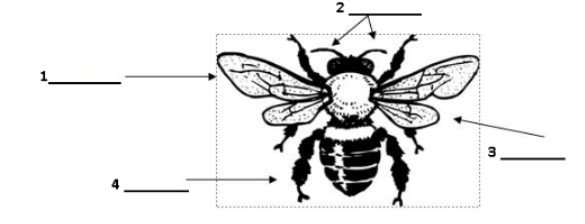
Show Answers
(Note: The text in italics is from the reading passage and shows the location from where the answer is taken or inferred. The text in regular font explains the answer in detail.)
- forewing (or) forewings
Explanation: They have four single wings. The largest are called forewings and the smallest hindwings.
- antennae
Explanation: At the front of the head are two antennae for sensing their environment.
- hindwing (or) hindwings
Explanation: They have four single wings. The largest are called forewings and the smallest hindwings.
- pollen basket
Explanation: The hind legs are specialised for collecting pollen - each leg is flattened to form a pollen basket near the end.
Answer questions 1-6 which are based on the reading passage below,
School Experiments
It is essential when conducting this experiment to wear safety goggles. This experiment is divided into four distinct sections. The first, the reaction stage, is when a glass beaker is placed on top of a tripod, and 20cm of dilute sulphuric acid poured into it. The acid is then heated. When it is almost boiling, a small quantity of copper oxide powder is added to the beaker. The mixture is then stirred with a glass spatula until the copper oxide has dissolved. This process is then repeated until 1g of powder has been added to the sulphuric acid. The heat is then removed from the beaker and the solution allowed to cool. The second stage is the filtration stage and, as the name suggests, is where a filter and conical flask are used to remove any copper oxide that has not reacted. A clear copper sulphate solution will be left in the glass dish. The third stage is where heat is applied to the copper sulphate solution in order to concentrate the solution: the concentration stage. The final crystallization stage happens when the solution begins to cool, and pure copper sulphate crystals start to form.
Questions 1 – 6
The diagram below shows how copper sulphate can be made using simple laboratory equipment.
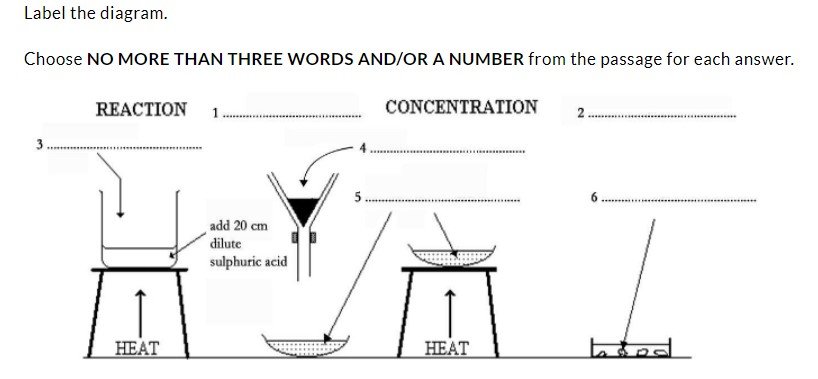
Show Answers
(Note: The text in italics is from the reading passage and shows the location from where the answer is taken or inferred. The text in regular font explains the answer in detail.)
1 Filtration
Explanation: The second stage is the filtration stage and,
2 Crystallization
Explanation: The final crystallization stage happens when the solution begins to cool, and pure copper sulphate crystals start to form.Answers 1 and 2 can be understood from the mentioned information that defines stages. The two stages( out of four) are mentioned in the diagram. As it is a list, similar information is required. The guiding words for you are: first, second, third and final.
3 Copper oxide powder
Explanation: When it is almost boiling, a small quantity of copper oxide powder is added to the beaker.
The process of heating is mentioned in the diagram, and the arrow at Question 3 indicates the addition of an element.
4 Remove copper oxide / filter copper oxide
Explanation: The second stage is the filtration stage and, as the name suggests, is where a filter and conical flask are used to remove any copper oxide that
has not reacted.
The dimensions of the flask and the shaded portion in the flask indicate the residue in the filter.
5 Copper sulphate solution
Explanation: A clear copper sulphate solution will be left in the glass dish. The third stage is where heat is applied to the copper sulphate solution in order to concentrate the solution; the concentration stage.
The shape of the dish, the heat are indicators of what is obtained next.
6 Copper sulphate crystals
Explanation: The final crystallization stage happens when the solution begins to cool, and pure copper sulphate crystals start to form.
The keyword 'final' guides you to the answer and the shape of the contents also lead you to the word crystals!
The platypus (Ornithorhynchus anatinus)
The platypus (Ornithorhynchus anatinus) is one of the most unusual, unlikely and evolutionary distinct animals alive. According to the BBC, the first time a platypus was brought from Australia to Britain, people believed that a hoodwinker had sewn two animals together and that they were the victims of a hoax.
Platypuses are best described as a hotchpotch of more recognizable species such as the duck, beaver or otter. The physical structure, habitat and reproduction svstem of the platypus makes it an interesting and unique mammal.
Weighing around three pounds, the platypus measures 15 inches (38 cm) from its head to lower back. The tail adds about 5 inches (13 cm). However, the creatures inhabiting colder regions are bigger. The physiology of the platypus is adapted for survival on land as well as in water. The shape of its bill gives it the name duck-billed platypus. This flexible body part is smooth like suede and has receptors for navigation and detection of movements of freely-swimming food, such as shrimp. The eyes and ears located in the grooves behind the bill are covered by folds of skin and a watertight seal that closes the nostrils when it is underwater. Platypuses have thick waterproof fur which allows them to stay warm underwater. Although most of its fur is dark brown, a patch near the eyes and on the underside is of a lighter shade. When on land, the webbing on their feet retracts, making their claws more pronounced and hence, these animals walk awkwardly on their knuckles to protect the web.
Yet another peculiar fact about these animals is that they are one of the very few mammals which are poisonous. Male platypuses have a horny spur on the ankles of their hind feet. It is connected to a venom gland in the upper leg. It releases a poison capable of causing excruciating pain to humans and is also capable of killing other small animals. Fat is stored in the tail.
These mammals inhabit only one small area of the world. Platypuses make their homes in freshwater bodies that flow throughout the eastern and southeastern coasts of Australia and the island of Tasmania. Though these creatures exist only on one side of one continent, platypuses can be found in various climate extremes such as in lowlands, plateaus, cold mountains and tropical rainforests. Although platypuses spend a lot of time in the water, they waddle onto the riverbanks to claw through the mud using their nails and feet to make burrows which are tunnels with chambers or rooms. They can also reside under debris, rock ledges or roots.
Platypuses are nocturnal and hence are most actively hunting during the night which can last for about 10 to 12 hours. Huhting for food takes place under the water. As they swim, they try to detect food such as insects, larvae, worms or shellfish along the muddy bottom of the water body. They scoop the prey in their bills, store it in cheek pouches and swim to the surface. Because they do not have teeth but grinding plates, they use the gravel and dirt that they scooped up to fragment their food into digestible portions.
The platypus is listed as a species of ‘least concern’ by the International Union for Conservation of Nature (IUCN). However, being a carnivore, its role as that of controlling the population of species in the lower level of the food chain cannot be ignored. The biggest threats include natural predators such as snakes, water rats and goannas, and some introduced animals such as foxes, dogs and cats. Human activities such as land clearing and dams are the biggest threat to the loss of habitat. However, platypuses have been able to evade most of the human intrusion of their natural environment.
Questions 1-6
Label the diagram below.
Write ONE WORD ONLY from the passage for each answer.
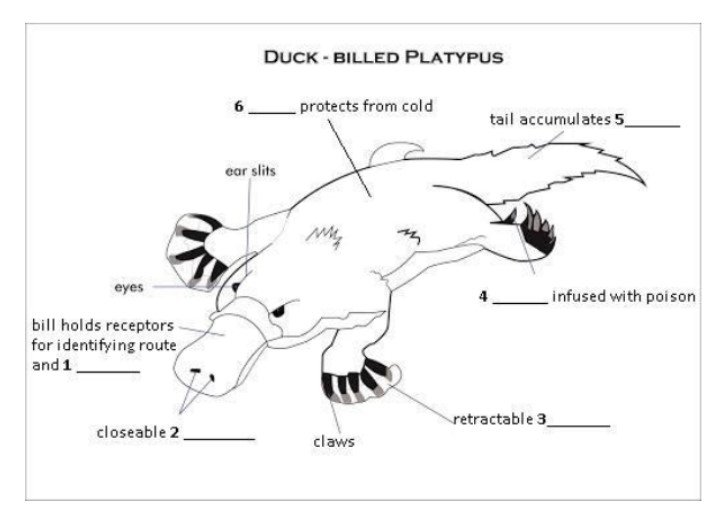
Show Answers
(Note: The text in italics is from the reading passage and shows the location from where the answer is taken or inferred. The text in the regular font explains the answer in detail.)
1 food
Explanation: Paragraph 2 - The shape of its bill gives it the name duck-billed platypus. This flexible body part is smooth like suede and has receptors for navigation and detection of movements of freely-swimming food, such as shrimp.
2 nostrils
Explanation: Paragraph 2 - The eyes and ears located in the grooves behind the bill are covered by folds of skin and a watertight seal that closes the nostrils when it is underwater.
3 webbing
Explanation: Paragraph 2 - When on land, the webbing on their feet retracts, making their claws more pronounced...
4 spur
Explanation: Paragraph 3 - Male platypuses have a horny spur on the ankles of their hind feet. It is connected to a venom gland in the upper leg. It releases a poison ...
5 fat
Explanation: Paragraph 3 - Fat is stored in the tail.
6 fur
Explanation: Paragraph 2 - Platypuses have thick waterproof fur which allows them to stay warm underwater
HOW DOES NIGHT VISION WORK
Night vision technology has transformed from old-fashioned bulky devices to compact sophisticated equipment that can intensify any light source up to 50,000 times. A device for night vision was first developed in the 1930s by the German military, and later by the Americans. Today, it has become an essential device in the kit of soldiers, permitting them to find out their targets in reduced visibility or complete darkness and move around in comparative safety as there are fewer chances of a surprise attack. ‘It improves their mobility, their survivability and their lethality, says Lt. Col. Timothy Fuller.
So, what makes night vision possible? Light is an electromagnetic wave, and the entire range of light that exists is termed as the electromagnetic spectrum.
The light visible to humans is only a part of this spectrum, while infrared light and ultraviolet light are invisible to naked eyes. The night vision devices work on two different technologies. The first is image enhancement using the tiny amount of light available which is collected and amplified to the extent that we can easily see the image. Thermal imaging, on the other hand, functions by capturing the higher areas of the infrared spectrum, which is radiated by obiects as heat instead of light.
Even on dark nights, the stars and the moon emit near-infrared light. In a device that works on image enhancement technique, this faint light is captured to amplify it to a visible level. As the light consisting of photons enters the front lens of the image intensifier tube, it hits a photocathode which converts the photons into electrons. These electrons multiply as they pass through a thin microchannel plate. At the end of the tube, the electrons strike a phosphor screen which converts them back into photons and creates an image, usually green, on the screen. Since more photons are emerging than those which entered the tube, the image is much brighter than the original scene. Rich Urich, director of operations at Night Vision Equipment Company in Prescott Valley Arizona, says, ‘The reason it is green is because when you put the unit down, you want your eyes to remain dilated so you can see in dim light.
Thermal imaging devices record the temperature difference between an object and its surroundings using a sensor called a microbolometer. An image of the object is created, which is then sent to the display where the user can see it.
However, it is not only in warfare that this technology finds use. Night vision equipment is used extensively by law enforcement departments to detect criminals in the dark. They are also used on borders to keep a check on illegal crossings. The technology is also used to find leaks and repair insulation in homes.
Questions 1-5
Label the diagram below.
Write NO MORE THAN TWO WORDS from the passage for each answer.
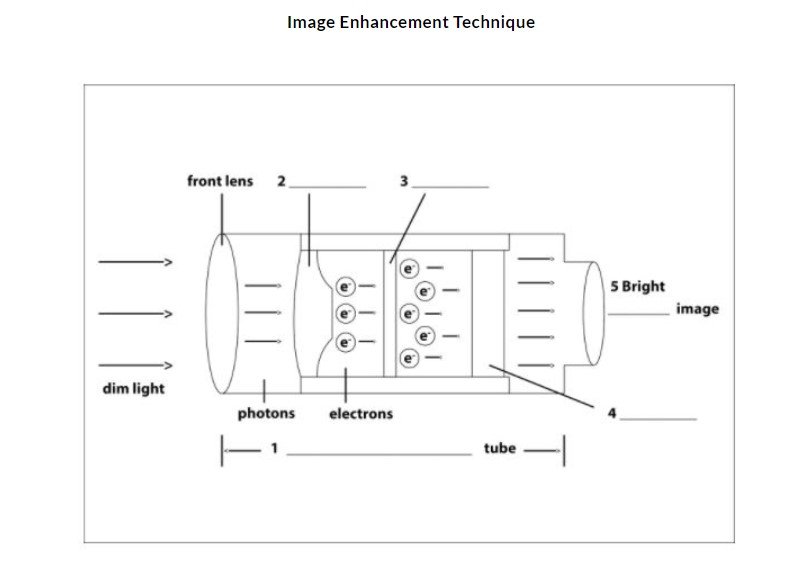
Show Answers
(Note: The text in italics is from the reading passage and shows the location from where the answer is taken or inferred. The text in the regular font explains the answer in detail.)
1 image intensifier
Explanation: Paragraph 3 - As the light consisting of photons enters the front lens of the image intensifier tube....
2 photocathode
Explanation: Paragraph 3 - ... it hits a photocathode which converts the photons into electrons.
3 microchannel plate
Explanation: Paragraph 3 - These electrons multiply as they pass through a thin microchannel plate.
4 phosphor screen
Explanation: Paragraph 3 - At the end of the tube, the electrons strike a phosphor screen which converts them back into photons..
5 green
Explanation: Paragraph 3 - ... and creates an image, usually green, on the screen. Since more photons are emerging than those which entered the tube, the image is much brighter than the original scene.
Answer questions 1-5 which are based on the reading passage below.
MASLOW’S HIERARCHY OF NEEDS
The most influential psychologist of the 20th century is, without doubt. Abraham Maslow. He is well known for his contribution to humanistic psychology and his famous hierarchy of needs. Maslow’s achievement in psychology predates the contemporary positive psychology movement, which would have been quite different without him.
Maslow’s hierarchy of need is a motivational theory which consists of a five-layered model of human requirements. It is depicted as a pyramid with five hierarchical levels. The model is categorised into deficiency needs and growth needs. The first four levels, from the bottom, are termed as deficiency needs or D-needs, while the top level is referred to as growth needs or being needs or B-needs. Deprivation gives rise to deficiency needs and motivates people to achieve them. The longer the duration these needs are unmet, the stronger is the motivation to fulfil them. As a deficiency need is relatively satisfied, the motivation decreases and a person automatically starts working for the next set of needs which are still not met. Growth needs, on the other hand, arise not due to lack of something, but from the desire to grow as a human being, and this desire stays and may become stronger with involvement.
In Maslow’s model, physiological needs are at the first level as physical survival is our most basic requirement. These are the biological requirements of the human body to survive, such as food, water, air, and sleep. They take precedence over any other need. Once these needs are relatively fulfilled, safety needs become important. People want personal and financial security, health and wellness, protection against crime, accidents and injuries. Love and belongingness needs are placed at the third level. These include trust, intimacy, acceptance, friendship, getting and giving love and affection and being part of a group, be it family, friends or employment. Esteem needs come in at the fourth level. They are classified into two categories by Maslow. One is self-esteem or esteem for oneself, which include mastery, achievement, independence and dignity and the other is the desire for respect from others such as status or prestige in society. At the fifth and highest level of the hierarchy pyramid, are the self-actualisation needs. These refer to self-fulfilment, personal growth, the realisation of one’s full potential as a person and aspiring to attain that.
Maslow continued to fine-tune his theory of the hierarchy of needs over many decades. Where management of classrooms and teaching in schools are concerned, this theory has contributed in a major way. For example, the physiological requirements of a student need to be fulfilled before his cognitive needs can be addressed. A student who is tired and hungry, cannot concentrate on his studies. To reach their full potential, the students must not only be physically and emotionally safe in their environment but feel accepted in their classrooms. However, not everyone agrees with Maslow’s theory. Some critics feel that there are considerable limitations in the theory, especially when it comes to his methodology.
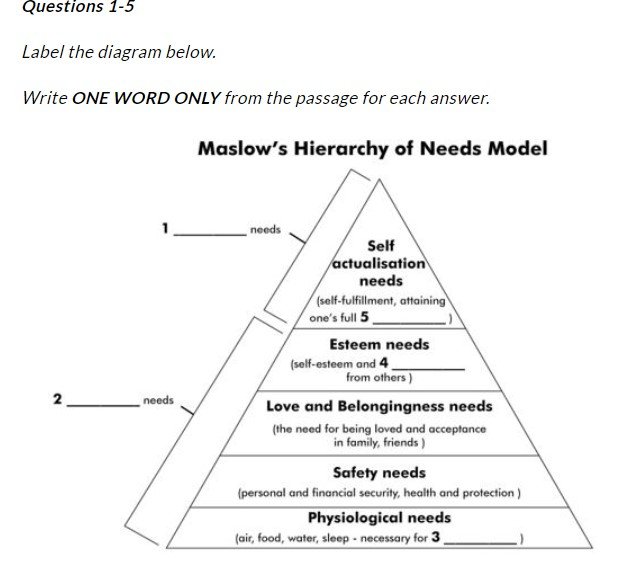
Show Answers
(Note: The text in italics is from the reading passage and shows the location from where the answer is taken or inferred. The text in the regular font explains the answer in detail.)
1 growth/ being
Explanation: Paragraph 2 - The first four levels, from the bottom. are termed as deficiency needs or D-needs, while the top level is referred to as growth needs or being needs or B-needs.
2 deficiency
Explanation: Paragraph 2 - The first four levels, from the bottom, are termed as deficiency needs or D-needs, while the top level is referred to as growth needs or being needs or B-needs.
3 survival
Explanation: Paragraph 3 - physiological needs are at the first level as physical survival is our most basic requirement. These are the biological requirements of the human body to survive, such as food, water, air, and sleep.
4 respect
Explanation: Paragraph 3 - Esteem needs come in at the fourth level... One is self-esteem or esteem for oneself, which include mastery, achievement, independence and dignity and the other is the desire for respect from others...
5 potential
Explanation: Paragraph 3 - At the fifth and highest level of the hierarchy pyramid, are the self-actualisation needs. These refer to self-fulfilment, personal growth, the realisation of one's full potential as a person and aspiring to attain that.
- Tips
- Exercise 1
- Exercise 2
- Exercise 3
- Exercise 4
Matching Sentence Endings
In this task, you are given a number of sentences with their latter part missing. You are required to complete these sentences by matching the first half with the correct ending from a given list. The options in the list are labelled with alphabets A, B, C… and you must write the correct letter on your answer sheet and not any words or phrases). There are more options than questions. So you will not be using all.
Tips to solve:
i) Read the first incomplete sentence and then go through the list of options. You can see some options do not fit with the earlier part either grammatically or logically i.e., do not make any sense. Such options can be rejected here only.
ii) Now, with the help of the keyword(s) and meaning of this incomplete sentence, locate the relevant place in the passage.
iii) Read this portion carefully. You may find that there are more than one options in the list that contain keywords or information from this place. But. They may be partially correct or an irrelevant detail.
iv) The correct option will make the completed sentence grammatically correct and true according to the information in the passage.
v) Repeat the procedure with other questions of this set. The questions are in order but the options are not necessarily in order.
Now look at the following short article and answer the questions below.
The Tea Trade
When America eventually won its independence from British rule in 1783, it began its own free and independent tea trade with China. The success of this trade made some people in Britain question the wisdom of the East India Company’s ongoing monopoly on British trade with the East. In 1813, the Company lost its monopoly on trade with India, but still had it on trade with China, which meant it was heavily dependent on the tea trade.
The Company’s charter was due for renewal in 1834, and in the decades before that, there was a growing call for the abolition of the monopoly and the instigation of free trade with China as well. Supporters of free trade argued strongly that the Company kept tea prices artificially high in order to maximise its profits, using tactics which included restricting the supply of tea.
Questions 1-3
Complete each sentence (Questions 1-3) with the correct ending, A- E, below.
1) In the late eighteenth century,
2) The success of free trade between America and China
3) People blamed the East India Company
A. America started tea trade independent from China. B. for creating an artificial shortage of tea in Britain. C. America became free. D. for restricting tea prices. E. led Britishers to challenge the Company’s dominance in trade. |
Show Answers
(Note: The text in italics is from the reading passage and shows the location from where the answer is taken or inferred. The text in regular font explains the answer in detail.)
1. C America became free.
Explanation: The paragraph states When America eventually won its independence from British rule in 1783.
Option A( America started tea trade independent from China) may confuse you here, but it is wrong information as option A means that America separated its tea trade from China or it did not remain dependent on China for its tea trade.
However, the passage sentence states- it began its own free and independent tea trade with China. Notice that different prepositions are used. Option A has 'from' in the sentence whereas the passage sentence has with!
2. E led Britishers to challenge the Company's dominance in trade.
Explanation: The success of this trade made some people in Britain question the wisdom of the East India Company's ongoing monopoly on British trade with the East.
3. B for creating an artificial shortage of tea in Britain.
Explanation: Supporters of free trade argued strongly that the Company kept tea prices artificially high in order to maximise its profits, using tactics which included restricting the supply of tea.
Option D is wrong as it contradicts the information in the article.
The Penny Black
In 1840, the United Kingdom introduced the penny black, the first adhesive postage stamp issued anywhere in the world.
For many years the postal service in the U.K. had been a very expensive service for ordinary people to use. The costs were prohibitive. a single letter sometimes costing a working person’s full day’s wage. The postal system also had many strange anomalies, such as certain categories of mail going free (and therefore being paid for by the charges on others), newspapers going for nothing, most mail being paid for by the addressee rather than by the sender, and so on.
There were moves for postal reform for many years, until eventually these moves started gathering some force through the attention of many, amongst whom Rowland Hill is the best known, and Robert Wallace. MP for Greenock, was instrumental. The story is long and involved, but eventually. The Penny Postage Bill was passed by Parliament on 17 August 1839. Some basic elements of the plan were the lowering of postage rates for basic letters to one penny, the removal of certain idiosyncrasies that prepayment would become normal, and the availability of printed envelopes, letter sheets, and labels to show prepayment. The “labels” were the penny black and twopence blue
A bookseller and printer from Dundee, James Chalmers, holds a strong claim to be the actual inventor of the adhesive postage stamp. He is said to have been interested in postal reform from about 1822, and to have printed samples of his idea for printed gummed labels in August 1834. It seems that, although Hill also presented the idea of adhesive stamps, he was probably keener on the use of standard prepaid letter folders, such as were issued in 1840 using a design by William Mulready.
The new stamps went on sale on 1st May 1840 and were valid for postage from 6th May 1840 (although some were used during the 1st-5th May period).
The Mulreadies were issued at the same time. Public reaction to these new items was quite the opposite to Rowland Hill’s expectations. The labels were well-received and admired: the Mulready design was lambasted and ridiculed. Initial supplies of the stamps were rushed through the printing and distribution process, but supplies soon caught up with requirements.
The stamps were printed in sheets of 240, engraved on steel plates, on gummed paper with a single small crown watermark on each stamp. Eleven different printing plates were used, and it is possible in almost every case to work out which plate any individual stamp was printed from by a few characteristics.
Things like the positioning of the corner letters within their squares, the presence of the “O flaw”, which rays of the stars in the upper corners are broken at what points, and so on, can point to a correct plate identification, but more specialised literature is required in order to do this. Some plates are scarcer than others, plate 11 being the scarcest.
Every penny black stamp has letters in the lower two corners. These simply identify what sheet position the stamp occupied. When the printing plates were produced the lower squares were blank, and the letters were punched in by hand. The left square letter shows which horizontal row the stamp was in
– the first row being A, the second B, and so on down to the twentieth row with T. The right square letter indicates the vertical column, again with A for the first column, B, C, and so on across to L for the last (twelfth) column. It should be noted therefore that each letter combination is just as common or as scarce as any other.
There were 68,158,080 penny blacks issued (yes, 68 million!), and even with only a 2% survival rate, there are likely to be about 1.3 million still in existence. The survival rate may well be considerably higher than 2%, as it should be remembered that in 1840 the use of envelopes was unusual, most letters being written, folded, and sealed with sealing wax; this meant that whenever a letter was filed in a lawyer’s office, bank, etc., the whole thing would be kept – letter and outer cover including the adhesive stamp.
From collector’s perspective, the physical condition of the stamp – any fault such as a thin, tear, crease, or stain will lower the value, and the number, size, and regularity of the margins make a big difference to value. The stamps were not perforated and had to be separated using scissors or a knife. As there was only about 1mm between one stamp and another, it was very easy to stray just a little and cut into the printed design of the stamp. A stamp with two full margins and perhaps a couple of other part margins is about average. Collectors will pay higher prices for examples with four good, wide, and even margins.
Questions 1-5
Complete each sentence with the correct ending, A-G, below.
Write the correct letter, A-G, as your answer to each question.
1 After reforms, most mail was
2 Each steel printing plate was
3 Every penny black was
4 Putting a letter in an envelope was
5 Keeping the borders of each stamp was
A. unusual in 1840. B. able to print sheets of 240 stamps. C. paid for by the sender. D. very difficult to achieve. E. very expensive to send. F. designed with two letters in the bottom corners. G. quickly accepted. |
Show Answers
(Note: The text in italics is from the reading passage and shows the location from where the answer is taken or inferred. The text in regular font explains the answer in detail.)
- C paid for by the sender.
Explanation:
Paragraph 3 - There were moves for postal reform for many years, until eventually these moves started gathering some force .. Some basic elements of the plan were the lowering of postage rates for basic letters to one penny, the removal of certain idiosyncrasies, that prepayment would become normal,.
The word 'prepayment' implies that postage was paid by the sender
- B able to print sheets of 240 stamps.
Explanation:
Paragraph 6 - The stamps were printed in sheets of 240, engraved on steel plates,
- F designed with two letters in the bottom corners.
Explanation:
Paragraph 7 - Every penny black stamp has letters in the lower two corners.
- A unusual in 1840.
Explanation:
Paragraph 8 - ... as it should be remembered that in 1840 the use of envelopes was unusual,
- D very difficult to achieve.
Explanation:
Paragraph 9 - The stamps were not perforated and had to be separated using scissors or a knife. As there was only about 1mm between one stamp and another, it was very easy to stray just a little and cut into the printed design of the stamp.
Music Piracy
In 1999, a nineteen-year-old student decided he wanted a fast and efficient way to share his favourite songs with his friends. But, he didn’t just want to make compilation tapes on cassettes. He wanted to do the sharing via the computer. The result was Napster. A file-sharing community that allowed Shawn Fanning and his friends to share all the mp3 files they ripped from their CD collections with each other. and 60 million other users. The rest would be history if it were not for one small issue – what they were doing was illegal.
At first, that stopped no one. Napster clones with marginally different peer-to-peer client-server architectures appeared. Gnutella networks, Donkey, AudioGalaxy, Kazaa, FastTrack, Grokster, Limewire, Morpheus, BearShare, and countless others emerged totalling hundreds of millions of users sharing billions of megabytes of files. Add to that Usenet binaries and ICQ/IRC channels through which music, video, software, and other copyright materials had already been shared illicitly for years. This was still years before the advent of BitTorrent networks.
Figures have shown repeatedly that the rise of Napster and its ilk had actually caused a resurgence in lacklustre CD sales. Many users download lots of tracks but then buy the complete album on CD for the sake of having something more tangible to own. The whole file-sharing culture has also, it is claimed, boosted interest in music in much the same way that video piracy in the 1980s saw more people going to the cinema.
Nevertheless, it was inevitable that the copyright holders were going to be a little less than pleased with P2P. With support and advocacy from certain artists themselves, most notably Metallica’s Lars Ulrich and Dr Dre, the record industry began to fight this cultural sea change. Napster was shut down under court order, and many of the other early P2P systems followed. However, others sprang up to replace them almost as quickly as others were knocked down. The development of Bit Torrent has added a whole new approach to file sharing veiled with a layer of legitimacy.
In the meantime, more savvy agencies, namely Apple Corp and a Russian site going by the name of Allofmp3.com, as well as a few other innovators, had latched on to the fact that mp3 downloads, despite the fears of the wider industry would be the way forward.
The difference between these paid-for downloads (Allomp3 ‘ dubious international legality aside) and the original incarnation of Napster is that users had to pay and royalties were apparently passed on to the record companies, and one would hope, the artists themselves. Ultimately, the Napster name was resurrected as a paid-for service endorsed by the record industry and others followed suit.
Questions 1-5
Complete each sentence with the correct ending, A-H, from the box below.
Write the correct letter, A-H, as your answer to each question.
1 The desire to share songs quickly
2 The popularity of Napster and similar services
3 People buy CDs because
4 The record companies
5 Apple Corp and Allofmp3
A. believed in the success of mp3 downloads. B. resulted in the compilation of CDs. C. gave birth to the concept of file sharing on computers. D. they want to have something for themselves. E. were not in support of P2P sharing. F. they are popular. G. resulted in revived sales of CDs. H. were happy with the rising interest in music. |
Show Answers
(Note: The text in italics is from the reading passage and shows the location from where the answer is taken or inferred. The text in the regular font explains the answer in detail.)
1 C
Explanation: Paragraph 1- In 1999, a nineteen-year-old student decided he wanted a fast and efficient way to share his favourite songs with his friends.
But, he didn't just want to make compilation tapes on cassettes. He wanted to do the sharing via the computer. The result was Napster.
2 G
Explanation: Paragraph 3 - Figures have shown repeatedly that the rise of Napster and its ilk had actually caused a resurgence in lacklustre CD sales.
3 D
Explanation: Paragraph 3 - Many users download lots of tracks but then buy the complete album on CD for the sake of having something more tangible to own.
4 E
Explanation: Paragraph 4 - ... the record industry began to fight this cultural sea change. Napster was shut down under court order, and many of the other early P2P systems followed.
5 A
Explanation: Paragraph 5- ... Apple Corp and a Russian site going by the name of Allofmp3.com... had latched on to the fact that mp3 downloads, despite the fears of the wider industry would be the way forward.
Answer questions 1-6 which are based on the reading passage below.
COMMERCIAL DOG BREEDING
With increasing demands for exotic dog breeds, breeding of dogs has become a lucrative business. Those engaged in this business often claim that they are responsible breeders, however, there is no such thing as for every puppy produced by a breeder, many animals in shelters that are waiting for adoption find it difficult to find a home. If they are in there long enough, they are euthanized.
One major worrying factor is the practice of breeding for the sake of appearance. Although the concerned animal is not aware of its appearance, the breeder and buyer are. It is the animal that suffers due to genetic exploitation. Another cause of concern is inbreeding, which leads to life-threatening genetic defects that can be excruciatingly painful. These are more apparent in ‘purebred dogs. The common diseases in such animals include blindness, deafness, hip dysplasia, skin problems and heart defects.
Also, the ‘puppy-mill’ kennels function in abysmal conditions. They generally consist of small cages constructed from wire mesh and wood or tractor-trailer cabs that are tethered to tree trunks. As a rule, female dogs breed twice a year. Once they are incapable of breeding, they are either put to death or abandoned. It has also been noticed that female dogs and their pups suffer from exposure, malnutrition and have next to no medical care. Puppies are separated from their mothers early and sold to animal brokers transporting them to pet shops in crates. During the process, the puppies travel hundreds of miles in trailers, trucks or airplanes without enough food, water, or air.
UK’s biggest dog welfare charity, Dogs Trust, recently released a report that is the result of six months of investigation into breeding and trafficking of puppies from Eastern European countries to the UK. Apart from concerns such as risk to public health because of rabies and other related diseases, tapeworm infestation can be debilitating, although it is not found in the UK at present. Shocking footage of this investigation shows how commercial breeders, transporters and even vets in Hungary and Lithuania are abusing the EU legislation by using the Pet Travel Scheme (PETS) for the commercial importation of puppies to Great Britain.
Where pet owners are concerned, a rather disturbing trend has picked up in the past few decades. They buy puppies of Bulldogs and other high-priced pedigree animals, mainly as a novelty and status symbol. Little do the buyers realise that these puppies are ill bred and it is very likely that they suffer from diseases because of inbreeding. According to the 2006 statistics, 287,000 such animals made an entry into America. Taking into account the increasing demand for crossbred and purebred puppies in the country, experts feel that these statistics will, in all likelihood, spiral out of control.
In countries like India, the pet dog figures in homes have suddenly jumped from around 7 million in the year 2009 to a little over 12 million in 2014, as per research conducted by Euromonitor. Alarmingly, there is a rising demand for Saint Bernards and Siberian Huskies. These animals that are meant to live in cold climates are trapped inside apartments that are small, hot and humid. Serious health problems are seen to be increasing in these animals. When the situation gets dire, the owners are unable to cope and abandon them on the roadside.
It is obvious that not enough is being done to stop the trade of puppies. By the end of this year, there are chances that the EU legislation on pet travel will come into force. This will ensure that law breakers will be penalised. However, organisations like Dogs Trust and their associates, at the ports in the UK, feel that the projected changes are sadly not adequate and will not serve the purpose
Questions 1-6
Complete each sentence with the correct ending. A-l. from the box below.
Write the correct letter, A-I, as your answer to each question.
1) Breeding of dogs for appearance is harmful
2) Inbreeding is a major concern
3) The dogs in a puppy mill
4) The investigation by Dogs Trust reveals
5) The pet owners prefer high-priced animals
6 The hot and humid Indian climate is
A. because it makes looks more important for B. unsuitable for breeds native to colder regions. C. because it interferes with their genetic code. D. are generally maltreated. E. the illegal transportation of puppies to the UK. F. because it leads to genetic disorders. G. because purebred dogs are affected by it. H. because they are considered a status symbol. I. because they are healthy. |
Show Answers
(Note: The text in italics is from the reading passage and shows the location from where the answer is taken or inferred. The text in the regular font explains the answer in detail.)
1 C
Explanation: Paragraph 2 - One major worrying factor is the practice of breeding for the sake of appearance ...and it is the animal which suffers due to genetic exploitation.
2 F
Explanation: Paragraph 2 - Another cause of concern is inbreeding, which is the cause of life-threatening genetic defects that can be excruciatingly painful.
3 D
Explanation: Paragraph 3 - Also, the puppy-mill' kennels function in abysmal conditions. They generally consist of small cages constructed from wire mesh and wood ... Once they are incapable of breeding, they are either put to death or abandoned ... female dogs and their pups suffer from exposure, malnutrition and have next to no medical care.
4 F
Explanation: Paragraph 4 - UK's biggest dog welfare charity, Dogs Trust, recently released a report that is the result of six months of investigation ...
Shocking footage of this investigation shows how commercial breeders, transporters and even vets in Hungary and Lithuania are abusing the EU legislation by using the Pet Travel Scheme (PETS) for the commercial importation of puppies to Great Britain.
5 H
Explanation: Paragraph 5 - Where pet owners are concerned, a rather disturbing trend has picked up in the past few decades. They buy puppies of Bulldogs and other high-priced pedigree animals, mainly as a novelty and status symbol.
6 B
Explanation: Paragraph 6 - In countries like India, ... Alarmingly, there is a rising demand for Saint Bernards and Siberian Huskies. These animals that are meant to live in cold climates are trapped inside apartments that are small, hot and humid. Serious health problems are seen to be increasing in these animals.
Answer questions 1-5 which are based on the reading passage below.
MASLOW’S HIERARCHY OF NEEDS
The most influential psychologist of the 20th century is, without doubt. Abraham Maslow. He is well known for his contribution to humanistic psychology and his famous hierarchy of needs. Maslow’s achievement in psychology predates the contemporary positive psychology movement, which would have been quite different without him.
Maslow’s hierarchy of need is a motivational theory which consists of a five-layered model of human requirements. It is depicted as a pyramid with five hierarchical levels. The model is categorised into deficiency needs and growth needs. The first four levels, from the bottom, are termed as deficiency needs or D-needs, while the top level is referred to as growth needs or being needs or B-needs. Deprivation gives rise to deficiency needs and motivates people to achieve them. The longer the duration these needs are unmet, the stronger is the motivation to fulfil them. As a deficiency need is relatively satisfied, the motivation decreases and a person automatically starts working for the next set of needs which are still not met. Growth needs, on the other hand, arise not due to lack of something, but from the desire to grow as a human being, and this desire stays and may become stronger with involvement.
In Maslow’s model, physiological needs are at the first level as physical survival is our most basic requirement. These are the biological requirements of the human body to survive, such as food, water, air, and sleep. They take precedence over any other need. Once these needs are relatively fulfilled, safety needs become important. People want personal and financial security, health and wellness, protection against crime, accidents and injuries. Love and belongingness needs are placed at the third level. These include trust, intimacy, acceptance, friendship, getting and giving love and affection and being part of a group, be it family, friends or employment. Esteem needs come in at the fourth level. They are classified into two categories by Maslow. One is self-esteem or esteem for oneself, which include mastery, achievement, independence and dignity and the other is the desire for respect from others such as status or prestige in society. At the fifth and highest level of the hierarchy pyramid, are the self-actualisation needs. These refer to self-fulfilment, personal growth, the realisation of one’s full potential as a person and aspiring to attain that.
Maslow continued to fine-tune his theory of the hierarchy of needs over many decades. Where management of classrooms and teaching in schools are concerned, this theory has contributed in a major way. For example, the physiological requirements of a student need to be fulfilled before his cognitive needs can be addressed. A student who is tired and hungry, cannot concentrate on his studies. To reach their full potential, the students must not only be physically and emotionally safe in their environment but feel accepted in their classrooms. However, not everyone agrees with Maslow’s theory. Some critics feel that there are considerable limitations in the theory, especially when it comes to his methodology.
Show Answers
(Note: The text in italics is from the reading passage and shows the location from where the answer is taken or inferred. The text in the regular font explains the answer in detail.)
1 growth/ being
Explanation: Paragraph 2 - The first four levels, from the bottom. are termed as deficiency needs or D-needs, while the top level is referred to as growth needs or being needs or B-needs.
2 deficiency
Explanation: Paragraph 2 - The first four levels, from the bottom, are termed as deficiency needs or D-needs, while the top level is referred to as growth needs or being needs or B-needs.
3 survival
Explanation: Paragraph 3 - physiological needs are at the first level as physical survival is our most basic requirement. These are the biological requirements of the human body to survive, such as food, water, air, and sleep.
4 respect
Explanation: Paragraph 3 - Esteem needs come in at the fourth level... One is self-esteem or esteem for oneself, which include mastery, achievement, independence and dignity and the other is the desire for respect from others...
5 potential
Explanation: Paragraph 3 - At the fifth and highest level of the hierarchy pyramid, are the self-actualisation needs. These refer to self-fulfilment, personal growth, the realisation of one's full potential as a person and aspiring to attain that.
- Tips
- Exercise 1
- Exercise 2
- Exercise 3
- Exercise 4
Matching features/ categorisation
In this task, you have to:
- match opinions/statements/findings with the names of persons that make them. There may be more options than needed. Some options may not be used at all, and some may be used more than once. You are required to understand paraphrased information and/or the main idea in statements or opinions.
- match features with the categories listed e.g. classifying some occurrences into different periods. This question type is usually found in informative passages.
Both the task assess the student’s skill to spot information quickly and relate it to the names or categories specified.
Tips to solve:
i) The questions will obviously NOT be in progressive order so don’t search in that manner. They may be scattered across the entire passage.
ii) Names of people and places are written in capitals. These are easy to spot. Read the names in the list and begin locating them. The required information for each question is usually within a paragraph, not in different paragraphs.
iii) Look for quotes and assertive sentences that report information. Look for verbs such as – says, asserts, mentions, agrees, disagrees and pronouns such as – he, she, they, their, these, etc. The words will quickly guide you to the required area in the passage
iv) Options are reworded using synonyms or by restructuring the sentences completely. Do not be misguided by words picked up ditto from the text. These are meant to confuse you
v) To match categories, look for the specified categories starting from the first paragraph. The information may be scattered across the passage or may be clustered in one or two paragraphs.
Options may appear as complete sentences or phrases.
Now try the skill building exercise given below:
(Note: The passage is of the same length as in the actual IELTS Reading Test. This will help you to identify the approach to attempt this question.)
The Origin of Language
The question of the origin of language is one that has been raised and discussed repeatedly at least since the eighteenth century. Before that, it was supposed that language must have been part of God’s gift to Adam. There was a tradition of linguistic inquiry that sought to discover what original tongue it was that Adam spoke, but the question of how he came to be able to speak at all was not really raised
In the eighteenth century, especially in France, the idea that human characteristics could be accounted for by nature rather than by Divine gift, was widely discussed, and such figures as Rousseau, Condillac and Maupertuis, among others, attempted to show that language could have had natural beginnings or could have been invented by natural reason. There were some who countered this – for example, the Lutheran pastor Sussmilch who, in 1756, attempted to refute the arguments of Maupertuis that language was an invention by showing that its intricate and systematic patterning could not be the product of human reason alone but must have been the creation of God.
However, it was the German philosopher Herder who in 1772 won the competition set by the Berlin Academy of Sciences with an essay that refuted all arguments for a Divine origin of language. For a long time, his statement was considered to have settled the question.
The nineteenth century saw the development of historical linguistics and, for a time, this seemed to give new life to the question of language origins. It was found that careful and systematic comparison of related languages could lead to a reconstruction of older languages of which they were descendants. In particular, much effort was expended in the reconstruction of Indo-European, the language proposed as ancestral to many languages of Europe and some of India. For a time it was thought that such historical work could lead to an understanding of the nature of earlier forms of language and perhaps, eventually, to an insight into its earliest form.
However, it soon became apparent that this was impossible. In reconstructing the ancestors of languages presently spoken it was realized that all you could do was to reconstruct versions of language which, though precedents for contemporary forms, were no different in principle from those that could be directly observed. It was realized that such reconstructions, whatever they might tell us about how specific languages change with time, could throw no light on the issue of how language came about in the first place.
Furthermore, as historical work proceeded and more and more languages were carefully examined, it appeared that the changes languages undergo with time, though to some degree lawful, were neither consistent nor progressive. It was not found, for instance, that older languages were simpler than contemporary languages, nor was it found possible to show that any of the various types of language proposed – such as isolating. ‘agglutinating’ or
‘inflecting – represented earlier or later stages in language development. In other words, the changes that languages were found to undergo with time were manifestly not to be accounted for by any clear process of evolution. The practitioners of historical linguistics, accordingly, abandoned any quest for a general theory of language development, and they gave up the idea that their work could throw light on language origins.
By the end of the first decade of the twentieth century, the emphasis in linguistics had shifted from historical analysis to the analysis of the synchronic structure of languages. De Saussure’s argument that historical (diachronic) analysis was not relevant for understanding the organisation of a given linguistic system when considered in its use by a community of speakers had an important influence. In addition, Franz Boas and his pupil Edward Sapir, working in North America, showed that the languages of the Native Americans had to be understood in their own terms since they had grammars and sound systems that could not be comprehended in terms of systems derived from European languages.
This work helped to show that the languages of so-called primitive peoples were just as complicated as the most sophisticated and modern of European languages and that there was no evidence for the preservation of earlier forms of language. The development of methods for describing the diversity of human languages became a major preoccupation for linguistics, and questions about the origin of the human capacity for language, or of how languages had evolved from earlier forms to those of the present, seemed less and less relevant. Speculation about language origins thus appeared worthless, for there was no evidence on which it could be based. Anyone’s guess was as good as another’s. The wastepaper baskets of London were perhaps, after all, the best destination for such imaginings.
Questions 1 – 3
Look at the following statements and the list of people below.
Match each statement with the correct person.
Refer tip no. ii and iii. Rather than picking up keywords from question statements and locating them in the text, locate each person. Read the information at that place for the person’s opinion or claim or belief etc. Tally it with each statement to find out the correct answer. |
1) Felt that historical analysis was irrelevant.
2) Believed that it was impossible for all languages to be explained with one system.
3) Felt that human language was Divine.
List of People
A. Condillac
B. Boas
C. Herder
D. Sussmilch
E. De Saussure
Show Answers
(Note: The text in italics is from the reading passage and shows the location from where the answer is taken or inferred. The text in regular font explains the answer in detail.)
- E
Explanation:
Paragraph 7 - De Saussure's argument that historical (diachronic) analysis was not relevant for understanding the organisation of a given linguistic system when considered in its use by a community of speakers, had an important influence.
- B
Explanation:
Paragraph 7 - In addition, Franz Boas and his pupil Edward Sapir, working in North America, showed that the languages of the Native Americans had to be understood in their own terms since they had grammars and sound systems that could not be comprehended in terms of systems derived from European languages.
- D
Explanation:
Paragraph 2 - There were some who countered this - for example, the Lutheran pastor Sussmilch who, in 1756, attempted to refute the argument of Maupertuis that language was an invention by showing that its intricate and systematic patterning could not be the product of human reason alone but must have been the creation of God.
Answer questions 1-8 which are based on the reading passage below.
The Chicken Tikka Masala Story
Organizers of National Curry Week claim that if all the portions sold in one year in the UK were stacked on top of each other they would constitute a tikka tower 2,770 times taller than the Greenwich Millennium Dome and yet in an article in The Daily Telegraph in November 1999, journalist Amit Roy referred to it as “a dish which does not exist in Indian cuisine”. So the question is, “is it a genuine Indian dish or isn’t it?” The name of this enigma? Chicken Tikka Masala: the flagship dish of Britain’s newly acclaimed national cuisine, boasting a huge 14.6% of the sales of the almost half a million curries consumed, on average, in the restaurants and homes of the United Kingdom every day of the year. Chicken Tikka Masala, or CTM as it was affectionately dubbed by writer Colleen Grove in ‘Spice n Easy Magazine in November 1994 is one of those culinary fables that lend a touch of intrigue and excitement to an already exotic cuisine.
Amit Roy was quite correct to observe that the dish does not hail from India and that it was specifically created to appeal to the British palate by some very astute restaurateurs. This much is not in doubt, but when one moves on to the history of the dish, fact becomes fiction and depends on just who one talks to. No ‘Indian chef seems to have produced any real evidence that he or she first invented the dish and it is commonly thought that its invention came about almost by accident. Journalist and restaurateur labal Wahhab claims it was created when a Bangladeshi chef produced a dish of traditional Chicken Tikka only to be asked “Where’s my gravy?” The response was, supposedly, a can of cream of tomato soup and a few spices and the ‘masala’ element was born.
Top food writer Charles Campion refers to CT as, “a dish invented in London in the Seventies so that the ignorant could have gravy with their chicken tikka”. Several chefs have made claims to the invention of CM, but none with any evidence or witness support so the mystery will have to remain. The descendants of Sultan Ahmed Ansari, who owned the Taj Mahal in Glasgow claim he invented it in the 1950s, but there is no other evidence of the dish at this early date or of the tandoor in Glasgow.
The tandoor, which boosted tikka sales, had not even arrived in Britain at that time, having only been introduced to the first Indian restaurant, Moti Mahal in New Delhi in 1948. In fact, this can be seen as the birth of CTM in its original form of Butter Chicken. Lala Kundan Lal Guiral first set up in Peshawar in 1920 but came to Delhi in 1947 to set up Moti Mahal. He worked with a local man to produce the first restaurant version of the tandoor and invented a tandoori spice mix for tandoori chicken – ground coriander seeds, black pepper and mild red pepper. Called Murg Makhani in Hindi, Butter Chicken originated in the 1950s at the Moti Mahal restaurant in Old Delhi. Famed for its Tandoori Chicken, the cooks there used to recycle the leftover chicken juices in the marinade trays by adding butter and tomato. This sauce was then tossed around with the tandoor-cooked chicken pieces and presto – Butter Chicken was ready! The leftover dish appealed to Delhites and was quickly lapped up by the rest of the world.
So impressed was India’s first Prime Minister Jawaharlal Nehru by Kundan Lal’s dishes that Moti Mahal became a permanent fixture in all his state banquets. Legend has it that when former Soviet premier Nikita Kruschev was asked what he liked about India, he replied, “Taj Mahal and Moti Mahal.
When the Shah of Iran came on a state visit to India, the Indian Education Minister Maulana Azad told him that coming to Delhi without eating at Moti Mahal was like going to Agra and not seeing the Taj Mahal.
Top restaurateur Amin Ali, owner of The Red Fort and Soho Spice in London’s Soho, remembers serving CTM when he first arrived in London in 1974. A lowly waiter at the time he remembers wondering just what the dish was. CTM was introduced to Waitrose by G.K.Noon in 1983 when he was still in the United States, and by the end of the Millennium, it was generally acknowledged as the most popular single dish in Britain.
For something that is so popular with the public and with the restaurateurs who make their living from it. Chicken Tikka Masala is very much a Cinderella of culinary creations. Very few recipes for CTM appear in the plethora of Indian Cuisine cookbooks that have appeared over the last twenty vears and Alan Davidson’s recent ‘Oxford Companion to Food’ does not even consider it deserving of a listing. Indeed, such are the passions it generates in the industry, that many top chefs refuse to cook or serve it due to its complete lack of authenticity?
Mridula Baljekar is one of the few cookery writers to have included CM in her bestselling Complete Indian Cookbook’ (1993) including food colouring and tomato puree, as well as double cream and almonds. Chef Mohammed Moneer introduces yet another ingredient with half a cup of coconut milk instead of cream.
Chicken Tikka Masala was most certainly invented in Britain, probably by a Bangladeshi chef, and is so popular it is even being served in some hotel restaurants in India and Bangladesh. It does not come from the Raj or the kitchens of the Moghul Emperors, but millions of people enjoy it every year, and perhaps that is all the pedigree it needs!
Questions 1 – 8
Look at the following statements (Questions 1-8) and the list of people, A – 1, below.
Match each statement with the correct person.
Write the correct letter, A-I, as your answer.
1) He asserts that the dish was born as a quick response to a customer’s demand.
2) He presented an analogy between a restaurant and a well-known monument.
3) He noted that Chicken Tikka Masala was made to suit British taste.
4) He replaced one of the ingredients.
5) He used the acronym CTM in his article.
6) He served the dish without having any knowledge about it.
7) He has not mentioned Chicken Tikka Masala in his book.
8) He introduced Chicken Tikka Masala to Waitrose.
List of People A. Colleen Grove B. Amit Roy C. labal Wahhab D. Charles Champion E. Nikita Kruschev F. Maulana Azad G. Amin Ali H. G K Noon I. Alan Davidson J. Mohammed Moneer |
Show Answers
- C
Explanation: Paragraph 2 - Journalist and restaurateur Iqbal Wahhab claims it was created when a Bangladeshi chef produced a dish of traditional Chicken Tikka only to be asked "Where's my gravy?" The response was, supposedly, a can of cream of tomato soup and a few spices and the 'masala' element was
born.
- F
Explanation: Paragraph 5 - When the Shah of Iran came on a state visit to India, the Indian Education Minister Maulana Azad told him that coming to Delhi without eating at Moti Mahal was like going to Agra and not seeing the Taj Mahal.
- B
Explanation: Paragraph 2 - Amit Roy was quite correct to observe that the dish does not hail from India and that it was specifically created to appeal to the British palate by some very astute restaurateurs.
- J
Explanation: Paragraph 8 - Chef Mohammed Moneer introduces yet another ingredient with half a cup of coconut milk instead of cream.
- A
Explanation: Paragraph 1 - Chicken Tikka Masala, or CTM as it was affectionately dubbed by writer Colleen Grove in 'Spice n Easy Magazine in November 1994,
- G
Explanation: Paragraph 6 - Top restaurateur Amin Ali, owner of The Red Fort and Soho Spice in London's Soho, remembers serving CTM when he first arrived in London in 1974. A lowly waiter at the time he remembers wondering just what the dish was.
7.1
Explanation: Paragraph 7 - Very few recipes for CTM appear in the plethora of Indian Cuisine cookbooks that have appeared over the last twenty years and Alan Davidson's recent 'Oxford Companion to Food' does not even consider it deserving of a listing.
- H
Explanation: Paragraph 6 - CTM was introduced to Waitrose by G.K.Noon in 1983…
Answer questions 1-6 which are based on the reading passage below.
The Penny Black
In 1840, the United Kingdom introduced the penny black, the first adhesive postage stamp issued anywhere in the world.
For many years the postal service in the U.K. had been a very expensive service for ordinary people to use. The costs were prohibitive, a single letter sometimes costing a working person’s full day’s wage. The postal system also had many strange anomalies, such as certain categories of mail going free (and therefore being paid for by the charges on others), newspapers going for nothing, most mail being paid for by the addressee rather than by the sender, and so on.
There were moves for postal reform for many years, until eventually these moves started gathering some force through the attention of many, amongst whom Rowland Hill is the best known, and Robert Wallace, MP for Greenock, was instrumental. The story is long and involved, but eventually, The Penny Postage Bill was passed by Parliament on 17 August 1839. Some basic elements of the plan were the lowering of postage rates for basic letters to one penny, the removal of certain idiosyncrasies, that prepayment would become normal, and the availability of printed envelopes, letter sheets, and labels to show prepayment. The “labels” were the penny black and twopence blue.
A bookseller and printer from Dundee, James Chalmers, holds a strong claim to be the actual inventor of the adhesive postage stamp. He is said to have been interested in postal reform from about 1822, and to have printed samples of his idea for printed gummed labels in August 1834. It seems that, although Hill also presented the idea of adhesive stamps, he was probably keener on the use of standard prepaid letter folders, such as were issued in 1840 using a design by William Mulready.
The new stamps went on sale on 1st May 1840 and were valid for postage from 6th May 1840 (although some were used during the 1st-5th May period).
The Mulreadies were issued at the same time. Public reaction to these new items was quite the opposite to Rowland Hill’s expectations. The labels were well-received and admired; the Mulready design was lambasted and ridiculed. Initial supplies of the stamps were rushed through the printing and distribution process, but supplies soon caught up with requirements.
The stamps were printed in sheets of 240, engraved on steel plates, on gummed paper with a single small crown watermark on each stamp. Eleven different printing plates were used, and it is possible in almost every case to work out which plate any individual stamp was printed from by a few characteristics.
Things like the positioning of the corner letters within their squares, the presence of the “O flaw”, which rays of the stars in the upper corners are broken at what points, and so on, can point to a correct plate identification, but more specialised literature is required in order to do this. Some plates are scarcer than others, plate 11 being the scarcest.
Every penny black stamp has letters in the lower two corners. These simply identify what sheet position the stamp occupied. When the printing plates were produced the lower squares were blank, and the letters were punched in by hand. The left square letter shows which horizontal row the stamp was in
– the first row being A, the second B, and so on down to the twentieth row with T. The right square letter indicates the vertical column, again with A for the first column, B, C, and so on across to L for the last (twelfth) column. It should be noted therefore that each letter combination is just as common or as scarce as any other.
From the collector’s perspective, the physical condition of the stamp – any fault such as a thin, tear, crease, or stain will lower the value, and the number, size, and regularity of the margins make a big difference to value. The stamps were not perforated and had to be separated using scissors or a knife. As there was only about 1mm between one stamp and another, it was very easy to stray just a little and cut into the printed design of the stamp. A stamp with two full margins and perhaps a couple of other part margins is about average. Collectors will pay higher prices for examples with four good, wide, and even margins.
Questions 1-6
Look at the following statements (Questions 1-5) and the list of people and organisations below.
Match each statement with the correct person or organization.
You may use any letter more than once.
- introduced new legislation to lower the cost of sending letters
- designed a prepaid letter folder
- preferred prepaid letter folders
- interested in postal reforms since the 1820s
- his design was not liked by people
- probably invented adhesive postage stamps
List of people (and organization) A. Rowland Hill B. James Chalmers C. William Mulready D. Parliament |
Show Answers
(Note: The text in italics is from the reading passage and shows the location from where the answer is taken or inferred. The text in the regular font explains the answer in detail.)
1 D
Explanation: Paragraph 3 - The Penny Postage Bill was passed by Parliament on 17 August 1839. Some basic elements of the plan were the lowering of postage rates for basic letters to one penny.
2 C
Explanation: Paragraph 4 - It seems that, although Hill also presented the idea of adhesive stamps, he was probably keener on the use of standard prepaid letter folders, such as were issued in 1840 using a design by William Mulready.
З А
Explanation: Paragraph 4 - It seems that, although Hill also presented the idea of adhesive stamps, he was probably keener on the use of standard prepaid letter folders, ...
4 B
Explanation: Paragraph 4 - A bookseller and printer from Dundee, James Chalmers, holds a strong claim to be the actual inventor of the adhesive postage stamp. He is said to have been interested in postal reform from about 1822.
5 C
Explanation: Paragraph 5 - The labels were well-received and admired; the Mulready design was lambasted and ridiculed.
6 B
Explanation: Paragraph 4 - A bookseller and printer from Dundee, James Chalmers, holds a strong claim to be the actual inventor of the adhesive postage stamp,
Answer questions 1-7 which are based on the reading passage below.
OBJECTS FROM DIFFERENT CIVILIZATIONS
Obiects from lost civilisations can tell us about the social relationships and the way of life of the people belonging to those societies. The Indus valley civilisation and the Chinese civilisation have been influential with their innovations and contributions to advanced technology.
The Indus Valley civilization is also called the Harappa civilization. Developing along the mighty Indus River, it was at its peak around 2500 and 3500 BC.
This Bronze Age civilisation is believed to be among the oldest world civilisations together with the Egyptian and Mesopotamian civilisations. The famous figurine of the dancing girl from the Harappa region shows the advances made in art and metallurgy at the time. The statue describes details such as the hairstyle and ornaments prevalent then such as the more than 20 bangles in her left arm and four on her right arm, and the necklace. Although the bronze statuette is in standing position, it was named the dancing girl by assuming that it was her profession.
The seals are other famous obiects from the Bronze Age. Seals are beautifully carved out of stone and then fired for durability. Over 3,500 seals discovered are mostly square with different symbols at the top, an animal in the centre and a few more symbols at the bottom are, which are presumed to be the inscription of the Indus valley language. The inscription indicates that people of this age wrote the first line from right to left, the second line from left to right and so on. Some common animal inscriptions on these seals include elephants, unicorns, rhinoceros, and bulls. On the reverse face, most seals have projections with a hole to possibly carry it comfortably. The imprint on some of the seals suggests that they were used as clay tags for sacks of traded goods such as grain, which means that the Harappan people were involved in long-distance trading networks. Hunting tools show that the Indus people were fond of game. Many of the toys are carts and animals made from baked clay, and most were for children, which has led to the conclusion that the people had an active social life.
Standardised measurement is another valuable contribution of the Indus valley people. The oldest ruler with markings was a copper alloy rod found by a German archaeologist and he claims that it was used as a standard measurement unit. He mentions that the measurements on the ruler are divided into units that correspond to 1.32 inches which are further divided into perfectly calculated decimal subdivisions. Measurements of the bricks found in excavations of the Mohenio Daro and Harappa civilisations match with those on the ruler mentioned by the German archaeologist.
China was the first nation to invent paper. In the older civilisations, words were written on natural materials such as grass stalks, earthen plates, wood and bamboo strips, tree leaves, and sheepskins. The first paper from the Chinese people was known as bo and was made of silk. However, it was expensive. In the 2nd century, a new kind of paper was produced from rags, bark, wheat stalks, and other materials, which was not only cheaper but was also durable and could be used for brush writing. Papermaking had spread to other parts of the world in the beginning of the third century. Ancient China also gets credit for the invention of gunpowder. In a collection of most important military techniques as described in Wujing Zongyao that was edited in 1044 by Zeng Gong Liang, three formulas of making gunpowder were discovered and have been described as the earliest formulas of such kinds. Another significant gift from China was the compass. It was developed after some miners got hold of a piece of a natural magnetite that attracted iron and pointed north. The compass that we use today is a result of a series of improvements to the earliest design. Before it was invented, navigators depended on the position of the moon, sun, and the polestar for their bearings.
Questions 1-7
The reading passage mentions a number of objects/achievements related to Indus Valley and Chinese civilisations and their relevance.
Match each object/ achievement (Questions 1-7) in List A with its relevance (A-J) in
List B.
Write the correct letter, A-J, as your answer.
List A
1) figurine of the dancing girl
2) seals for marking goods
3) weapons for hunting
4) toys for children
5) copper alloy ruler
6) production of paper from plant material
7) invention of the compass
List B A. strength and affordability of a product B. the various uses of clay C. spread of commerce in a wide area D. advancements in metal craft E. recognition of dance as a profession F. social activity G. a consequence of the discovery of natural magnet H. navigators depended on astronomical bodies I. use of standard measurements in construction J. the consumption of wild birds and animals as food |
Show Answers
(Note: The text in italics is from the reading passage and shows the location from where the answer is taken or inferred. The text in the regular font explains the answer in detail.)
1 D
Explanation: Paragraph 2 - This famous figurine of the dancing girl from the Harappa region shows the advances made in art and metallurgy at the time.
2 C
Explanation: Paragraph 3 - The imprint on some of the seals suggests that they were used as clay tags for sacks of traded goods such as grain, which indicates that the Harappan people were involved in long-distance trading networks.
3 J
Explanation: Paragraph 3 - Hunting tools indicate that the Indus people were fond of game.
'Game- wild animals and birds that are hunted for food or sport are also called game
4 F
Explanation: Paragraph 3 - Many of the toys are carts and animals made from baked clay, and most were for children, which has led to the conclusion that the people had an active social life.
5 1
Explanation: Paragraph 4 - The oldest ruler with markings was a copper alloy rod, found by a German archaeologist and he claims that it was used as a standard measurement unit ... Measurements of the bricks found in excavations of the Mohenjo Daro and Harappan civilisations match with those on the ruler mentioned by the German archaeologist.
6 A
Explanation: Paragraph 6 - In the 2nd century, a new kind of paper was produced from rags, bark, wheat stalks, and other materials, which was not only cheaper but was also durable...
7 G
Explanation: Paragraph 6 - Another significant gift from China was the compass. It was developed after some miners got hold of a piece of a natural magnetite that attracted iron and pointed north.
Answer questions 1-5 which are based on the reading passage below.
OLDEST FOSSILS FOUND?
For thousands of years, people have been fascinated by fossils. The ancient Greeks were correctly able to interpret fossils as the remnants of impressions of creatures that died and got embedded in sediments. The word fossil in its modern context refers to the physical manifestation of former life from an era earlier than recorded by human history. There is no recognized age at which any evidence can be considered as a fossil. While the occurrence of fossils around the world is common, only a small number make their way to fossil records.
So how are fossils formed? The most important factor in the formation of fossils is the immediate burial of remains of an organism as exposure to predators or the elements can destroy them. Muddy areas or sandy soil is better as the creature gets buried for fossilisation to take place. After burial, the soft tissues decay quickly leaving the hard body parts like bones or shells behind. Gradually, sediment deposits over the remains and hardens into rock.
Depending on the natural minerals present in the sediment, fossilization takes place. Once the rocky layer preserving the vestiges erodes, the remains are exposed as fossils.
According to scientists, they have discovered the oldest fossils of the world, estimated to have formed some 3.77 to 4.28 billion years ago. Found in Canada, these microfossils consist of filaments and tiny tubes made of iron oxide. It is believed that they are the remnants of bacteria which lived around hydrothermal vents on the seabed and derived energy from iron-based chemical reactions. If this is true, these fossils will be the oldest confirmation of life on Earth, offering valuable information into the origin of life.
Matthew Dodd from University College, London who is the leading author of the research says, “If these rocks do indeed turn out to be 4.28 billion years old, then we are talking about the origins of life developing very soon after the oceans formed 4.4 billion years ago.” As iron-oxidising bacteria exist even today, these findings underline the achievement of such microorganisms. “They have been around for 3.8 billion years at least,” says, Dominic Papineau, the main author from UCL.
According to the research team, this finding strengthens the theory that life appeared and diversified quickly on Earth. Also, the discovery shows up a path to research for the existence of life on any other planet of our solar system where oceans existed once. “If we look at similar old rocks from Mars and we can’t find evidence of life, then this certainly may point to the fact that Earth may be a very special exception and life might just have arisen on Earth.” remarks Dodd. The discovery is, however, heading for a hot debate, much like the microfossil discovery that was reported in Western Australia.
An expert on ancient fossil bacteria. Frances Westall, who works at the French National Centre for Scientific Research, is not convinced by this study. She says, “The thing that bothers me most about these structures is the fact that they all seem to be extremely oriented. They are parallel to each other, and microbes don’t grow parallel to each other.”
Questions 1-5
Look at the following statements (Questions 1-5) and the list of people or the group below.
Match each statement with the correct person or group A, B, C or D.
Write the correct letter, A, B, C or D as your answer.
You may use any letter more than once,
1) Iron-oxidising bacteria have been existing for over three billion years.
2) Various forms of life evolved at a great speed on Earth.
3) Our Earth is unique to bear life.
4) The discovered fossils do not match with the formation pattern of bacteria.
5) There is not much time gap between the formation of oceans and the beginning of life
List of people A. Matthew Dodd B. Dominic Papineau C. Frances Westall D. The Research Team |
Show Answers
(Note: The text in italics is from the reading passage and shows the location from where the answer is taken or inferred. The text in the regular font explains the answer in detail.)
1 B
Explanation: Paragraph 4 - As iron-oxidising bacteria exist even today, these findings underline the achievement of such microorganisms. "They have been around for 3.8 billion years at least," says, Dominic Papineau, the main author from UCL
2 D
Explanation: Paragraph 5 - According to the research team, this finding strengthens the theory that life appeared and diversified quickly on Earth.
ЗА
Explanation: Paragraph 5 - "If we look at similar old rocks from Mars and we can't find evidence of life, then this certainly may point to the fact that Earth may be a very special exception and life might just have arisen on Earth." remarks Dodd.
4 C
Explanation: Paragraph 6 - An expert on ancient fossil bacteria, Frances Westall, She says, "The thing that bothers me most about these structures is the fact that they all seem to be extremely oriented. They are parallel to each other, and microbes don't grow parallel to each other."
5 A
Explanation: Paragraph 4 - Matthew Dodd from University College, London who is the leading author of the research says, "If these rocks do indeed turn out to be 4.28 billion years old, then we are talking about the origins of life developing very soon after the oceans formed 4.4 billion years ago."
- Tips
- Exercise 1
- Exercise 2
- Exercise 3
- Exercise 4
In this task, you are required to complete the sentences by filling in the blanks with words and/or a number from the reading passage. The instructions specify the maximum number of words to be used
Tips to Solve:
i) Read the instructions carefully. Your answer will be marked wrong if it exceeds the word limit.
(il) Read the first question sentence. Identify the keywords and understand the meaning as well.
iii) Go to the passage and locate the keywords(or their synonyms).
iv) Once you get the relevant place, read that part carefully to understand the meaning. Compare this sentence with the question sentence and decide what information is missing.
v) Identify which word or words or number fits in the blank best to complete the meaning. Check whether your chosen answer fits in grammatically also,ie. what kind of word you are looking for- verb, noun(singular/plural) or adjective etc.
vi) Remember that you cannot change the word-form. It must exactly match with the word in the passage
vii) Write the answer on your answer sheet. Do not repeat any word which is already in the question before or after the blank.
viii) Repeat the procedure with other questions. The questions are in order, so start looking for the next question from just below from where you found the previous question.
Read the short paragraph below and answer the two questions that follow.
Sea-otters worth 700 million in carbon credits
Want to slow global warming? Save a sea otter. So says Chris Wilmers at the University of California, Santa Cruz, whose team has calculated that the animals remove at least 0.18 kilograms of carbon from the atmosphere for every square metre of occupied coastal waters. That means that if sea otters were restored to healthy populations along the coasts of North America, they could collectively lock up a mammoth 1010 kg of carbon – currently worth more than $700 million on the European carbon-trading market.
Questions 1 – 2
Complete the sentences below.
Choose NO MORE THAN ONE WORD AND/OR A NUMBER from the passage for each answer.
1 Increasing the otter population might be a way to reduce the amount of ________in the atmosphere.
2 The amount of carbon that a restored population of otters could remove would be worth over______
Show Answers
(Note: The text in italics is from the reading passage and shows the location from where the answer is taken or inferred. The text in regular font explains the answer in detail.)
1 carbon
Location: Want to slow global warming? Save a sea otter... the animals remove at least 0.18 kilograms of carbon from the atmosphere..
2 $700 million
Location: That means that if sea otters were restored to healthy populations along the coasts of North America, they could collectively lock up a mammoth 1010 kg of carbon - currently worth more than $700 million
Explanation: The passage sentence states that increasing otter population could reduce 1010 kg which is equivalent to over $700million in terms of money and in the question sentence, the words just before the blank( worth over) indicates that the answer is a money value.
Answer questions 1-5 which are based on the reading passage below.
The Halifax Explosion
Before the atomic bomb was dropped on Hiroshima in 1945, the largest-ever non-natural explosion had taken place in 1917 in the eastern Canadian port city of Halifax. With the outbreak of World War I, Halifax was effectively transformed into a boomtown. Convoys gathered weekly in Bedford Basin (the north-western end of Halifax Harbour) in order to traverse the Atlantic, and Halifax Harbour became heavy with vessels of one variety or another. This spike in boat traffic was not dealt with efficiently, and collisions became almost normal.
On December 1st. 1917, the French vessel Mont Blancleft New York in order to join a convoy in Halifax after being loaded with 226.797 kilograms of TNT (an explosive), 223,188 kilograms of benzol (a type of gasoline), 1,602,519 kilograms of wet picric acid (an explosive), and 544,311 kilograms of dry picric acid (another explosive). On December 6th, the Mont Blancwas ushered into Halifax’s harbour after the U-boat nets had been raised.
At the same time, the cargoless Norwegian ship, Imo, left Bedford Basin en route to New York in order to pick up relief items for transport to war-torn Belgium. Imo was behind schedule and attempting to remedy that. She passed a boat on the wrong side before sending a tugboat retreating to port. By the time she reached the Narrows, she was in the wrong channel and going too fast. The Mont Blanc sounded her whistle, but the Imo sounded back twice, refusing to alter course. At the last moment, the Mont Blanc veered, and the Imo reversed, but it was too late. From the gash formed in the French boat’s hull seeped a noxious spiral of oily, orange-dappled smoke. Mont Bland’s crew rowed to shore on the Dartmouth side, but no one could decipher their warnings. Their fiery vessel then casually drifted toward the Halifax side, where it came to rest against one of the piers.
This spectacle drew thousands of onlookers. People crowded docks and windows filled with curious faces. As many as 1,600 died instantly when the boat exploded. Around 9,000 were injured, 6,000 seriously so. Approximately 12,000 buildings were severely damaged, virtually every building in town was damaged to some extent; 1,630 were rendered nonexistent. Around 6,000 people were made homeless, and 25,000 people (half the population) were left without suitable housing.
The Halifax Explosion, as it became known, was the largest manmade detonation to date, approximately one fifth the ferocity of the bomb later dropped on Hiroshima. It sent up a column of smoke reckoned to be 7,000 metres in height. It was felt more than 480 kilometres away. It flung a ship gun barrel some 5.5 kilometres, and part of an anchor, which weighed 517 kilograms, around 3 kilometres. The blast absolutely flattened a district known as Richmond. It also caused a tsunami that saw a wave 18 meters above the high-water mark depositing the Imo onto the shore of the Dartmouth side. The pressure wave of air that was produced snapped trees bent iron rails, and grounded ships. That evening, a blizzard commenced, and it would continue until the next day, leaving 40 centimeters of snow in its wake. Consequently, many of those trapped within collapsed structures died of exposure. Historians put the death toll of the Halifax Explosion at approximately 2,000.
Adapted from a passage in ‘A Sort of Homecoming – In Search of Canada’ by Troy Parfitt
Questions 1-5
Complete the sentences using NO MORE THAN THREE WORDS from the passage for each answer
- During World War One, Halifax Harbour was unable to handle the increased shipping traffic properly, and there were numerous_________
- The Imo was not in the correct______and travelling too fast.
- ________of people were watching the burning ship when it exploded.
- The Halifax Explosion had about________of the power of the Hiroshima bomb.
- Freezing weather brought by a blizzard caused the death of some survivors who were_____under collapsed buildings.
Show Answers
1 During World War One, Halifax Harbour could not handle the increased shipping traffic properly, and there were numerous collisions.
Explanation:
Paragraph 1 -
This spike in boat traffic was not dealt with efficiently and collisions became almost normal.
Vocab spike means a sharp increase. (The question sentence is a paraphrased version of passage sentence.)
2 The Imo was not in the correct channel and travelling too fast.
Explanation:
Paragraph 3 -
By the time she reached the Narrows, she was in the wrong channel and going too fast.
3 Thousands of people were watching the burning ship when it exploded.
Explanation:
Paragraph 4 - This spectacle drew thousands of onlookers.
'This spectacle refers to the Halifax Explosion mentioned in the previous paragraph.
4 The Halifax Explosion had about one fifth of the power of the Hiroshima bomb.
Explanation:
Paragraph 5 - The Halifax Explosion, as it became known, was the largest manmade detonation to date, approximately one fifth the ferocity of the bomb later dropped on Hiroshima.
5 Freezing weather brought by a blizzard caused the death of some survivors who were trapped under collapsed buildings.
Explanation:
Paragraph 5 - consequently, many of those trapped within collapsed structures died of exposure.
Answer Questions 1-7 which are based on the reading passage below
Alaskans* vitamin D production slows to a halt.
Interested people are needed to participate in a one-year study to assess the effects of long dark winters on the vitamin D and calcium levels of Fairbanks residents.
So began a recruitment poster Meredith Tallas created 25 years ago. Now living in Oakland, California, Tallas was a University of Alaska Fairbanks student in 1983 who wanted to study how levels of a vitamin related to sun exposure fluctuated in people living so far from the equator. “The most obvious vitamin to study in Alaska is vitamin D, because of the low light in winter, Tallas said recently over the phone from her office in Berkeley.
Forty-seven people responded to Tallas 1983 request, and her master’s project was underway. By looking at the blood work of those Fairbanks residents every month and analyzing their diets, she charted their levels of vitamin D, which our skin magically produces after exposure to a certain amount of sunshine. We also get vitamin D from foods, such as vitamin-D enriched milk and margarine, and fish (salmon are a good source). Vitamin D is important for the prevention of bone diseases, diabetes and other maladies.
If you live at a latitude farther north than about 42 degrees (Boston, Detroit, or Eugene, Oregon), the sun is too low on the horizon from November through February for your skin to produce vitamin D. according to the National Institutes of Health. Tallas also saw another potential Alaska limitation on the natural pathway to vitamin D production.
“Most outdoor activity requires covering all but the face and hands approximately seven months of the year, she wrote in her thesis. “During the summer months residents keep much of their bodies clothed because of the persistent and annoying mosquitoes and biting flies and because of this, an Alaskan summer suntan becomes one of the face and hands.”
But even over bundled people like Alaskans show signs of enhanced vitamin D production from the sun. Tallas found the highest levels of vitamin D in the Fairbanks volunteers’ blood in July, and the lowest levels in March. Tallas attributed the July high occurring about a month after summer solstice to the time needed for the body’s processing of sunlight and the conversion to vitamin D.
In Tallas’ study, volunteers showed low levels of vitamin D in the winter months, but most got sufficient doses of vitamin D from sources other than the sun.
Tallas also found that males had an average of 16 percent more vitamin D in their blood throughout the study, which she attributed in part to men being outside more.
In charting an average for people’s time outside (you can’t convert sunlight to vitamin D through windows), she found December was the low point of sunlight exposure when the sun struck the skin of her volunteers for less than 20 minutes per day. People spent an average of more than two hours exposed to Alaska sunlight in June and July. They seemed to hunker down in October when time outside in the sun dropped to about half an hour after almost two hours of daily sun exposure in September.
Vitamin D levels in the volunteers’ blood dropped in August, September, October, November, December, January, February, and March, but Tallas saw an occasional leap in midwinter. “When someone had gone to Hawaii, we could see, very exactly, a significant spike in their vitamin D levels.” Tallas said. “The only surprise was how it came a month or two after.”
In her thesis, Tallas wrote that a midwinter trip to somewhere close to the equator would be a good thing for boosting Alaskans’ vitamin D levels.
“Presuming that an individual’s lowest circulating vitamin D level is found in March or April, such trips could potentially have a very significant effect in improving late winter vitamin D status,” she wrote in her thesis. “Unfortunately a majority of Alaskan residents do not take such trips often.” An easy alternative for Alaskans not travelling southward during the winter is eating foods rich in vitamin D or taking vitamin D supplements, Tallas said.
Questions 1 – 7
Complete the sentences below.
Write ONE WORD ONLY from the passage for each answer.
1. Tallas invited Fairbank residents to her_______ through an advertisement.
2. Tallas examined the food intake as well as_____samples of the subjects to record their vitamin D levels.
3. As you move up_____, there is insufficient availability of sunlight.
4. To avoid insect bites. Alaskans remain almost entirely______
5. Spending more time _______led to higher vitamin D levels in male volunteers.
6. At its lowest, Alaskans are exposed to the sun for only a few___every day.
7. A ___ to sunny regions during winters can surge the vitamin D levels of Alaskans.
Show Answers
(Note: The text in italics is from the reading passage and shows the location from where the answer is taken or inferred. The text in the regular font explains the answer in detail.)
1. study/ project
Explanation: The subtitle of the passage and the first sentence of the first paragraph give the answer.
Interested people are needed to participate in a one-year study to assess the effects of long dark winters on the vitamin D and calcium levels of Fairbanks residents.
So began a recruitment poster Meredith Tallas created 25 years ago.
Paragraph 2 - Forty-seven people responded to Tallas' 1983 request, and her master's project was underway.
2. blood
Explanation: Paragraph 2 - By looking at the blood work of those Fairbanks residents every month and analyzing their diets, she charted their vitamin D levels,...
3. north
Explanation: Paragraph 3 - If you live at a latitude farther north than about 42 degrees (Boston, Detroit, or Eugene, Oregon), the sun is too low on the horizon from November through February for your skin to produce vitamin D..
4. clothed
Explanation: Paragraph 4 - "During the summer months residents keep much of their bodies clothed because of the persistent and annoying mosquitoes and biting flies...
5. outside
Explanation: Paragraph 6 - Tallas also found that males had an average of 16 percent more vitamin D in their blood throughout the study, which she attributed in part to men being outside more.
6. minutes
Explanation: Paragraph 7- she found December was the low point of sunlight exposure when the sun struck the skin of her volunteers for less than 20
minutes per day.
7. trip
Explanation: Paragraph 9 - In her thesis, Tallas wrote that a midwinter trip to somewhere close to the equator would be a good thing for boosting Alaskans' vitamin D levels.
Answer questions 1-8 which are based on the reading passage below.
HOW GEESE MIGRATE
Weighing over twenty pounds, the Canada Goose is the largest in the world. Generally, most geese weigh around 5 to 14 pounds. Females are smaller in size than their male counterparts. A full-grown Canada goose has a wingspan of 50 to 75 inches.
The Canada goose is the most widely distributed in North America. The breeding grounds of the geese cover the stretch from eastern Labrador to Western Alaska, and it is the only goose in North America to breed south of 49°N. The geese are known to occupy a wide range of habitats in temperate to low arctic areas including The Tundra which is not so rich in geographical features, The Boreal forest, The Parklands and The Prairies, meadows and the higher mountains.
For most goose populations, nesting areas in the Arctic are secure; however, the development of gas and oil industries poses a danger to these groups.
During migration, the geese head for warmer places where food is readily available.
Canada geese migrate in the V- formation and are always in large groups. Scientists believe that geese travel in V-formation because of what is called the ‘drafting effect. It aids the birds to preserve their energy as they cover long distances. The same paths are followed by the migrating birds each year. The name given to these paths is flyways or routes. The four flyways that the Canada Geese use are: the Atlantic Flyway which is along the eastern coast of North America, the Mississippi Flyway, the Central Flyway which spans the Rocky Mountains, and the Pacific Flyway which is the route along the west of the Rocky Mountains.
Canada geese follow seasonal patterns of migration. The autumn migration is seen from September to the starting of November. The early migrant geese are likely to migrate faster as they spend less time at the designated rest stops. Some geese are known to return year after year to the same nesting grounds and lay their eggs with their partners. The chicks are raised in the same way every year. We know this from the records of many geese that have been tagged by scientists on the East Coast. However, It has been noticed that a few migratory populations of the Canada Goose are not fling as far south in the winter months as they used to. This Northward range shift is probably because of the availability of waste grain in the fall and winter months. Agricultural fields offer food that is available in abundance and is also of superior quality for the geese compared to natural crops. Changing weather patterns and hunting pressure are the other reasons.
Every autumn, the snow geese move from their chief breeding area in central Canada to Squaw Creek National Wildlife Refuge where they make a stopover before moving to their destination in the Gulf of Mexico. They breed during the Arctic summers and then migrate to Mexico to spend the winter. During the summer, the young geese grow rapidly and become ready to fly. By the end of August, the birds make their journey to Mexico with the young ones on their first migration. They travel back to Canada in late spring along with their young ones. Some birds make the entire journey without stopping for rest, making it a journey of 70 straight hours of flying. Most of the geese are not inclined to make a stop on their return journey north as they are eagerly waiting to mate.
The Squaw Creek National Park is an essential stopover for the geese on the Central Flyway migratory route. The area was a private hunting area, but now the wildlife here is protected by law.
Questions 1 – 8
Complete the sentences below.
Write NO MORE THAN TWO WORDS from the passage for each answer.
1. The geese live in various types of_____
2. Extraction of___and_____ in the Arctic can threaten the goose population.
3. Migrating geese can save energy due to the created by flying in V-formation
4. Some groups of Canada goose do not migrate to the far south anymore because they can get plentiful_______on farmlands.
5. After______in central Canada, Snow geese migrate to Mexico for the winters.
6. The return journey to Canada takes place by the end of______
7. Some geese do not take_______as they fly back to the north.
8. _____is not allowed in the Squaw Creek National Park.
Show Answers
1. habitat
Explanation: Paragraph 2 - The geese are known to occupy a wide range of habitats in temperate to low arctic areas including the tundra...
2. oil, gas/ gas, oil
Explanation: Paragraph 3 - For most goose populations, nesting areas in the Arctic are secure; however, the development of gas and oil industries poses a danger to these groups.
3. drafting effect
Explanation: Paragraph 3 - Scientists believe that geese travel in -formation because of what is called the drafting effect.' It aids the birds to preserve their energy as they cover long distances.
4. food/ waste grain
Explanation: Paragraph 4 - However, it has been noticed that a few migratory populations of the Canada Goose are not flying as far south in the winter months as they used to. This Northward range shift is probably because of the availability of waste grain in the fall and winter months. Agricultural fields offer food that is available in abundance...
5. breeding
Explanation: Paragraph 5 - Every autumn, the snow geese move from their chief breeding area in central Canada to... before moving to their destination in the Gulf of Mexico. They breed during the Arctic summers and then migrate to Mexico to spend the winter.
6. spring
Explanation: Paragraph 5 - They travel back to Canada in late spring along with their young ones.
7. rest
Explanation: Paragraph 5 - Some birds make the entire journey without stopping for rest;
8. Hunting
Explanation: Paragraph 6 - The Squaw Creek National Park is an essential stopover for the geese on the Central Flyway migratory route. The area was a private hunting area, but now the wildlife is protected by law.
THE APPALACHIAN TRAIL
The Appalachian Trail or AT. is a hiking trail in the Eastern United States. The trail commences from Springer Mountain in Georgia and ends at Mount Katahdin in the Maine region. It runs through 14 American states, and Virginia is home to a quarter of the trail. The estimated length of the trail is about 2,200 miles; however, the exact dimensions undergo some change with time, due to rerouting or modifications. Appalachian Trail Conservancy, an organisation established in 1925 for the day-to-day management and conservation of the trail, describes it as the longest hiking-only trail in the world.
The idea of the trail was conceived by a forester, Benton MacKaye, who penned down his thoughts in an article titled An Appalachian Trail, A Project in Regional Planning’ in 1921. The plan had the details of a vast trail that would interconnect a succession of farms and work or study related wilderness camps engineered for people living in the cities. A year later, Raymond Torrey published the idea in the New York Evening Post under the headline, A Great Trail from Maine to Georgia! at the suggestion of Major William Welch, who was at that time, the director of the Palisade Interstate Park Commission. This led to the adoption of the idea by the new Palisades Interstate Park Trail Conference and was considered their chief project. The trail saw completion in 1937. However, there were gaps in the Trail soon after its opening when a lot of the area was made inaccessible due to the New England Hurricane, and later, the displacement of 120 miles due to the Virginia parkway. Through the dark years of World War Il, the Trail was in disrepair.
In 1936, Myron Avery, the long-standing chairman of the Appalachian Trail Conservancy, became the first person to walk the entire trail in parts. Some other hikers also followed. However, no one had attempted a continuous backpacking journey through the whole trail until the year 1948, when Earl Shaffer, a World War I veteran residing in Pennsylvania, decided to attempt it. In his memoir, he noted. I almost wished that the Trail really was endless, that no one could ever hike its length. Amazingly, he repeated the adventure fifty years later when he was 79 years old and became the oldest ‘thru-hiker’ at that time.
Current statistics say that 12,000 people have traversed the full stretch of the Appalachian Trail since the year 1937 when it was completed. As per estimates made by the Appalachian Trail Conservancy, it generally takes around five to seven months to complete the hike up the trail. In 2004, an 81-year-old man completed that stretch, breaking the record set by Earl Shaffer. In the following year, trekker Andrew Thompson of New Hampshire made history by completing the hike in a matter of just 47 days, walking up the trail at the amazing speed of 45 miles per day. In spite of consuming somewhere around 8,000 calories per day, he lost 30 pounds during the trek.
Thousands of species of plants and animals have made their home on the Appalachian Trail. Among them are the 2,000 plant and animal varieties that are rare, endangered or threatened. The largest animal which inhabits the entire region of the trail is the American black bear, but confrontations with humans are rare. Even sightings of bears are not that common, apart from certain areas such as the Shenandoah National Park and parts of New Jersey. New York, Massachusetts and the Connecticut portions, where there has been a steady increase in the bear population since the 1980s. Other hazardous creatures are the venomous snakes such as the Eastern Timber rattlesnake or the copperhead. It is the drier and the rockier parts of the trail that the snakes prefer to dwell in.
Even in cases where people are ‘navigationally challenged, the Appalachian Trail is very forgiving as there are thousands of white paint markings guiding the trekkers as they walk. However, there are still a few trekkers who end up going the wrong way.
Questions 1 – 7
Complete the sentences below.
Write ONE WORD ONLY from the passage for each answer.
1. A______of the Appalachian Trail passes through Virginia.
2. The length of the trail keeps on changing due to_____and diversions
3. Benton Mackaye intended to develop a long trail connecting forest camps and___
4. Earl Shaffer was the first to complete a______hike through the entire trail.
5. The cases of human-bear______are occasional on the trail.
6. Poisonous_______inhabit the dry, rocky areas of the trail.
7. Despite clear_____, some hikers get lost on the Appalachian Trail.
Show Answers
(Note: The text in italics is from the reading passage and shows the location from where the answer is taken or inferred. The text in the regular font explains the answer in detail.)
1 quarter
Explanation: Paragraph 1 - It runs through 14 American states, and Virginia is home to a quarter of the trail.
2 modifications
Explanation: Paragraph 1 - The estimated length of the trail is about 2,200 miles; however, the exact dimensions undergo some change with time, due to rerouting or modifications.
3 farms
Explanation: Paragraph 2 - The idea of the trail was conceived by a forester, Benton MacKaye, ... The plan had the details of a vast trail that would interconnect a succession of farms and work or study related wilderness camps engineered for people living in the cities.
4 continuous
Explanation: Paragraph 3 - However, no one had attempted a continuous backpacking journey through the whole trail until the year 1948, when Earl Shaffer, a World War I veteran residing in Pennsylvania, decided to attempt it.
5 confrontations
Explanation: Paragraph 5 - The largest animal which inhabits the entire region of the trail is the American black bear, but confrontations with humans are rare.
6 snakes
Explanation: Paragraph 5 - Other hazardous creatures are the venomous snakes such as the Eastern Timber rattlesnake or the copperhead. It is the drier and the rockier parts of the trail that the snakes prefer to dwell in.
7 markings
Explanation: Paragraph 6 - ... the Appalachian Trail is very forgiving as there are thousands of white paint markings guiding the trekkers as they walk.
However, there are still a few trekkers who end up going the wrong way.
- Tips
- Exercise 1
- Exercise 2
- Exercise 3
- Exercise 4
In this task, a number of questions will be given that can be answered in a few words, usually from one to three. The word limit is specified in the instructions. The words must be taken from the passage.
Tips to Solve:
i) Read the instructions carefully. Your answer will be marked wrong if it exceeds the word limit.
ii) Read the first question. Understand what type of information is asked for. Focus on the Wh- words. These questions ask for What, Where, Which and When or a number (How much or How many)
iii) Also, identify the keyword(s) and with their help locate the part in the passage where information is present.
iv) Now, look for the specific detail which is asked in the question. For example, if the question starts with What, the answer is usually a nouni.e. The name of a thing, place, process, phenomenon etc. Similarly. ‘When will be answered by a word or number indicating time, and Where’ by a place, destination.
v) Repeat the procedure with other questions. The questions are in order.
Now look at the following paragraph and answer the questions below.
US food waste worth more than the energy savings
Recent estimates suggest that 16 percent of the energy consumed in the US is used to produce food. Yet at least 25 percent of food is wasted each year.
Michael Webber and Amanda Cellar at the Center for International Energy and Environmental Policy at the University of Texas at Austin calculate that this is the equivalent of about 2,150 trillion kilojoules lost each year. It is more than that could be gained from many popular strategies to improve energy efficiency. It is also more than projections for how much energy the US could produce by making ethanol biofuel from grains.
Questions 1 – 3
Answer the questions below.
Choose NO MORE THAN THREE WORDS AND/OR A NUMBER from the passage for each answer.
1 How much food does the US waste every year?
2 How much energy could be saved annually if food is not wasted?
3 What could be obtained from crops in future?
Show Answers
(Note: The text in italics is from the reading passage and shows the location from where the answer is taken or inferred. The text in regular font explains the answer in detail.)
1 25 percent (or) 25%
Location:
The paragraph states - Yet at least 25 percent of food is wasted each year.
2 2.150 trillion kilojoules
Location:
Yet at least 25 percent of food is wasted each year. Michael Webber and Amanda Cuellar ...
calculate that this is the equivalent of about 2,150 trillion
kilojoules lost each year.
3 ethanol biofuel
Location:
It is also more than projections for how much energy the US could produce by making ethanol biofuel from grains.
As it is a projection, it is a future possibility.
Answer questions 1-6 which are based on the reading passage below.
Vancouver
Vancouver is quite different from virtually any other city in North America. Despite the fact it is a large modern cosmopolitan city, it seems to have a relaxed, small-town, close-to-nature feel about it. There is little comparison with other large Canadian cities such as Toronto or Montreal. which are more akin to the large eastern US centres like New York and Chicago. Vancouver, like all large North American cities, is a conglomerate of high-rise cubic office towers, although urban planners have kept the heights down. There are, however, some notable exceptions such as the Marine Building at the north foot of Burrard Street, once the tallest structure in the British Empire, the courthouse at Howe & Robson, and the library at Georgia & Hamilton.
Vancouver offers a wide range of attractions catering to all tastes but those with only a day to spare cannot be better advised than to take one of the many organised excursions recommended by the Vancouver Tourist Office
Stanley Park, a 1,000-acre nature preserve, is Vancouver’s best-known landmark and a must for any visitor. It was established in 1887 and, in the opinion of many, is the most beautiful urban park in the world. Contrary to popular belief, this park was not established through the foresight of the city council of the day, but at the urging of a real estate developer called Oppenheimer. He is now considered the father of Stanley Park. All areas of the park are accessible to the public except for Dead Man’s Island, which has a small naval base.
The Eco Walk is a fun and informative way to see the park. The guide gives information on the trees, plants, birds and animals as well as on the rich aboriginal culture and legends of the park. The walking is medium paced, taking 3 hours to complete and covering 5 miles of relatively flat paved and gravelled trails over the selected seawall and forest paths. This walk is suitable for families, including active seniors.
There is also a world-class aquarium in the park and was the first to have killer whales in captivity and probably the first one to stop making them into a side-show. The aquarium feels the purpose of keeping the whales, namely re-educating the public and stopping the hunting of them, has been accomplished. In 2000, the last remaining killer whale at the aquarium was sold to Sealand in California, where it died shortly after arriving. The main threat to the park is the sheer volume of people who want to be in it. Efforts are being made to restrict the amount of automobile traffic passing through it.
One of the ultimate goals is to eliminate the causeway leading to Lions Gate Bridge, but this will not likely occur until well into the 21st century.
Beaches are also a big attraction and temperatures are usually high enough to tempt most people to have a swim. However, one of the biggest days on these beaches is on New Year’s Day when the annual “Polar Bear Swim” attracts several hundred die-hard individuals out to prove that Vancouver is a year-round swimming destination.
Chinatown is North America’s third largest, in terms of area, after San Francisco and New York. It is steeped in history and is well worth walking around. It is most active on Sundays when people head to any of a wide selection of restaurants that offer dim sum. Chinatown also contains the world’s thinnest building at only 1.8 metres wide.
Questions 1-6
Answer the questions below.
Choose NO MORE THAN THREE WORDS AND/OR A NUMBER from the passage for each answer.
1 What makes Vancouver similar to the big cities of North America?
2 What famous building was once the highest in the British Empire?
3 What was the profession of the park’s founding father?
4 What is one of the final aims of the park?
5 What event tries to encourage people to swim?
6 What can you eat in Chinatown?
Show Answers
(Note: The text in italics is from the reading passage and shows the location from where the answer is taken or inferred. The text in regular font explains the answer in detail.)
1 cubic office towers
Explanation:
Paragraph 1 - Vancouver, like all large North American cities, is a conglomerate of high-rise cubic office towers,
'high-rise is not included in the answer as maximum three words are allowed. (Refer tip number i).
2 Marine Building
Explanation:
Paragraph 1 - .....the Marine Building at the north foot of Burrard Street, once the tallest structure in the British Empire, the courthouse at Howe & Robson,..
3 Real estate developer
Explanation:
Paragraph 3 - ... at the urging of a real estate developer called Oppenheimer. He is now considered the father of Stanley Park.
4 eliminate the causeway
Explanation:
Paragraph 5 - One of the ultimate goals is to eliminate the causeway leading to Lions Gate Bridge, but this will not likely occur until well into the 21st century.
5 Polar Bear Swim
Explanation:
Paragraph 6 - However, one of the biggest days on these beaches is on New Year's Day when the annual "Polar Bear Swim" attracts several hundred diehard individuals out to prove that Vancouver is a year-round swimming destination.
6 dim sum
Explanation:
Paragraph 7 - Chinatown is North America's third largest. in terms of area... It is most active on Sundavs when peoole head to any of a wide selection of restaurants that offer dim sum.
Answer questions 1-6 which are based on the reading passage below.
The Wild West Village near Tabernas
Sandwiched between the Sierra Nevada mountains, Gador, Filabres and Alhamilla is one of the most dramatic landscapes in Spain, the desolate Deserto de Tabernas. Tabernas desert is one of Europe’s most geologically interesting landscapes since it clearly shows the process of natural desertification and erosion. Its features include sheer- sided gullies, carved out by the infrequent but torrential rains that only fall on a few days in the year. Another feature is piping, where water permeates through the top of a slope and emerges farther down through a hole, the water creating an underground pipe in the process. In certain places, there are so many holes that they have created a Swiss cheese effect.
Eight million years ago, in the Miocene period, the sea covered the Tabernas desert area, reaching inland as far as the foothills of the Sierra de Los Filabres, where today a strip of fossilised coral dunes delineates the former coastline. The deposited material consisted of sand and loam, and this is what makes up the Tabernas desert today. A million years later the Sierra Alhamilla rose up, cutting off the Tabernas desert area from the ocean and creating an inland sea, where more sand, loam, clay, limestone and gypsum were deposited. At the end of the Pliocene epoch, the sea receded, leaving the seabed exposed to erosion.
Although the desert may look like it has scarce vegetation, it, in fact, harbours a fair variety of xerophyte flora accustomed to surviving in semi-arid areas, including some plants that are unique to the Desierto de Tabernas. Among these species are the attractive sea lavender. Another is the winter-flowering toadflax, which after a wet autumn, clothe the usually barren desert slopes around Tabernas in white and release their vanilla scent into the air. You can find it on flat land next to the Solar Platform of Almeria (a vast expanse of solar panels, installed to take advantage of the 3,000 hours of sun received in this area every year) near Tabernas, off the road north to Senes. It also grows in dry river beds.
With its annual rainfall of 240mm concentrated in no more than four days a year, only plants that have adapted to semi-arid climate can thrive here. With high levels of salinity in the soil, plants also need to be salt-resistant, like the saltwort, Salsola genistoides, commonly seen here. The desert is riddled with numerous dry riverbeds or ramblas, which provide a unique microclimate that is more humid than any other place in this otherwise parched landscape.Here you can see reeds, oleanders and tamarisks
It may appear as if this harsh landscape is incapable of supporting much in the way of fauna, but along the edges of the seasonal rivers, there is a wealth of vertebrates, most notably reptiles and birds. The most commonly seen reptiles are ladder snakes, spiny-footed lizards and ocellated lizards. Around the more moist areas of the dry riverbeds, you can see amphibians such as marsh frogs, natterjack toads and terrapins. Birds of prey, including Bonelli’s eagles and peregrines, come from the nearby Sierra de Alhamilla Natural Area to use the desert as a hunting ground. The steppe region, including former areas of cereal cultivation, is one of Europe’s few refuges for trumpeter finches, a common resident of oases in the Sahara desert. They hide themselves away in the numerous rocky crevices in this Spanish desert, along with the Sierra de Alhamilla and the Cabo de Gata-Niar Natural Park. Bee-eaters make their nests in holes in the rocky slopes.
Given the arid conditions, mammals are less common with around 20 species inhabiting the park, the most important being the Algerian hedgehog. As a North African species, this is one of only several places, concentrated in eastern Spain, where it is found in the Iberian Peninsula. Abundant rabbits, hares and dormice provide plentiful prey for the carnivores and raptors in the area.
Questions 1-6
Answer the questions below.
Write NO MORE THAN THREE WORDS from the passage for each answer.
- What process creates a landscape that resembles an edible product?
- What existing feature marks the extent of the sea in the earlier times?
- What type of flora can survive in high salt concentrations?
- What is the Ramblas?
- What is created in the places that have comparatively higher moisture levels?
- What purpose does the desert serve for the predator birds from the neighborhood?
Show Answers
(Note: The text in italics is from the reading passage and shows the location from where the answer is taken or inferred. The text in the regular font explains the answer in detail.
1 piping/ piping process/ the piping process
Explanation: Paragraph 1 - Another feature is piping, where water permeates through the top of a slope and emerges farther down through a hole, the water creating an underground pipe in the process. In certain places, there are so many holes that they have created a Swiss cheese effect.
2 fossilised coral dunes
Explanation: Paragraph 2 - Eight million years ago, in the Miocene period, the sea covered the Tabernas desert area, reaching inland as far as the foothills of the Sierra de Los Filabres, where today a strip of fossilised coral dunes delineates the former coastline.
3 Salt-resistant
Explanation: Paragraph 4 - With high levels of salinity in the soil, plants also need to be salt-resistant, like the saltwort, Salsola genistoides, commonly seen here.
4 dry riverbeds
Explanation: Paragraph 4 - The desert is riddled with numerous dry riverbeds or ramblas...
5 microclimate/ a microclimate/ a unique microclimate
Explanation: Paragraph 4 - The desert is riddled with numerous dry riverbeds or ramblas, which provide a unique microclimate that is more humid than any other place in this otherwise parched landscape.
6 hunting/ hunting ground/ a hunting ground
Explanation: Paragraph 5 - Birds of prey, including Bonelli's eagles and peregrines, come from the nearby Sierra de Alhamilla Natural Area to use the desert as a hunting ground.
Answer questions 1-5 which are based on the reading passage below.
DROSERA – A CARNIVOROUS PLANT
Carnivorous plants are predatory flowering plants that trap and kill small creatures to derive nutrients from their body. The carnivorous flowers often attract their prey by bright colours, nectar, or scent. The prey can be insects, protozoa or small animals such as lizards and mice that are trapped by suction traps or pitfalls made up of modified leaves or flypaper traps with sticky secretions. Most of these plants will still grow without eating insects, but they grow much faster and reproduce better if they absorb nutrients such as nitrogen and phosphorus from their prey. Not every plant that traps and kills small animals is considered carnivorous. Some capture insects in their flowers to allow pollination. They do not kill the insects, and in case the insect dies inside the flower, it is unfortunate and not to the advantage of the plant.
Drosera is one of the most popular carnivorous plants and is often called Sundews as the flower looks like it is covered in dew. Due to the large number of seeds it produces, this carnivorous plant can be found in almost every part of the world except the Antarctic. Nearly 200 different species of this plant have been identified. Most of them are common in nutrient-deficient places such as sandy beaches and bogs. The Australian Drosera pygmaea is the smallest and has leaves that measure 5 mm. The largest Drosera flower is referred to as king Drosera and grows up to 60 cm. Depending on the species, the sundews can form either prostrate or upright rosettes. These plants can live up to 50 years.
Drosera plants trap their prey with the help of mucilage, a thick, glue-like fluid. The tips of bright coloured tentacles on the leaves of Drosera plants secrete mucilage which glistens like dew drops. The insects get attracted considering them drops of nectar, and as they sit on the tentacles, they get ensnared.
Upon sensing the touch of an insect, mucilage production increases and coats the insect further. The struggle to escape triggers the leaves to roll lengthwise towards the centre by thigmotropism, thus covering the insect completely. This helps the plant to easily digest the prey as more digestive glands come in contact with it. The time taken in tentacle movement can vary from a few minutes to a couple of hours.
The flowering season of Drosera plants is late summer or early spring. The flowers open one at a time and last just one day. They blossom in the morning and close by afternoon. Self-pollination takes place inside the closed flower, and large quantities of spindle-shaped seeds are produced. These get released, and under perfect horticultural conditions, they find their way into the neighbourhood and readily germinate. The sundew is thus regarded as a weed. The sundew is among the easiest carnivorous flowers to keep indoors, and most carnivorous plants enthusiasts grow the plant very well in the open air or on sunny window sills.
Questions 1-5
Answer the questions below.
Write ONE WORD AND/OR A NUMBER from the passage for each answer.
- For what activity do some non-carnivorous plants trap insects?
- In which region is the Drosera NOT found?
- What is the maximum lifespan of a Drosera plant?
- What is the process by which Drosera leaves curl up?
- How long does a Sundew flower survive?
Show Answers
(Note: The text in italics is from the reading passage and shows the location from where the answer is taken or inferred. The text in the regular font explains the answer in detail.)
1 pollination
Explanation: Paragraph 1 - Not every plant that traps and kills small animals is considered carnivorous. Some capture insects in their flowers to allow pollination.
2 Antarctic
Explanation: Paragraph 2 - Due to the large number of seeds it produces, this carnivorous plant can be found in almost every part of the world except in the Antarctic.
3 50 years/ fifty years
Explanation: Paragraph 3 - These plants can live up to 50 years.
4 thigmotropism
Explanation: Paragraph 4 - The struggle to escape triggers the leaves to roll lengthwise towards the centre by thigmotropism, thus covering the insect completely.
5 one day
Explanation: Paragraph 5 - The flowers open one at a time and last just one day.
Answer questions 1-6 which are based on the reading passage below.
A CAR IN SPACE!
On February 6, 2018, Elon Musk, tech entrepreneur and the CEO of Space, launched a red car into space. The car had been programmed to play the song
‘Space Oddity’ by David Bowie repeatedly. Thousands of people watched as the Falcon Heavy rocket soared into space with the car to put it into orbit around the planet Mars. Musk stated that the take-off was a risky venture.
The car, a Tesla Roadster, however, will be going further into the Solar System than planned originally. The plan was to place the car on a path around the Sun which would then lead the vehicle to Mars orbit. However, according to the experts, the rocket carrying the car apparently overshot the route, and now, the Tesla will end up in an orbit far beyond the path of Mars but,as originally claimed by Musk, the Tesla will not make it to the asteroid belt.
One of the objectives of this launch was to show that the rocket, Falcon Heavy, could carry a payload to the orbit of Mars. Three of Musk’s company’s Falcon 9 rockets were joined together on the Falcon Heavy, giving the super rocket 27 Merlin engines. This gave the rocket the capability of generating around 23,000 kiloNewtons of thrust which was slightly more than double that of the Delta IV Heavy – the world’s most powerful rocket at the time, owned by the US competitor United Launch Alliance. Elon Musk promised that the cameras that had been strapped to the vehicle would provide viewers with epic views of space.
After the launch, the Tesla cruised through space for around six hours. Before the rocket completed its final engine burn and succeeded in putting the car into its ultimate orbit, it showcased a unique orbital manoeuvre. It can be assumed that the burn took place somewhere over Southern California as there were people in the state who reported seeing the rocket igniting in the night around 9:30 PM ET the day of the launch. Musk had stated much before the launch of the Tesla that there was only a small chance that the car would ever reach or hit Mars; and as things stand, this seems to be true. In the next few years, around October of 2020, the Roadster will be the closest to Mars, within a distance of 4.3 million miles, says Jonathan McDowell, who is an astrophysicist at Harvard and also a spaceflight expert. According to his estimates, the next time the car gets close enough to Earth will be in the month of March 2021, when there will only be a distance of 28 million miles between the Roadster and the Earth.
So why did Musk spend untold sums of money to send his car into space? The decision to launch his Tesla into space can be construed as a clever ploy of cross-promotional marketing that only Musk is able to think of. Sceptics call the move nothing but a cheap publicity stunt for his Roadster. The Made on Earth by Humans, label printed on the circuit board added to the Don’t Panic label on the dashboard of the vehicle did their bit to add intrigue and drama to the event. With the entire launch live-streamed in high-quality YouTube feed from various angles, the feat that the world witnessed is nothing short of mankind’s landing on the moon.
Questions 1-6
Answer the questions below.
Write NO MORE THAN THREE WORDS AND/OR A NUMBER from the passage for each answer.
- How did Musk consider the launch?
- Where, according to Musk, will the car NOT reach?
- How many rockets were used in Falcon Heavy?
- What extraordinary feature was displayed by the rocket as it put the car into the orbit?
- How did skeptics perceive the launch of the Tesla into space?
Show Answers
(Note: The text in italics is from the reading passage and shows the location from where the answer is taken or inferred. The text in the regular font explains the answer in detail.)
1 (a) risky venture
Explanation: Paragraph 1- Musk stated that the take-off was a risky venture.
2 (the) asteroid belt
Explanation: Paragraph 2 - ... as originally claimed by Musk, the Tesla will not make it to the asteroid belt.
3 three/ 3 (rockets)
Explanation: Paragraph 3 - Three of Musk's company's Falcon 9 rockets were joined together on the Falcon Heavy,
4 orbital manoeuvre
Explanation: Paragraph 4 - Before the rocket completed its final engine burn and succeeded in putting the car into its ultimate orbit, it showcased a unique orbital maneuver.
5 (cheap) publicity stunt
Explanation: Paragraph 5 - Sceptics call the move nothing but a cheap publicity stunt for his Roadster.